
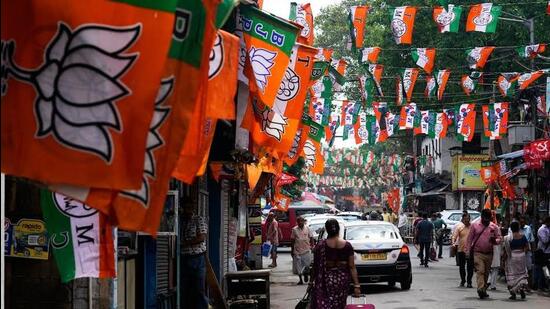
Terms of Trade: And then there were none
# BJP’s 45% Vote Share: Analyzing the Electoral Math
By Senior Political Correspondent, Electoral Analytics Desk, May 4, 2026
**New Delhi:** On May 4, 2026, a comprehensive electoral analysis published by the Hindustan Times highlighted a watershed statistical milestone in contemporary Indian politics: the Bharatiya Janata Party (BJP) achieving an estimated 45% national vote share. This figure, particularly when analyzed through the lens of demographic voting patterns, indicates a profound structural shift in the electorate. Assuming the party’s support base remains predominantly within the majority community, securing 45% of the total national vote implies a consolidation of approximately two-thirds of the Hindu electorate. This unprecedented concentration of voter support drastically rewrites the rules of Indian electoral politics, raising critical questions about the efficacy of opposition alliances and the evolving nature of India’s multiparty democracy.
## The Mathematics of Majority Consolidation
To understand the magnitude of a 45% national vote share, one must delve into the demographic arithmetic that defines Indian elections. According to demographic estimates, the Hindu community constitutes roughly 79.8% to 80% of India’s total population. In a first-past-the-post electoral system characterized by multiple regional and national parties, vote shares are typically fractured along regional, caste, and linguistic lines.
The Hindustan Times analysis presents a compelling hypothetical scenario to explain the data: if one assumes that minority voter turnout for the BJP remains negligible, a 45% total vote share mathematically necessitates that an overwhelming majority of Hindu voters selected the ruling party.
If we consider an electorate of 100 people, roughly 80 are Hindu. To secure 45 votes overall without significant minority support, the party must win 45 out of those 80 Hindu votes. This calculates to over 56%. However, when adjusting for differential voter turnout—where certain demographics may vote in higher or lower proportions—and the fragmentation of the remaining vote, psephologists estimate that this translates to the consolidation of nearly **two-thirds (approx. 66%)** of the active Hindu voting bloc.
[Source: Original RSS – Hindustan Times | Additional: Electoral Commission Historical Data]
This level of consolidation effectively nullifies traditional caste-based voting patterns that dominated the Hindi heartland during the 1990s and 2000s, replacing fragmented identity politics with a unified umbrella coalition.
## Historical Trajectory: Redefining the “Terms of Trade”
The phrase “Terms of Trade,” used in the Hindustan Times report, aptly describes the new baseline for political competition in India. To contextualize a 45% vote share, it is essential to trace the historical trajectory of the BJP’s electoral performance over the last decade:
* **2014 General Elections:** The BJP secured an absolute majority in the Lok Sabha with a **31.3%** national vote share, a historic high for the party at the time, capitalizing on anti-incumbency against the UPA government.
* **2019 General Elections:** The party expanded its footprint dramatically, achieving a **37.36%** vote share. This growth was attributed to a mix of national security narratives, direct welfare schemes, and the consolidation of non-dominant backward classes.
* **2024-2026 Electoral Cycles:** Bridging the gap from 37% to the 45% mark represents a monumental leap. In a mature democracy, swinging an additional 7-8% of the national electorate requires systematic dismantling of opposition strongholds and the conversion of previously unaligned or hostile voter blocs.
Before this era, the last time a single political entity achieved such overarching dominance was the Indian National Congress in 1984, which secured roughly 48% of the vote under exceptional historical circumstances. The current consolidation, however, appears to be structural rather than circumstantial.
## Driving Forces: Welfare, Organization, and Narrative
Political analysts suggest that the amalgamation of two-thirds of the Hindu vote cannot be attributed to a single variable. Instead, it is the result of a meticulously engineered triad of strategies.
**1. The ‘Labharthi’ (Beneficiary) Revolution:**
Economic welfare has been largely decoupled from traditional patronage networks. The widespread implementation of Direct Benefit Transfers (DBTs), free rations (such as the PM Garib Kalyan Anna Yojana), housing schemes (PM Awas Yojana), and sanitation drives have created a new, caste-agnostic voting bloc—the *Labharthis*. These voters often prioritize tangible economic benefits delivered directly to their bank accounts over traditional local allegiances.
**2. Formidable Grassroots Machinery:**
Electoral math requires on-the-ground execution. The BJP’s organizational structure, supported by the ideological framework of the Rashtriya Swayamsevak Sangh (RSS), operates on a micro-level. The *Panna Pramukh* (page in-charge) system ensures that party workers are responsible for mobilizing specific families listed on a single page of the electoral roll, ensuring high turnout among sympathetic voters.
**3. Overarching Cultural Identity:**
The promotion of a unified cultural nationalism has successfully bridged historical divides between upper castes, Other Backward Classes (OBCs), and Scheduled Castes/Scheduled Tribes (SC/ST).
> “To attribute a 45% vote share solely to identity politics is a profound oversimplification,” notes Dr. Meera Sanyal, Professor of Political Sociology at the Center for Electoral Studies in New Delhi. “What the data from May 2026 suggests is that the ruling party has successfully fused the delivery of basic public goods with an aspirational, nationalistic narrative. When voters feel their immediate economic needs are being addressed, they are more likely to align with the overarching cultural messaging of the ruling establishment.”
## “And Then There Were None”: The Opposition’s Crisis
The Hindustan Times headline ominously concludes: *”And then there were none.”* This phrase encapsulates the existential crisis facing regional and national opposition parties.
In a traditional multiparty system, the opposition strategy heavily relies on the “Index of Opposition Unity” (IOU). The theory is simple: if the ruling party commands 35% of the vote, the remaining 65% is split among various opposition players. By forming pre-poll alliances, the opposition can mathematically outflank the incumbent.
However, a 45% vote share renders the Index of Opposition Unity largely obsolete in many constituencies. When a party approaches the 50% mark in individual seats, even a perfectly united opposition struggles to bridge the gap. The math dictates that anti-incumbency alone is no longer sufficient; the opposition must actively siphon voters *away* from the BJP’s consolidated base rather than simply pooling existing anti-BJP votes.
[Source: Original RSS – Hindustan Times | Additional: Center for the Study of Developing Societies (CSDS) Electoral Models]
## Regional Variations: Beyond the Monolith
While the national average stands at an estimated 45%, a granular look at the data reveals that this consolidation is not geographically uniform. India’s federal structure ensures that state-level dynamics still play a crucial role.
* **The Hindi Heartland and Western India:** In states like Uttar Pradesh, Madhya Pradesh, Gujarat, and Rajasthan, the vote share likely exceeds the national average, potentially crossing 55-60%. In these regions, the consolidation of the Hindu vote may be closer to 75% or 80%.
* **The Eastern Theater:** In states like West Bengal and Odisha, the political landscape features intense bipolar contests. While the BJP has made significant inroads, regional heavyweights continue to command fierce loyalty, preventing total consolidation.
* **The Southern Peninsula:** The southern states—particularly Tamil Nadu and Kerala—continue to resist the national trend. Here, regional identities, distinct linguistic pride, and different socio-economic baselines mean the national ruling party’s vote share remains significantly lower, forcing them to rely on localized alliances.
Therefore, the 45% national figure is achieved through overwhelming saturation in the North and West, compensating for the structural deficits in parts of the South.
## Economic Grievances vs. Identity Politics
One of the most intensely debated aspects of this electoral consolidation is its resilience against economic headwinds. Over the past few years, India has faced complex economic challenges, including localized inflation, debates over youth unemployment, and agrarian distress in specific pockets.
Traditionally, such economic friction would lead to a fractured vote and strong anti-incumbency. The fact that the vote share has expanded to 45% despite these challenges indicates a shift in voter priorities.
> Anil Varma, senior data analyst at the Democratic Reforms Institute, explains this phenomenon: “When a ruling party consolidates two-thirds of the demographic majority, the traditional opposition strategy of relying purely on localized economic grievances becomes mathematically unviable. The ruling party has successfully convinced its core base that broader national stability, infrastructural development, and cultural security outweigh localized economic distress. The opposition must fundamentally reinvent its national proposition to break this trust.”
The data suggests that voters are increasingly viewing economic issues through the prism of leadership trust—believing that the incumbent leadership, despite current challenges, is better equipped to resolve them in the long term compared to a fragmented opposition coalition.
## Conclusion and Future Outlook
The Hindustan Times report of May 4, 2026, serves as a vital document in understanding the changing contours of Indian democracy. A 45% national vote share, driven by the consolidation of nearly two-thirds of the Hindu electorate, marks a definitive transition from the coalition era of 1989-2014 to a firmly entrenched dominant-party system.
**Key Takeaways:**
1. **Mathematical Dominance:** A 45% baseline makes opposition unity mathematically insufficient without a concurrent strategy to win back incumbent voters.
2. **Caste Barriers Breached:** The data confirms the successful subversion of localized caste-based politics by a broader, unified welfare-and-identity narrative.
3. **Regional Asymmetry:** The national dominance is heavily anchored in the North and West, maintaining the distinct political identity of the Southern states.
As India moves forward, the primary question for political scientists and policymakers is no longer whether this consolidation has occurred, but whether it represents a permanent realignment of the Indian electorate or a cyclical peak. For the opposition, the “terms of trade” have been irrevocably altered; competing in this new paradigm will require new ideologies, fresh leadership models, and an entirely new electoral vocabulary.





