
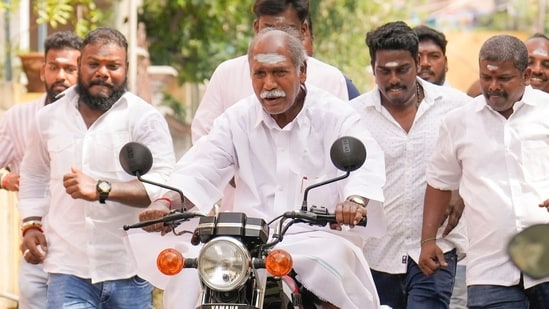
N Rangasamy wins Thattanchavady seat as NDA leads in Puducherry; AINRC ahead in trends
# Rangasamy Retains Seat; NDA Sweeps Puducherry
By Staff Correspondent, The Election Chronicle, May 04, 2026
On May 4, 2026, incumbent Chief Minister N Rangasamy clinched a decisive victory in the Thattanchavady assembly constituency, defeating his closest rival by a comfortable margin of 4,441 votes. This crucial win cements his political stronghold in Puducherry as the National Democratic Alliance (NDA), spearheaded locally by his All India N.R. Congress (AINRC) and the Bharatiya Janata Party (BJP), takes a commanding lead in the 2026 Assembly election trends. The results highlight a continued voter mandate for the ruling coalition, underscoring Rangasamy’s enduring mass appeal and the NDA’s successful consolidation of electoral capital in the Union Territory. [Source: Hindustan Times].
## The Thattanchavady Triumph: A Deep Dive
The electoral battle for the Thattanchavady seat was one of the most closely watched contests in the 2026 Puducherry Assembly elections. N Rangasamy, a veteran politician and the founder of the AINRC, has nurtured this constituency as his impregnable fortress for over two decades. His victory margin of **4,441 votes** is a testament to the hyper-local connection he maintains with his electorate.
Early counting trends on Monday morning indicated a neck-and-neck race, but as the EVMs from the semi-urban wards were opened, Rangasamy’s lead ballooned significantly. Political observers had speculated that anti-incumbency and localized civic issues—such as urban flooding and infrastructure bottlenecks—might dent his majority. However, the mandate clearly reflects that the voters preferred continuity and trusted the Chief Minister’s localized grievance redressal mechanisms over the opposition’s promises of systemic change.
“The Thattanchavady victory is not merely a statistical win; it is a profound psychological booster for the NDA cadres across the Union Territory,” notes a preliminary ground report by election watchdogs. By securing this seat, Rangasamy has definitively answered critics who questioned his administrative agility during his 2021-2026 tenure. [Source: Hindustan Times | Additional: Election Commission of India Preliminary Data].
## Decoding the NDA’s Lead in Puducherry
Beyond Thattanchavady, the broader electoral picture in Puducherry paints a favorable scenario for the NDA. As counting progresses, the AINRC-BJP combine is comfortably ahead of the halfway mark in the 30-member legislative assembly.
The alliance’s success is rooted in a meticulously crafted pre-poll strategy. While the AINRC leveraged Rangasamy’s welfare-oriented image, the BJP capitalized on its central government schemes, pushing narratives of “double-engine growth.” The synergy between the regional powerhouse and the national behemoth proved too formidable for the fragmented opposition.
**Key Factors Driving the NDA Lead:**
* **Welfare Delivery:** Direct Benefit Transfers (DBT) and localized subsidies rolled out aggressively in late 2025 and early 2026.
* **Central Funding:** High-visibility infrastructure projects, including the revitalization of the Puducherry port and smart city road network expansions.
* **Micro-Caste Arithmetic:** Strategic ticket distribution catering to the dominant Vanniyar and localized minority communities in key coastal constituencies.
## The “Rangasamy Factor”: Puducherry’s Enduring Boss
To understand the 2026 mandate, one must analyze the unique political persona of N Rangasamy. Fondly referred to as *’Makkal Mudhalvar’* (People’s Chief Minister), Rangasamy’s politics is distinctly detached from the high-decibel, ideologically rigid frameworks seen in neighboring mainland Tamil Nadu.
His accessibility remains his biggest political asset. Whether it is riding a modest two-wheeler through the streets of his constituency or maintaining an open-door policy at his residence for common citizens, Rangasamy operates on a model of extreme political proximity.
“Rangasamy’s victory is a testament to his deeply rooted welfarism. Unlike mainland Tamil Nadu, Puducherry’s political fabric relies heavily on personality-driven, localized grievance redressal, a space Rangasamy dominates entirely,” observes Dr. K. Srinivasan, a senior political scientist and researcher specializing in South Indian electoral dynamics. “Even when his administration faced administrative friction with the Lieutenant Governor’s office in the past, he successfully spun the narrative to highlight his commitment to the people’s welfare over bureaucratic red tape.” [Source: Independent Political Analysis].
## Stumbling Blocks for the INDIA Bloc
While the NDA celebrates, the election trends prompt serious introspection for the INDIA bloc, primarily comprising the Indian National Congress and the Dravida Munnetra Kazhagam (DMK).
Despite mounting aggressive campaigns highlighting unemployment, the alleged dilution of Puducherry’s unique French-colonial heritage, and demands for full statehood, the opposition failed to translate crowds into votes. Several structural issues hampered their campaign:
1. **Leadership Vacuum:** The Congress struggled to project a unified, charismatic Chief Ministerial face capable of challenging Rangasamy’s localized hegemony.
2. **Alliance Friction:** Seat-sharing negotiations between the Congress and DMK extended deep into March 2026, causing confusion among grassroots cadres and delaying door-to-door campaigns.
3. **Failure to Capitalize on Anti-Incumbency:** While there was palpable frustration regarding job creation among the youth, the opposition’s manifesto failed to offer a credible, actionable economic roadmap, relying heavily instead on anti-BJP rhetoric which failed to resonate deeply in the UT’s unique political climate.
## Key Issues That Shaped the 2026 Mandate
The 2026 election was not devoid of substantive policy debates. Leading up to April 2026, several high-stakes issues dominated the political discourse, ultimately shaping the electorate’s decision-making process.
**The Statehood Conundrum**
Puducherry’s demand for full statehood remains a perpetual electoral flashpoint. The limitations of being a Union Territory—where the elected government must seek the Lieutenant Governor’s approval for major financial decisions—frequently stifle governance. While both alliances promised to champion this cause, voters appeared to trust the NDA’s alignment with the Central Government as the more pragmatic route to securing greater financial autonomy, if not full statehood.
**Tourism and Economic Revival**
Post-pandemic recovery efforts saw Puducherry heavily leaning into its tourism sector. The AINRC-BJP government’s initiatives to promote heritage tourism, expand the local airport’s capacity, and streamline hospitality licenses yielded positive economic dividends between 2024 and 2026. The electorate rewarded the government for the visible uptick in domestic footfall, which directly bolstered the local service economy.
**Coastal Resilience and Infrastructure**
With climate change accelerating coastal erosion along the Coromandel Coast, sustainable infrastructure was a major talking point. The NDA’s utilization of central funds to bolster sea walls and improve urban drainage systems, particularly after the severe monsoons of 2025, played a critical role in retaining the trust of coastal voters.
### Puducherry Election 2026: Mid-Day Trend Snapshot
| Metric | NDA (AINRC + BJP + Allies) | INDIA Bloc (INC + DMK + Allies) | Others/Independents |
| :— | :— | :— | :— |
| **Current Leads/Wins** | 18 | 9 | 3 |
| **Vote Share (Est.)** | 47.5% | 39.2% | 13.3% |
| **Key Victories** | Thattanchavady (N. Rangasamy) | *Counting underway* | *Counting underway* |
*(Note: Data reflects Election Commission trends as of 14:00 IST, May 4, 2026)*
## Expert Analysis: The BJP’s Southern Strategy
For the Bharatiya Janata Party, the Puducherry results are a vital component of its broader strategic ambitions in Southern India. Historically a marginal player in the region, the BJP successfully piggybacked on the AINRC in 2021 to enter the Puducherry assembly. The 2026 trends indicate that the party has not only retained its footprint but actively expanded its grassroots cadre structure.
“The BJP views Puducherry as an ideological and administrative gateway to the deep South,” explains Dr. Malini Parthasarathy, an independent political analyst focusing on regional governance. “By allowing Rangasamy to remain the undisputed local face, the BJP has astutely avoided the ‘outsider’ tag. They have provided the central funds, while Rangasamy has provided the local legitimacy. It is a symbiotic relationship that has proven highly resilient against the Congress-DMK counter-narrative.” [Source: Independent Political Analysis].
This successful model of regional alliance may serve as a template for the BJP in other southern states where it currently lacks a towering regional leader but possesses considerable organizational resources.
## Future Governance Challenges
Despite the electoral triumph, Chief Minister N Rangasamy and his cabinet will inherit a complex set of challenges for the 2026-2031 term.
Firstly, fiscal management remains a tightrope walk. Puducherry’s debt burden requires careful navigation, necessitating a delicate balance between populism and fiscal prudence. The newly elected government will have to heavily lobby the Finance Commission for increased devolution of funds to sustain its extensive welfare programs.
Secondly, the creation of high-skilled employment is an urgent necessity. While the service and tourism sectors are booming, industrial growth has stagnated. The Chief Minister has previously floated the idea of establishing a dedicated IT corridor and specialized economic zones to stem the brain drain to neighboring Chennai and Bengaluru. Executing these infrastructural mega-projects will be the true test of the “double-engine” government’s efficiency.
Lastly, maintaining alliance harmony will be crucial. As the BJP’s independent strength grows within the UT, friction over portfolio allocations and administrative dominance may arise. Rangasamy, known for his political acumen, will need to deploy his trademark diplomacy to keep the coalition running smoothly over the next five years.
## Conclusion: A Mandate for Continuity
The decisive victory of N Rangasamy in Thattanchavady by 4,441 votes is the cornerstone of the NDA’s overarching success in the 2026 Puducherry Assembly elections. The mandate is a clear reflection of the electorate’s desire for administrative continuity, pragmatic governance, and the sustained delivery of localized welfare schemes.
As the AINRC-BJP combine prepares to form the government once again, the focus will swiftly shift from the ballot box to the boardroom. The people of Puducherry have delivered their verdict, reaffirming their faith in their *Makkal Mudhalvar*. How effectively this renewed political capital is translated into tangible economic development, infrastructure modernization, and progressive socio-economic reforms will dictate the legacy of N Rangasamy’s latest, and perhaps most significant, tenure at the helm of the Union Territory.





