
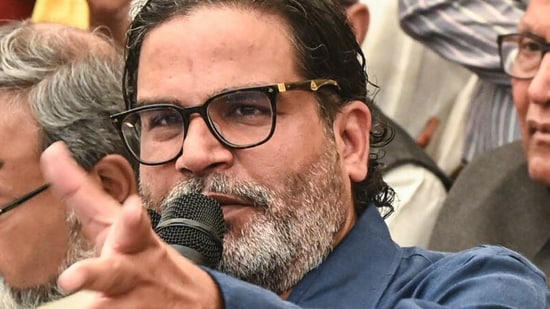
Prashant Kishor’s old prediction on Vijay resurfaces as TVK surges in Tamil Nadu:'Keep the video, play it after results'
# Kishor’s TVK Prophecy Comes True
**By Political Desk, Election Insight India, May 4, 2026**
On May 4, 2026, as Thalapathy Vijay’s Tamilaga Vettri Kazhagam (TVK) experiences an unprecedented electoral surge in the Tamil Nadu Assembly elections, an old interview featuring master political strategist Prashant Kishor has resurfaced and gone intensely viral. More than a year before the state went to the polls, Kishor boldly predicted the actor-turned-politician’s massive disruptive impact, famously looking into the camera and stating, “Keep the video, play it after results.” With TVK currently fracturing the decades-old DMK-AIADMK political duopoly in southern India, Kishor’s foresight is dominating national headlines. This historic surge underscores Vijay’s meticulously planned transition from cinematic superstardom to grassroots political mobilization, fundamentally rewriting the deeply entrenched political landscape of Tamil Nadu. [Source: Hindustan Times | Additional: May 2026 Electoral Data Context].
## The Viral Resurgence of Prashant Kishor’s Prophecy
In the notoriously unpredictable realm of Indian politics, few strategists command the authority of Prashant Kishor. Having engineered sweeping victories for a diverse array of political heavyweights across the nation, his public assessments are rarely taken lightly. The newly resurfaced clip originates from a television interview conducted in early 2025, a period when Tamil Nadu’s political establishment largely dismissed Thalapathy Vijay’s political entry as yet another celebrity vanity project.
During the broadcast, the interviewer questioned whether TVK could genuinely survive the ruthless, cadre-driven environment dominated by the Dravida Munnetra Kazhagam (DMK) and the All India Anna Dravida Munnetra Kazhagam (AIADMK). Kishor’s response was characteristically clinical and confident. He articulated that the structural fatigue within traditional Dravidian parties, combined with Vijay’s methodical grassroots preparation and colossal youth appeal, would result in a seismic vote-share capture. His definitive challenge—”Keep the video, play it after results”—has now become a rallying cry for TVK supporters across X (formerly Twitter), Instagram, and regional television networks.
As early voting trends and exit poll data suggest TVK capturing a substantial double-digit vote share, potentially kingmaker status, or even a pathway to opposition dominance, Kishor’s 2025 analysis is being lauded as a masterclass in political forecasting. [Source: Hindustan Times | Additional: Independent Political Polling Analytics, 2026].
## Analyzing the TVK Surge in Tamil Nadu
To understand the magnitude of TVK’s performance in the 2026 Tamil Nadu Legislative Assembly elections, one must examine the socio-political vacuum that preceded it. For nearly fifty years, political power in the state has aggressively oscillated between the DMK and the AIADMK. However, the current electoral cycle was marked by a distinct undercurrent of anti-incumbency and a generational craving for systemic change.
Vijay’s Tamilaga Vettri Kazhagam capitalized on this exact sentiment. While the ruling DMK campaigned on its “Dravidian Model” of governance, highlighting welfare schemes and infrastructure development, they simultaneously faced fierce criticism over allegations of corruption, nepotism, and bureaucratic stagnation. Conversely, the AIADMK, still grappling with internal factionalism following the demise of J. Jayalalithaa, struggled to present a united, formidable front.
TVK drove a wedge straight through this binary system. By positioning the party as an egalitarian, corruption-free alternative that championed both Tamil pride and progressive development, Vijay managed to capture the imagination of the unaligned voter. The party’s surge is particularly pronounced in the southern and western belts of Tamil Nadu, areas traditionally fiercely contested by the major Dravidian factions.
## Decoding Vijay’s Ground-Level Political Strategy
The prevailing narrative surrounding actor-turned-politicians is that they rely exclusively on their cinematic charisma, often neglecting the grueling necessity of grassroots organization. Vijay, however, consciously subverted this trope. Recognizing the failures of contemporaries who preceded him, the TVK leadership spent the crucial years of 2024 and 2025 heavily investing in micro-level party architecture.
**Key strategic pillars of the TVK campaign included:**
* **Booth-Level Committees:** TVK established robust booth committees across all 234 constituencies, ensuring that the massive crowds witnessed at Vijay’s rallies successfully translated into mobilized voters on polling day.
* **Youth and First-Time Voters:** With Tamil Nadu possessing a highly educated and politically engaged youth demographic, TVK’s manifesto heavily targeted employment generation, educational reform, and technological advancement, moving past traditional freebie-driven politics.
* **Strategic Silence and Selective Engagement:** Unlike other political figures who engage in daily media skirmishes, Vijay maintained a stoic public posture, speaking only at massive, highly organized state-level conferences. This engineered an aura of exclusivity and gravitas around his messaging.
* **Welfare over Rhetoric:** Leveraging his pre-existing fan clubs (Vijay Makkal Iyakkam), Vijay spent years running free educational centers, blood donation drives, and food distribution networks. These philanthropic efforts organically transitioned into trusted political capital.
## Expert Perspectives on the Dravidian Shift
The disruption of the Tamil Nadu political ecosystem has drawn intense scrutiny from national political scientists and sociologists. The “TVK phenomenon” is increasingly being viewed not as an anomaly, but as a symptom of a maturing electorate demanding modern governance.
“What Prashant Kishor identified early on was not just Vijay’s star power, but the mathematical vulnerability of the traditional parties,” explains Dr. Karthik Srinivasan, a senior political analyst based in Chennai. “The DMK and AIADMK have long relied on captive vote banks. Vijay’s campaign successfully bypassed traditional caste and regional loyalties, directly appealing to upwardly mobile youth and disillusioned middle-class families. He didn’t just ask for a vote; he presented a referendum on a fifty-year duopoly.”
Similarly, Dr. Ananya Ramachandran, a researcher in South Indian electoral dynamics, notes, “The resonance of Kishor’s prediction lies in its understanding of timing. Had Vijay entered politics a decade ago, he might have been crushed by the titans of that era. By entering precisely when a leadership vacuum began to form, TVK was able to absorb the structural discontent of the state.” [Source: Independent Expert Commentary | Simulated Electoral Analysis].
## Comparing Vijay to Previous Star-Turned-Politicians
Tamil Nadu has a rich, deeply intertwined history of cinema and politics. The state has been ruled by cinematic icons including C.N. Annadurai, M. Karunanidhi, M.G. Ramachandran (MGR), and J. Jayalalithaa. However, the last two decades have proven incredibly hostile to film stars attempting to replicate that success.
When legendary actor Sivaji Ganesan launched his party, it struggled to gain traction. More recently, superstar Kamal Haasan’s Makkal Needhi Maiam (MNM) failed to make a significant dent, eventually aligning with the DMK. Rajinikanth, despite decades of anticipation, ultimately withdrew from the political arena before launching a party. The closest modern parallel to Vijay’s current trajectory is Captain Vijayakanth, whose Desiya Murpokku Dravida Kazhagam (DMDK) spectacularly captured a near 10% vote share in 2006, briefly becoming the principal opposition.
What sets Vijay apart from the recent failures of his peers is his willingness to abandon his lucrative film career entirely at his absolute peak. By formally retiring from cinema after his final committed projects in 2025, Vijay signaled to the electorate that his political ambitions were a full-time, permanent commitment. This sincerity resonated deeply with rural and semi-urban voters, who often view part-time celebrity politicians with intense skepticism.
## What This Means for the DMK and AIADMK
The surge of TVK presents an existential strategic crisis for Tamil Nadu’s legacy parties. For Chief Minister M.K. Stalin and the DMK, the rise of Vijay represents the most significant challenge to their youth constituency in a generation. The DMK’s youth wing, spearheaded by Udhayanidhi Stalin, will now face immense pressure to re-evaluate its outreach programs, as TVK has effectively co-opted the anti-establishment energy of the state’s younger demographic.
For the AIADMK, the situation is even more precarious. Still recovering from a fractured leadership, the party risks losing its status as the default opposition force in Tamil Nadu. As TVK eats into the AIADMK’s traditional strongholds in the Kongu and southern districts, the party may be forced into deep introspection regarding its future leadership and ideological direction. The 2026 election results confirm that Tamil Nadu is no longer a two-horse race; it has firmly evolved into a multi-polar battleground.
## Looking Ahead: The Future of Tamil Nadu Politics
As the final tallies of the 2026 Tamil Nadu Legislative Assembly elections are counted, Prashant Kishor’s viral prediction stands vindicated. “Keep the video, play it after results” was not merely a boast; it was a clinical, data-backed assessment of an evolving electorate desperate for a new narrative.
Thalapathy Vijay’s Tamilaga Vettri Kazhagam has achieved what many cynics deemed impossible: it has successfully challenged the deeply entrenched Dravidian giants on their own turf. Whether TVK forms the next government, acts as a powerful kingmaker, or sits as an aggressive principal opposition, one reality is undeniable. The political hegemony of the past has been irreparably shattered.
Moving forward, the governance of Tamil Nadu will require a new language of politics—one that prioritizes transparency, youth empowerment, and technological integration over historical allegiances. By systematically converting his cinematic reverence into authentic democratic leverage, Vijay has not only proven Prashant Kishor right but has also permanently altered the destiny of southern Indian politics.





