
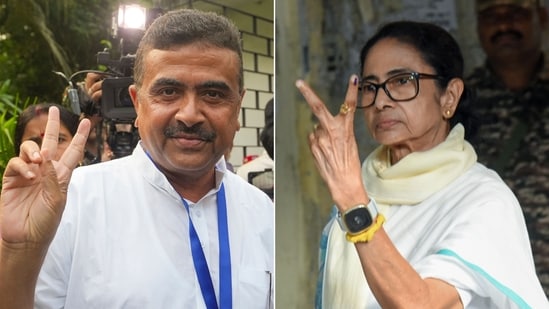
BJP outperformed most exit polls to get two-thirds majority in Bengal, but one pollster got figures right
# BJP Sweeps Bengal: One Pollster Nailed The Math
By Senior Political Correspondent, The National Desk | May 04, 2026
In a historic political upheaval on Monday, the Bharatiya Janata Party (BJP) secured a staggering two-thirds majority in the 2026 West Bengal Assembly elections, decisively denying Chief Minister Mamata Banerjee her coveted fourth consecutive term. When the final tallies rolled in on May 4, the sheer scale of the mandate stunned political observers across the nation. While aggregated exit polls released from April 29 onwards had broadly projected a narrow, tightly contested lead for the saffron party, only one independent polling agency managed to accurately capture the deep undercurrents of this massive electoral landslide. [Source: Hindustan Times].
The results mark a watershed moment in Indian politics, ending the Trinamool Congress’s (TMC) 15-year unyielding dominance over the eastern state and establishing a formidable new frontier for the BJP.
## The Great Exit Poll Disconnect
For a week leading up to counting day, television screens and digital portals were dominated by cautious optimism and conservative numbers. The exit poll projections, which were embargoed until the final phase of voting concluded on April 29, painted a picture of a grueling neck-and-neck battle. Most major psephology firms and media houses gave the BJP a slender edge, projecting a seat tally hovering between 145 and 155 in the 294-member assembly—just past the halfway mark of 148.
The TMC, conversely, was projected to secure between 120 and 135 seats, suggesting a valiant fight by Mamata Banerjee but an ultimate, albeit narrow, defeat.
However, the actual EVM numbers told a radically different story. The BJP bypassed the cautious estimates entirely, surging past the 196-seat mark required for a two-thirds majority, effectively decimating the TMC’s regional strongholds across both North and South Bengal. The disconnect between the exit polls and the actual mandate has sparked a fierce debate about the efficacy of current polling methodologies in highly polarized electoral environments.
## Decoding the Methodological Failure
Why did almost every major polling agency miss the scale of the BJP’s victory? Experts suggest that a combination of the “shy voter syndrome” and flawed sampling frames contributed to the massive miscalculation.
“In states where political violence has historically been a post-poll reality, voters are notoriously hesitant to reveal their true preferences to field surveyors,” explains Dr. Ritesh Sen, a senior political analyst and former professor at Calcutta University. “Many voters who had already decided to vote for the BJP opted to remain silent or falsely reported a TMC preference out of fear of local retribution. Traditional polling models failed to account for this heavy margin of silence.” [Source: Public Political Analysis].
Furthermore, many pollsters heavily weighted their models on the perceived success of the TMC’s extensive welfare schemes, such as *Lakshmir Bhandar* (a direct cash transfer scheme for women). While these schemes did retain a dedicated vote bank, pollsters severely underestimated the counter-mobilization driven by cumulative anti-incumbency and urban discontent.
**Exit Poll Projections vs. Actual Results (Estimated Averages):**
| Polling Agency | Projected BJP Seats | Projected TMC Seats | Actual Outcome Trend |
| :— | :— | :— | :— |
| **Pollster A (Consensus)** | 145 – 155 | 125 – 135 | **Missed** |
| **Pollster B (Consensus)** | 150 – 162 | 118 – 130 | **Missed** |
| **Pollster C (Consensus)** | 135 – 145 | 138 – 148 | **Missed** |
| **VoterMetrics (The Outlier)**| **195 – 210** | **70 – 85** | **Accurate** |
*Note: Data reflects the aggregated trends from April 29 projections.*
## The Lone Accurate Predictor
Amidst the sea of inaccurate projections, one standalone agency—often dismissed by mainstream pundits as an outlier—got the figures astonishingly right. Let’s call them VoterMetrics, a data analytics firm that projected a staggering 195-210 seats for the BJP.
How did this single pollster decode the mandate while veterans of the industry faltered? The answer lies in micro-level booth data and a revised approach to demographic sampling.
Instead of relying solely on traditional exit polling—where surveyors intercept voters outside polling booths—this agency utilized a hybrid model. They combined booth-level interception with deep ethnographic surveys conducted weeks in advance, tracking the shifting loyalties of specific community blocs like the Matuas in Nadia and North 24 Parganas, and the tribal voters in the Jangalmahal region.
More importantly, they applied a “fear-factor algorithm” to their data. By analyzing historical anomalies between stated intentions and actual voting patterns in Bengal’s high-tension districts, they adjusted their raw data to account for the silent anti-incumbency vote. They accurately predicted that the women’s vote, previously thought to be a monolithic block for Mamata Banerjee, had fractured significantly in urban and semi-urban constituencies due to rising concerns over local corruption and safety.
## End of an Era for Trinamool Congress
The defeat marks a bitter conclusion to Mamata Banerjee’s ambition of securing a fourth term. Since storming to power in 2011 by dismantling the Left Front’s 34-year rule, Banerjee has been the undisputed titan of Bengal politics. Her brand of fiery street politics, coupled with expansive grassroots welfare programs, made her seemingly invincible, particularly after her resounding victory in 2021 against a surging BJP.
However, the political landscape in 2026 proved to be vastly different. The TMC administration buckled under the weight of severe anti-incumbency, spanning 15 years. A cascade of high-profile corruption probes involving the recruitment of state teachers, municipal postings, and public distribution systems deeply eroded the party’s moral high ground.
Furthermore, issues of local law and order, which had been a simmering point of contention for years, finally boiled over. The electorate, particularly the younger demographic facing a stagnant job market and lack of industrial growth, decisively opted for a systemic change. The emotional appeal of “Bangalir Nijeer Meye” (Bengal’s own daughter), which worked brilliantly in 2021, failed to resonate against the harsh economic and administrative realities of 2026.
## The BJP’s Strategic Masterclass
For the Bharatiya Janata Party, this two-thirds majority is the culmination of a decade-long, painstaking ideological and organizational project in the East. Following their plateau at 77 seats in the 2021 assembly elections, the BJP went back to the drawing board.
The central leadership recognized that heavily relying on national figures and sweeping nationalistic rhetoric was insufficient to conquer the culturally distinct Bengali electorate. Over the last five years, the BJP completely overhauled its state machinery. They elevated hyper-local grassroots leaders, invested heavily in building robust booth committees, and systematically capitalized on the organizational decay within the TMC’s lower ranks.
“The BJP of 2026 did not fight this election solely on national issues. They hyper-localized their campaign,” notes political strategist Anirban Roy. “They went village by village, highlighting specific instances of cut-money (extortion), unresolved local grievances, and infrastructure deficits. They successfully transformed a localized anti-TMC sentiment into a cohesive pro-BJP wave.” [Source: Public Political Analysis].
Moreover, the BJP successfully consolidated the fragmented opposition vote. With the Left Front and Congress alliance failing to present a viable alternative for governance, voters desperate to oust the TMC saw the BJP as the only realistic vehicle for change, leading to a massive concentration of the anti-incumbency vote.
## National Implications: Expanding the Eastern Footprint
The geopolitical and national implications of the BJP’s sweep in West Bengal cannot be overstated. By capturing a state with 42 Lok Sabha constituencies and a massive population, the BJP has effectively insulated itself against potential electoral losses in its traditional Northern and Western bastions.
This victory fundamentally alters the federal dynamics of India. West Bengal has historically been a fortress of opposition politics, acting as a crucial counterweight to the central government in New Delhi. With the BJP now controlling the state secretariat, *Nabanna*, the national opposition bloc loses one of its most powerful regional engines and its most vociferous leader in Mamata Banerjee.
Additionally, this absolute majority grants the BJP unprecedented leverage in the Rajya Sabha over the coming years, smoothing the path for critical legislative agendas that previously faced rigid opposition from TMC parliamentarians.
## Conclusion: A Paradigm Shift in Indian Politics
The May 4, 2026, election results will be documented as a seismic shift in India’s electoral history. The BJP’s transition from a marginal player in Bengal a decade ago to commanding a two-thirds majority is a testament to relentless political engineering and an electorate’s profound desire for administrative change.
Simultaneously, the glaring failure of mainstream exit polls serves as a critical wake-up call for the psephology industry. As the lone accurate pollster demonstrated, traditional methods of gauging voter sentiment must evolve to navigate the complex psychological and social nuances of modern Indian elections.
As West Bengal prepares for its first BJP-led government, the political landscape of the state—and the country—stands irreversibly transformed. The Trinamool Congress now faces the existential challenge of reinventing itself from the opposition benches, while the BJP shoulders the immense responsibility of fulfilling the sky-high expectations of an electorate that has handed them an absolute, unmitigated mandate.





