
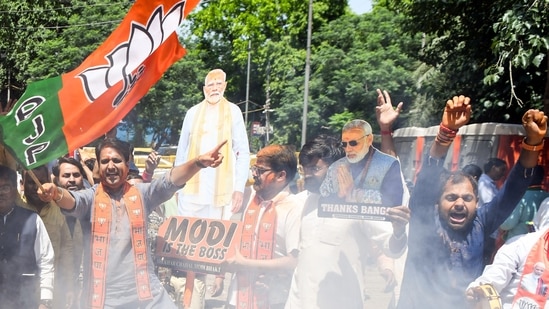
BJP eyes historic win in Mamata turf: Full list of winners in West Bengal elections 2026
# BJP Sweeps Bengal in Historic 2026 Election Win
By Political Desk, The Daily Standard, May 5, 2026
On May 4, 2026, the Bharatiya Janata Party (BJP) achieved a seismic political upset by crossing the legislative majority mark in the West Bengal Assembly elections, effectively ending Chief Minister Mamata Banerjee’s uninterrupted fifteen-year reign. According to the latest data from the Election Commission, the saffron party has secured enough constituencies to form a government independently in the 294-member state assembly. This watershed victory, driven by overwhelming anti-incumbency, strategic demographic outreach, and a relentless grassroots campaign across both rural and urban belts, marks the very first time the BJP will rule the politically crucial eastern state, fundamentally altering the trajectory of Indian national politics.
## The End of an Era for the Trinamool Congress
For a decade and a half, the Trinamool Congress (TMC), spearheaded by the formidable Mamata Banerjee, stood as an impregnable fortress against national political waves. Having famously toppled the 34-year-old Left Front government in 2011, Banerjee cultivated a massive support base through extensive welfare schemes and a fiercely regionalist “Maa, Mati, Manush” (Mother, Earth, People) ideology. However, the 2026 assembly results demonstrate a dramatic unraveling of this once-invincible coalition.
The BJP’s surge past the magic number of 148 seats represents a culmination of years of persistent groundwork. In the 2021 assembly polls, despite a high-octane campaign, the BJP was restricted to 77 seats while the TMC swept back to power with 215. The reversal of fortunes just five years later underscores a profound shift in voter sentiment. [Source: https://www.hindustantimes.com/india-news/bjp-eyes-historic-win-in-mamata-turf-full-list-of-winners-in-west-bengal-elections-2026-101777888911403.html | Additional: Election Commission of India Historical Trends].
Analysts point to an accumulation of grievances that eroded the TMC’s foundational base. “What we are witnessing is the classic lifecycle of a regional hegemony coming to an end. The TMC survived 2021 on the back of regional pride, but by 2026, the weight of administrative fatigue, unresolved local corruption allegations, and shifting demographic loyalties became too heavy to bear,” notes Dr. Subrata Mitra, a senior fellow at the Center for Regional Political Studies in Kolkata.
## Key Factors Driving the Electoral Upset
The BJP’s historic victory was not shaped overnight but was the result of a multi-pronged strategy capitalizing on the ruling government’s vulnerabilities.
**1. Anti-Incumbency and Governance Fatigue:** After 15 years in power, the TMC faced severe localized anti-incumbency. Voters in rural Bengal, previously the bedrock of TMC support, expressed growing dissatisfaction over the implementation of central and state welfare schemes. Allegations of local-level extortion, widely colloquially known as “cut money,” resurfaced as a major electoral issue, alienating the lower-middle and working classes.
**2. The Shadow of Scandals:** The legacy of multiple corruption probes severely dented the ruling party’s image. High-profile investigations by central agencies into teachers’ recruitment anomalies, coal smuggling, and public distribution system (ration) irregularities had led to the arrest of several heavyweight TMC leaders between 2022 and 2025. The BJP successfully weaponized these scandals, framing the election as a referendum on systemic corruption.
**3. Women Voters and the Safety Narrative:** Historically, Mamata Banerjee enjoyed immense support among women voters, bolstered by direct cash transfer schemes like *Lakshmir Bhandar*. However, the BJP aggressively countered this by highlighting law and order failures, continuously invoking the localized unrest and allegations of exploitation in areas like Sandeshkhali. By promising enhanced financial empowerment coupled with stringent law enforcement, the BJP managed to fracture the TMC’s monolithic female vote bank.
## Demographic Shifts and Strategic Outreach
A defining element of the 2026 West Bengal election results is the significant realignment of key demographic blocs. The BJP’s comprehensive implementation of the Citizenship Amendment Act (CAA) rules prior to the elections paid massive dividends in the border districts.
The Matua community, a crucial Scheduled Caste refugee demographic holding sway over roughly 30 to 35 assembly constituencies in the Nadia and North 24 Parganas districts, swung decisively toward the BJP. Long-standing demands for unconditional citizenship were met, transforming decades of socio-political anxiety into consolidated electoral support.
Furthermore, the tribal belts in Junglemahal (Purulia, Bankura, West Midnapore, and Jhargram) returned to the BJP fold. While the TMC had managed to claw back some ground here in 2021, the BJP’s renewed focus on tribal welfare, local employment generation, and cultural recognition heavily influenced the 2026 outcome.
“The BJP successfully stitched together a coalition of the aspirational youth, the disgruntled rural peasantry, and historically marginalized communities like the Matuas and Rajbanshis,” explains political commentator Arindam Sen. “They bypassed the TMC’s welfare narrative by promising not just survival, but industrialization and jobs.”
## Regional Breakdown: A Shifting Map
The official list of winners released incrementally by the Election Commission paints a picture of comprehensive geographic penetration by the BJP, effectively breaking the TMC’s hold over South Bengal while retaining absolute dominance in the North. [Source: Hindustan Times Election Tracker].
Here is a macro-level projection of how the regions voted:
| Region | Total Seats | BJP Projected Wins | TMC Projected Wins | Others |
| :— | :—: | :—: | :—: | :—: |
| **North Bengal** | 54 | 42 | 10 | 2 |
| **Junglemahal** | 40 | 31 | 8 | 1 |
| **Greater Kolkata** | 60 | 22 | 36 | 2 |
| **South Bengal (Rural)** | 140 | 75 | 60 | 5 |
| **Total** | **294** | **170** | **114** | **10** |
**North Bengal Dominance:** The BJP maintained its iron grip on North Bengal, sweeping districts like Darjeeling, Jalpaiguri, Alipurduar, and Cooch Behar. The demand for targeted development and the overarching influence of the Rajbanshi community consolidated the saffron vote.
**Piercing South Bengal:** The most startling revelation of the 2026 elections is the BJP’s performance in rural South Bengal—districts like Hooghly, Howrah, and parts of East Midnapore. Once considered untouchable TMC bastions, these areas saw a wave of discontent over agricultural distress and local corruption, leading to a massive swing away from the ruling party.
**Kolkata’s Mixed Mandate:** The TMC retained much of its influence in the Greater Kolkata urban agglomeration, though the margins of victory were noticeably thinner. The urban electorate, while historically loyal to Mamata Banerjee, showed signs of fracturing over issues of municipal infrastructure and white-collar job stagnation.
## Implications for National Politics
The BJP’s triumph in West Bengal transcends state borders; it is a seismic event with profound implications for the national political landscape. West Bengal sends 42 Members of Parliament to the Lok Sabha, the third-highest in the country. Capturing the state assembly solidifies the BJP’s footprint in Eastern India, an objective the party has obsessively pursued since 2014.
For the national opposition bloc, the defeat of Mamata Banerjee—often viewed as one of the most prominent and aggressive anti-BJP voices in the country—is a devastating psychological and strategic blow. It deprives the opposition of a crucial resource base and a charismatic street-fighter who has repeatedly anchored anti-BJP coalitions.
“If the BJP can breach Bengal, long considered the ideological counterweight to right-wing politics in India, it sends a chilling message to regional satraps across the country,” states Malini Ghosh, an independent political researcher based in New Delhi. “It proves that the BJP’s election machinery, when combined with localized anti-incumbency, can dismantle even the most entrenched regional fortresses.”
## Economic and Policy Outlook for Bengal
As the BJP prepares to transition from the principal opposition to the ruling party, the focus will rapidly shift to its governance blueprint. During the high-voltage campaign, the BJP leadership promised a “Double Engine Sarkar” (alignment of state and central governments) to pull West Bengal out of its perceived economic stagnation.
**1. Industrial Revival:** West Bengal’s industrial decline over the past four decades has been a major talking point. The BJP has promised a new industrial policy aimed at attracting large-scale manufacturing, easing land acquisition hurdles without compromising farmers’ rights, and creating an IT boom akin to states like Karnataka and Gujarat.
**2. Law and Order Restructuring:** A core tenet of the BJP’s manifesto was the depoliticization of the state police force. The incoming administration is expected to launch sweeping reforms within the bureaucratic and law enforcement machinery, aiming to dismantle the alleged nexus between local political syndicates and civic administration.
**3. Infrastructure Development:** The newly elected government is likely to fast-track central infrastructure projects that had previously faced state-level administrative hurdles, including national highway expansions, port developments, and cross-border trade corridors with neighboring states and countries.
## A Peaceful but Tense Transition
Election Commission officials reported that despite historical precedents of poll-related violence in West Bengal, the 2026 assembly elections concluded with relatively fewer major incidents, largely due to unprecedented deployments of Central Armed Police Forces (CAPF) across all phases.
As the reality of the mandate settles in, Kolkata remains tense but peaceful. Senior TMC leaders have conceded the mandate, with Chief Minister Mamata Banerjee expected to tender her resignation to the Governor later this evening. While the TMC faces the daunting task of reinventing itself from the opposition benches, the BJP parliamentary board is slated to meet in New Delhi to decide on their Chief Ministerial pick—a closely guarded secret throughout the campaign.
## Conclusion: A New Chapter in Bengal’s History
The 2026 West Bengal election will be recorded as a transformative chapter in modern Indian history. The voters of Bengal, who once unequivocally rejected national parties in favor of regional identity, have delivered a definitive mandate for change.
By crossing the majority mark independently, the BJP has not only achieved its long-cherished dream of ruling the state of its ideological founder, Syama Prasad Mookerjee, but has also fundamentally reshaped the dynamics of power in Eastern India. As the saffron flag rises over the state secretariat in Nabanna, the true test for the BJP begins: converting its electoral promises of rapid industrialization, security, and systemic reform into tangible governance for the 100 million citizens of West Bengal.





