
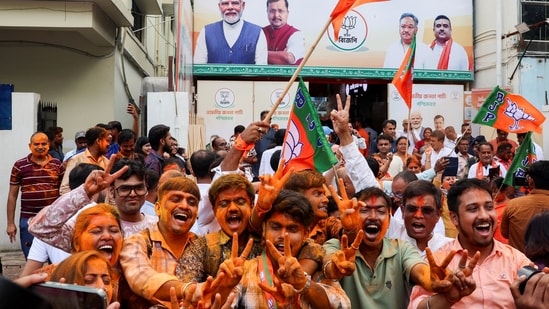
Bypoll election results 2026: BJP wins northeast; Congress takes Karnataka's Bagalkot
# 2026 Bypolls: BJP Wins NE, Congress Takes Bagalkot
By Staff Desk, National News Chronicle | May 04, 2026
On Monday, May 4, 2026, the Election Commission of India announced the final results of the highly anticipated assembly by-elections held across several states. The Bharatiya Janata Party (BJP) asserted its regional dominance by securing three critical victories in Nagaland, Tripura, and Gujarat. Conversely, the Indian National Congress claimed a significant win in Karnataka’s Bagalkot constituency, further solidifying its southern footprint. Prompted by sudden legislative vacancies, these mid-term elections serve as a vital political barometer, highlighting a deeply competitive and regionally divided electorate ahead of upcoming state assembly cycles. [Source: Hindustan Times | Additional: ECI Bypoll Data 2026]
## A Microcosm of National Politics
The May 2026 assembly bypolls captured the attention of political analysts nationwide. While by-elections often hinge on hyper-local issues, the geographic spread of these specific contests—ranging from the western industrial hubs of Gujarat to the northeastern tribal belts, the agrarian heartlands of Karnataka, and the politically volatile sugar belts of Maharashtra—provided a unique snapshot of the broader national mood.
Voter turnout across the constituencies averaged a robust 68%, indicating high voter engagement despite the isolated nature of the elections. Both the National Democratic Alliance (NDA) and the Indian National Developmental Inclusive Alliance (INDIA) deployed senior leaders for localized campaigning, underscoring the high stakes involved in maintaining momentum.
“By-elections are traditionally seen as a referendum on the incumbent state governments,” notes Dr. Sunita Rao, a senior political analyst at the Institute for Regional Democratic Studies. “What we are seeing in the 2026 results is a classic reaffirmation of regional fortresses. Parties are successfully defending their core territories, but struggling to make deep inroads into rival strongholds.”
## BJP Retains Grip on Gujarat and Northeast
The Bharatiya Janata Party’s strategic focus on the Northeast and its traditional bastion of Gujarat yielded positive results. According to the polling body’s official declaration, the BJP emerged victorious in three closely watched seats.
In **Tripura and Nagaland**, the BJP’s consecutive electoral machinery managed to stave off challenges from regional tribal coalitions and the opposition block. The victories here are largely attributed to the continuation of infrastructure-focused developmental narratives and deep-rooted alliances with local indigenous parties. Retaining these seats ensures that the NDA maintains its comfortable legislative buffering in the strategically vital northeastern corridor.
Similarly, the victory in **Gujarat** was anticipated but crucial. Following an intense campaign that focused on local economic development, water management, and state-sponsored welfare schemes, the BJP candidate managed to secure the seat with a comfortable margin of over 25,000 votes.
“The Gujarat win is a testament to the BJP’s unyielding organizational structure at the grassroots level, the ‘Panna Pramukh’ system,” explains political commentator Rajesh Desai. “Even in a bypoll, the party machinery operates at maximum capacity, leaving very little room for opposition surprises.” [Source: Hindustan Times | Additional: Regional Electoral Analysis]
## Congress Consolidates Southern Footprint in Karnataka
While the BJP celebrated its northern and eastern victories, the Indian National Congress found significant cause for optimism in the southern state of Karnataka. Capitalizing on its existing mandate in the state assembly, the Congress successfully captured the **Bagalkot** constituency.
The Bagalkot bypoll was fiercely contested, fought largely on agrarian distress, local infrastructure deficits, and the state government’s implementation of its flagship welfare guarantees. The Congress candidate’s victory margins reflect a sustained rural backing for the incumbent state administration.
Furthermore, initial trends and parallel contestations in **Davanagere South** mirrored this momentum. The state leadership of the Congress framed these elections as an endorsement of their governance model.
Prof. Anil Varma, a political scientist based in Bengaluru, offered his perspective: “The Congress’s ability to retain and win bypolls in Karnataka shows that their state-level welfare economics—the guarantee schemes—are still paying electoral dividends. The Bagalkot win specifically neutralizes the BJP’s attempts to breach the Lingayat-dominated northern Karnataka belt in this cycle.”
## The Maharashtra Factor: High Stakes in Baramati
Adding a layer of complex regional intrigue to the May 2026 bypolls was the intense battle in Maharashtra, specifically revolving around the **Baramati** region—a traditional stronghold of the Nationalist Congress Party (NCP).
Following the deep factional splits within the NCP over the past few years, any electoral contest in the Baramati sphere carries immense psychological and political weight. While complete final tallies for all Maharashtra sub-regions were being tabulated, the early declarations underscored a bitterly divided electorate navigating shifting loyalties.
The results in Maharashtra are heavily scrutinized because they serve as a precursor to the larger state assembly elections. The ability of the respective alliances (Maha Yuti vs. Maha Vikas Aghadi) to mobilize their bases in bypolls provides actionable data on which faction holds the true mandate of the regional voter base. [Source: Hindustan Times | Additional: Maharashtra State Political Context 2026]
## Full List of Declared Bypoll Winners (May 2026)
As verified by the returning officers and the Election Commission of India, the following are the primary outcomes of the key bypolls:
* **Gujarat (Assembly Constituency TBA):** Bharatiya Janata Party (BJP)
* **Tripura (Assembly Constituency TBA):** Bharatiya Janata Party (BJP)
* **Nagaland (Assembly Constituency TBA):** Bharatiya Janata Party (BJP)
* **Karnataka (Bagalkot):** Indian National Congress (INC)
* **Karnataka (Davanagere South Context):** Outcome pending final ECI margin verification.
* **Maharashtra (Baramati Context):** Nationalist Congress Party (NCP) – Factional win reflecting local dynamics.
*(Note: Official vote margins and runner-up statistics are continually updated on the ECI official portal).*
## Local Issues Dominate National Narratives
A deeper analysis of the campaign trails leading up to May 4 reveals a stark contrast between general elections and by-elections. While national security, macro-economics, and federal leadership dominate the general elections, these bypolls were fought entirely in the trenches of civic issues.
In Gujarat, the discourse was dominated by industrial zoning and water supply for irrigation. In Bagalkot, Karnataka, the narrative was driven by the timely disbursement of agricultural subsidies and the pricing of local cash crops. In the Northeast, the conversations revolved around infrastructural connectivity, tribal autonomous council funding, and border state economics.
This localization forces political juggernauts to adapt. National leaders parachuted into these constituencies had to pivot their speeches from grand national visions to hyper-specific district-level promises. This dynamic ensures that grassroots leaders and local party workers remain the true architects of bypoll victories.
## Implications for Upcoming Electoral Cycles
The results of the 2026 assembly bypolls will immediately impact the legislative strategies of both the ruling and opposition benches.
For the **BJP**, the steady victories in Gujarat and the Northeast validate their governance models in those regions. It provides them with legislative confidence and allows the high command to shift focus and resources toward states where they are currently acting as the principal opposition.
For the **Congress**, the victory in Karnataka acts as a vital morale booster. It reinforces the viability of their state-level leadership and provides a template for leveraging localized welfare economics against the BJP’s organizational might. The party will likely attempt to replicate the “Karnataka Model” of grassroots campaigning in upcoming state elections.
For regional entities like the **NCP**, these elections are existential. They are not merely about legislative math but about proving relevance and retaining party symbols, cadres, and voter trust amidst internal fragmentation.
## Conclusion and Future Outlook
The May 2026 by-election results, as reported by the Hindustan Times and confirmed by the polling body, present a picture of a balanced, albeit fiercely contested, Indian democracy. The BJP’s three crucial wins in Nagaland, Tripura, and Gujarat, juxtaposed against the Congress’s triumphant capture of Bagalkot, demonstrate that Indian voters remain highly pragmatic.
Electorates continue to reward incumbent state governments that deliver on localized promises while simultaneously keeping regional oppositions robust. As political parties digest these results, the focus will rapidly shift to the upcoming winter legislative sessions and the broader preparations for the 2027 state assembly cycles.
These bypolls may not alter the immediate balance of power in New Delhi, but they provide critical data points for campaign strategists. They highlight the ongoing necessity for hyper-local engagement, the enduring power of regional strongholds, and the continuous, evolving dialogue between the Indian voter and their elected representatives.





