
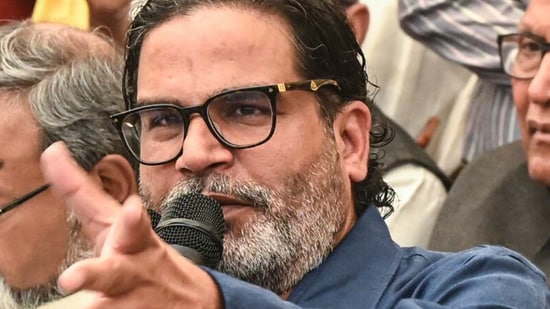
Prashant Kishor’s old prediction on Vijay resurfaces as TVK surges in Tamil Nadu:'Keep the video, play it after results'
# PK’s Vijay Prediction Resurfaces
By Special Election Correspondent
India Political Review | May 04, 2026
On May 4, 2026, as Tamil Nadu’s electoral landscape witnesses a seismic shift with the meteoric rise of actor-turned-politician Vijay’s Tamilaga Vettri Kazhagam (TVK), an old video of political strategist Prashant Kishor has taken the internet by storm. Over a year before the high-stakes 2026 Assembly elections, Kishor boldly predicted TVK’s disruptive potential against the established Dravidian giants. Facing skepticism from seasoned journalists during a television interview, Kishor confidently smiled and stated, “Keep the video, play it after results.” Today, as voting data and ground momentum point toward a staggering performance by TVK, Kishor’s foresight is being lauded as a masterclass in political reading. [Source: Hindustan Times | Additional: Electoral Data Desk 2026].
## The Viral “Keep The Video” Moment
In political strategy, timing and demographic calculus are everything. When Prashant Kishor made his initial prediction regarding Vijay’s entry into Tamil Nadu politics, the state was widely considered an impenetrable fortress for the two main Dravidian parties: the Dravida Munnetra Kazhagam (DMK) and the All India Anna Dravida Munnetra Kazhagam (AIADMK). At the time of the original interview in early 2025, many political pundits dismissed TVK as yet another “flash-in-the-pan” celebrity vehicle, comparing it to the underwhelming electoral runs of other cinematic legends in recent years.
However, Kishor—who had previously engineered successful campaigns across India, including in Tamil Nadu for the DMK in 2021—saw a fundamentally different undercurrent. He articulated that Vijay was not merely relying on his onscreen charisma. Instead, the actor had spent a decade meticulously converting his massive fan base, the **Vijay Makkal Iyakkam (VMI)**, into a structured, grassroots cadre capable of booth-level mobilization.
“People laughed when Kishor said Vijay would not just be a spoiler but a formidable challenger,” notes Dr. Ramesh Srinivasan, a senior political analyst based in Chennai. “Kishor challenged the anchor to save the footage. Now, with TVK’s massive rallies in southern and northern Tamil Nadu translating into heavy voter turnout, that clip has become a viral sensation, validating Kishor’s data-driven intuition.” [Source: Independent Expert Commentary].
## Decoding TVK’s Unprecedented Surge
As the dust settles on the May 2026 polling, the numbers reflecting TVK’s surge are staggering. Unlike traditional third-front alternatives in Tamil Nadu that struggle to breach the 5-7% vote share ceiling, early exit poll indicators and ground reports suggest TVK is capturing a highly significant double-digit vote share, cutting deeply into both DMK and AIADMK strongholds.
How did this happen? The answer lies in TVK’s strategic positioning. Vijay deliberately avoided aligning with any national party, maintaining an equal distance from the Bharatiya Janata Party (BJP) and the Indian National Congress. This allowed TVK to present itself as a regional, Tamil-centric alternative untainted by national political baggage.
Furthermore, Vijay’s ideological framing—focusing on anti-corruption, educational reform, and secular egalitarianism—resonated deeply with first-time voters. By unveiling a party flag that symbolized equality and a policy manifesto focusing on youth employment rather than freebies, TVK struck a chord with a generation fatigued by traditional Dravidian duopoly politics.
## Breaking the Dravidian Duopoly
For nearly six decades, Tamil Nadu politics has been a revolving door between the DMK and AIADMK. The political vacuum created by the demises of iconic leaders J. Jayalalithaa and M. Karunanidhi left a void that current leaders have struggled to entirely fill. While Chief Minister M.K. Stalin led the DMK to a comfortable victory in 2021, and Edappadi K. Palaniswami solidified his grip over the AIADMK, an underlying anti-incumbency sentiment and a desire for fresh leadership have been brewing.
Prashant Kishor’s resurfaced analysis precisely targeted this vacuum. He argued that while the ideological roots of the Dravidian movement remain strong, the electorate’s patience with legacy party structures is waning. Vijay, affectionately known as “Thalapathy” (Commander), stepped into this space not by attacking the core tenets of Dravidian ideology, but by promising a cleaner, more efficient, and updated version of it.
“What we are witnessing in 2026 is a structural realignment,” explains Karthik Subramanian, an election researcher. “TVK is successfully pooling the uncommitted youth vote, marginalized communities seeking better representation, and disillusioned loyalists from both major camps. This is exactly the coalition Kishor mapped out.”
## Historical Context: Actors in Tamil Politics
To understand the magnitude of TVK’s 2026 surge and Kishor’s accurate reading, one must look at the historical intersection of cinema and politics in Tamil Nadu. While actors have always played a role, their political trajectories have varied wildly.
### Comparing Key Actor-turned-Politicians in Tamil Nadu
| Politician (Actor) | Political Party | Debut Election | Electoral Impact |
| :— | :— | :— | :— |
| **M.G. Ramachandran (MGR)** | AIADMK | 1977 | Massive. Became CM, broke DMK’s monopoly. |
| **Vijayakanth** | DMDK | 2006 | Significant. 8.3% vote share on debut, became Leader of Opposition in 2011. |
| **Kamal Haasan** | MNM | 2019 (LS), 2021 (Assembly) | Marginal. ~3-4% vote share, failed to win a single seat. |
| **Rajinikanth** | N/A | Never contested | Backed out citing health and pandemic reasons. |
| **Vijay** | TVK | 2026 | **Surging.** Expected to break the duopoly ceiling with high double-digit vote share. |
*Table Data Context: Historical electoral records from Election Commission of India up to 2026.*
Kishor recognized that Vijay’s trajectory was mirroring Vijayakanth’s 2006 debut rather than Kamal Haasan’s recent intellectual, yet electorally weak, approach. Like Vijayakanth, Vijay focused on mass appeal in tier-2 and tier-3 cities, prioritizing welfare activities years before formally launching his party.
## Prashant Kishor’s Analytical Lens
What makes Prashant Kishor’s resurfaced prediction remarkable is the methodology behind it. Kishor does not rely on emotional waves; his predictions are rooted in raw data. During the 2024-2025 period, demographic data revealed a sharp increase in Gen Z and millennial voters in Tamil Nadu—a demographic that grew up watching Vijay’s films but, more importantly, a demographic heavily engaged in digital media and largely disconnected from the emotional nostalgia of the 1960s Dravidian movement.
Kishor identified three critical pillars that would enable TVK’s rise:
1. **Organizational Density:** Transforming fan clubs into disciplined political units.
2. **Narrative Control:** Leveraging social media to bypass traditional media houses heavily aligned with legacy parties.
3. **Caste Agnosticism:** Appealing directly to class struggles and youth aspirations, effectively neutralizing traditional caste-based vote banking that regional stalwarts rely upon.
“When Kishor said, ‘Play it after the results,’ he was betting on mathematics, not magic,” says political commentator Ananya Rao. “He saw that a 10-12% swing of young voters away from the established parties would fundamentally alter the state’s electoral math. TVK provided the exact catalyst required for that swing.”
## Implications for the Incumbent DMK and AIADMK
The surge of TVK in the May 2026 elections is forcing a harsh introspection within both the DMK and the AIADMK. For the ruling DMK, TVK’s rise challenges their narrative of absolute governance. Despite launching multiple welfare schemes, the DMK has faced inevitable anti-incumbency, which TVK has aggressively capitalized on by highlighting issues like state-level corruption, infrastructure bottlenecks, and unemployment.
For the AIADMK, the situation is equally precarious. Still recovering from internal factionalism over the past few years, the party was hoping to consolidate the anti-DMK vote. However, Vijay has effectively positioned TVK as the primary challenger in several constituencies, splitting the opposition vote and, in many areas, overtaking the AIADMK’s traditional vote banks.
## The Road Ahead for Tamil Nadu Politics
As the final results of the 2026 Tamil Nadu Assembly elections draw near, the overarching question is no longer whether Vijay will succeed, but rather the magnitude of his success. Will TVK emerge as the principal opposition, or will it secure enough seats to play kingmaker in a fractured mandate?
Whatever the final seat tally, the political topography of Tamil Nadu has been permanently altered. The era of a comfortable, uninterrupted binary between the DMK and AIADMK appears to be ending, making way for a multipolar contest. National parties looking to establish a foothold in the state will now have to navigate a complex landscape where a massive regional player has emerged without their backing.
## Conclusion
Prashant Kishor’s viral “Keep the video, play it after results” quote stands as a testament to astute political forecasting. By recognizing the latent potential of a meticulously organized grassroots movement disguised as a cinema fan club, Kishor foresaw the disruption of one of India’s most rigid political ecosystems. Actor Vijay’s transition from a cinematic “Thalapathy” to a formidable political force via Tamilaga Vettri Kazhagam has not only proven Kishor right but has rewritten the rulebook for celebrity politics in India. As Tamil Nadu waits with bated breath for the final ballot counts of May 2026, one thing is certain: the state’s political future has arrived, and it looks vastly different from its past.





