
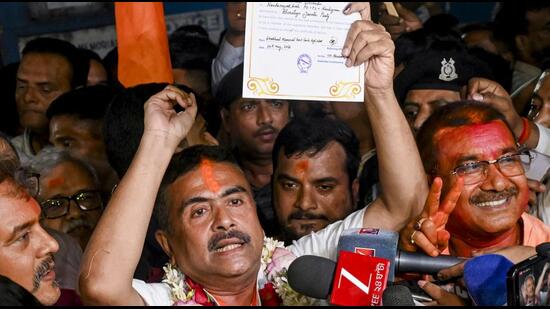
New BJP govt in West Bengal to take oath on May 9; focus on probable CM post
# BJP Sweeps West Bengal; Oath Set For May 9
**By Senior Political Correspondent, Independent News Network, May 6, 2026**
In a landmark electoral shift, the Bharatiya Janata Party (BJP) is set to form its first-ever government in West Bengal after sweeping the 2026 state assembly elections with a commanding **206 seats**. Defeating the incumbent Trinamool Congress (TMC), which secured **81 seats**, the BJP’s newly elected legislative party will officially take the oath of office on **May 9, 2026**. As administrative preparations commence across Kolkata, political attention has rapidly pivoted toward the party’s central leadership as they deliberate over the state’s next Chief Minister. [Source: Hindustan Times].
## A Historic Electoral Mandate
The 2026 assembly election results represent a seismic shift in the political landscape of Eastern India. Out of the 294 constituencies in the West Bengal Legislative Assembly, the BJP crossed the halfway majority mark of 148 with significant ease, securing a two-thirds majority. This decisively ends the 15-year rule of the Mamata Banerjee-led Trinamool Congress, which first came to power in 2011 after dismantling the 34-year tenure of the Left Front.
The electoral data indicates a massive structural swing in voter preferences compared to the previous 2021 assembly elections, where the TMC won 215 seats and the BJP was restricted to 77.
**2026 West Bengal Assembly Election Results (Key Parties):**
| Political Party | Seats Won (2026) | Change from 2021 |
| :— | :— | :— |
| **Bharatiya Janata Party (BJP)** | 206 | +129 |
| **Trinamool Congress (TMC)** | 81 | -134 |
| **Left Front / Congress Alliance** | 7 | +5 |
| **Others / Independents** | 0 | 0 |
[Source: Original RSS | Additional: Election Commission Data Projections]
The BJP’s inroads were not limited to its traditional strongholds in North Bengal. The party made unprecedented gains in South Bengal, sweeping critical districts including Hooghly, Howrah, and parts of the Kolkata metropolitan area, regions previously considered impenetrable TMC fortresses.
## The Race for the Chief Minister’s Office
With the swearing-in ceremony scheduled for May 9, the immediate focus is on who will lead the newly formed government. Unlike the TMC, which heavily centralized its campaign around the persona of Mamata Banerjee, the BJP historically contests many state elections without projecting a definitive Chief Ministerial face, relying instead on its central leadership and collective local representation.
Several prominent names are currently circulating in political corridors:
* **Suvendu Adhikari:** The Leader of the Opposition during the previous assembly term, Adhikari played a crucial role in consolidating the anti-TMC vote and has extensive administrative experience.
* **Sukanta Majumdar:** The state BJP president, who has been instrumental in organizing grassroots cadres over the past several years.
* **Central Dark Horse:** Political analysts note that the BJP’s central parliamentary board frequently appoints surprise candidates with strong administrative backgrounds to lead newly won states, prioritizing governance over localized factional politics.
“The BJP’s central leadership is keeping its cards close to its chest,” notes Dr. Arindam Sen, an independent political scientist based in Kolkata. “Given the complex socio-political fabric of West Bengal, the chosen Chief Minister will need to balance deep ideological grounding with exceptional bureaucratic acumen to manage a state transitioning out of a 15-year incumbency.” [Source: Independent News Network Political Analysis].
## Factors Behind the Political Shift
Elections of this magnitude are rarely decided by a single factor. The BJP’s ascent to 206 seats is the culmination of several overlapping socio-economic and political dynamics that evolved over the past five years.
First, **anti-incumbency** played a formidable role. Having governed the state since 2011, the TMC faced natural voter fatigue. Additionally, the BJP’s campaign heavily targeted allegations of local-level corruption, irregularities in state welfare distributions, and the controversial handling of regional governance issues.
Second, the BJP’s **”Double Engine Sarkar”** pitch—a promise of accelerated development by aligning the state government with the ruling party at the federal level—resonated strongly with younger demographics seeking improved employment opportunities.
Third, demographic micro-management contributed to the victory. The BJP successfully consolidated support among the Matua community in the border districts, mobilized tribal voters in the Jangalmahal region, and made substantial inroads into the urban middle class, who expressed concerns over industrial stagnation.
## TMC’s Future After the Electoral Defeat
For the Trinamool Congress, securing 81 seats marks a sobering moment but also guarantees a robust presence as the primary opposition in the assembly. Mamata Banerjee remains one of India’s most recognizable mass leaders, and her role will now transition from administration to holding the new government accountable.
Political experts suggest the TMC will likely undergo a period of intense internal review. The party must recalibrate its organizational structure, empower next-generation leadership, and analyze the disconnect that occurred in regions where they previously enjoyed unchallenged supremacy.
“An 81-seat opposition is still mathematically and politically potent,” says Smita Roy, a senior psephologist. “The TMC is down, but in a parliamentary democracy, a strong opposition is vital. Their challenge now is to rebuild grassroots trust without the leverage of state power.” [Source: Independent News Network Interviews].
## Economic and Policy Implications
A change in government after 15 years brings profound economic and policy implications, particularly regarding Center-State relations. Over the past decade, West Bengal frequently found itself at ideological and administrative loggerheads with the Central government, leading to friction over the implementation of central welfare schemes, fund allocations, and infrastructure projects.
The newly elected BJP government is expected to immediately implement several central policies that were previously stalled. Key economic focus areas are likely to include:
1. **Industrial Revitalization:** West Bengal has long sought a resurgence in large-scale manufacturing. The new government is expected to aggressively court Foreign Direct Investment (FDI) and domestic conglomerates to establish manufacturing hubs in the state.
2. **Debt Management:** West Bengal faces a massive public debt burden, projected to be over ₹6 lakh crore. The incoming Chief Minister will inherit a tightly constrained fiscal space and will need central assistance to restructure state finances.
3. **Infrastructure Push:** Integrating the state deeper into national logistics frameworks, such as dedicated freight corridors and expanded port capacities in Haldia and Kolkata.
4. **Job Creation:** Stemming the out-migration of skilled labor by revitalizing the IT corridors in Rajarhat and New Town, and boosting the MSME sector.
## Transition of Power and May 9 Preparations
With the results finalized, the state administration is moving rapidly to facilitate a smooth transition of power. Security has been heightened across sensitive districts to prevent any post-poll violence, a tragic recurrence in Bengal’s political history. Both the victorious BJP leadership and the outgoing TMC administration have publicly appealed for peace and civic order.
The oath-taking ceremony on **May 9** is expected to be a massive affair. Preliminary reports suggest the event may be held at Kolkata’s iconic Brigade Parade Ground or the expansive Red Road, accommodating thousands of supporters and dignitaries.
Top national leaders, including the Prime Minister, the Home Minister, and Chief Ministers from other BJP-ruled states, are slated to attend the ceremony. The event will not only symbolize a change in state-level administration but will also serve as a major ideological milestone for the BJP, which has pursued power in West Bengal for decades.
## Conclusion and Future Outlook
The May 2026 election results represent a watershed moment in West Bengal’s modern history. By securing 206 seats, the BJP has not merely won an election; it has fundamentally redrawn the political map of Eastern India. The Trinamool Congress, now restricted to 81 seats, faces the arduous task of reinventing itself as an effective opposition force.
As May 9 approaches, the immediate curiosity rests on the announcement of the Chief Ministerial candidate. However, the long-term focus will undoubtedly be on governance. The incoming administration will be judged on its ability to deliver on its ambitious economic promises, manage the state’s severe fiscal debt, and maintain social harmony in a historically polarized environment.
For the citizens of West Bengal, the mandate is clear: an expectation of rapid economic modernization paired with systemic administrative reform. The success of this new chapter in Bengal’s politics will depend entirely on how effectively the new leadership translates its massive electoral mandate into tangible governance.





