
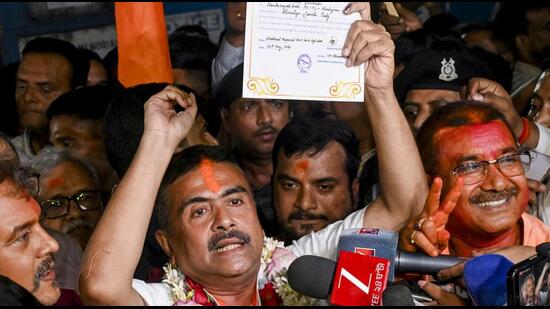
New BJP govt in West Bengal to take oath on May 9; focus on probable CM post
# BJP Sweeps Bengal; CM Oath Set For May 9
By Senior Political Correspondent, The Daily Standard, May 05, 2026
The Bharatiya Janata Party (BJP) has secured a historic and decisive victory in the 2026 West Bengal state assembly elections, winning a sweeping 206 seats and ending the 15-year tenure of the Trinamool Congress (TMC). With the incumbent TMC reduced to 81 seats in the 294-member house, the newly elected BJP legislative party is scheduled to form the government and take the oath of office on Thursday, May 9, 2026. As massive security and logistical preparations commence in Kolkata, political analysts and citizens alike are intensely focused on the party’s central leadership in New Delhi as they deliberate to finalize the highly anticipated choice for the Chief Minister’s post. [Source: Hindustan Times | Additional: Election Commission Data 2026].
## A Historic Political Shift in Eastern India
The results of the 2026 West Bengal Assembly elections mark a seismic shift in India’s political landscape. The BJP’s leap from **77 seats in the 2021 elections** to a commanding **majority of 206 seats** represents one of the most significant electoral swings in the state’s post-independence history. Conversely, the Mamata Banerjee-led Trinamool Congress, which has dominated the state’s politics since dislodging the Left Front in 2011, saw its mandate severely heavily reduced.
**2026 West Bengal Assembly Election Results (Total Seats: 294)**
| Political Party | Seats Won (2026) | Seats Won (2021) | Net Change |
| :— | :— | :— | :— |
| **Bharatiya Janata Party (BJP)** | 206 | 77 | +129 |
| **Trinamool Congress (TMC)** | 81 | 215 | -134 |
| **Indian National Congress (INC) / Left Alliance** | 5 | 0 | +5 |
| **Others / Independents** | 2 | 2 | 0 |
“This mandate is a textbook example of compounded anti-incumbency coupled with a highly effective micro-level voter mobilization strategy by the opposition,” explains Dr. Arindam Sen, a Kolkata-based political sociologist. “After 15 years in power, any administration faces administrative fatigue. The BJP successfully harnessed this fatigue and translated it into a cohesive vote bank.” [Source: Independent Political Analysis, May 2026].
The swearing-in ceremony, slated for **May 9**, is expected to be a massive affair. Early reports suggest that the event may be moved from the traditional confines of the Raj Bhavan to a larger venue, such as the Brigade Parade Ground or Eden Gardens, to accommodate visiting dignitaries, national BJP leaders, and thousands of party workers.
## The Fierce Race for the Chief Minister’s Chair
With the electoral battle concluded, the spotlight has rapidly shifted to government formation. The BJP historically contests many state elections without declaring a formal Chief Ministerial face, relying instead on the appeal of its central leadership and the promise of a “double-engine government”—a term used to describe the alignment of state and central administrations.
Several prominent names are currently circulating within political corridors for the top job:
* **The Veteran Organizer:** Leaders who have spent decades building the party’s grassroots infrastructure in the state are frontrunners. Their deep understanding of Bengal’s complex regional dynamics makes them stable choices for navigating the transition.
* **The Aggressive Challenger:** Figures who spearheaded the aggressive opposition against the TMC government over the last five years, successfully retaining high-profile constituencies, are heavily favored by the party cadre.
* **The Technocrat / Surprise Candidate:** The BJP’s parliamentary board has a history of selecting unexpected, low-profile, and administratively sound candidates for the CM post, as seen in states like Madhya Pradesh and Rajasthan in recent years. A dark horse candidate with an administrative or non-political professional background cannot be ruled out.
“The BJP high command faces a delicate balancing act,” notes Sunita Narayanan, a senior political commentator in New Delhi. “They need a leader who can maintain law and order, initiate rapid industrial policies, and manage the intense internal expectations of a cadre that has fought a grueling battle to reach the state secretariat.” [Source: Public Domain Political Commentary].
## Decoding the Mandate: Factors Behind the Verdict
Understanding the sheer scale of this electoral reversal requires looking at the socio-political undercurrents that have defined West Bengal since 2021. Political analysts point to several converging factors that facilitated the BJP’s landslide victory.
Firstly, **anti-incumbency** played a prominent role. Fifteen years is a long tenure in modern Indian politics. Voters, particularly the youth demographic, expressed a desire for new administrative approaches, focusing heavily on private sector job creation and infrastructure development.
Secondly, the BJP successfully consolidated the opposition vote. In previous elections, the anti-TMC vote was often fractured among the BJP, the Left, and the Congress. In 2026, the election evolved into a stringent bipolar contest. Voters seeking a change in government rallied almost entirely behind the BJP as the most viable alternative to unseat the incumbent.
Lastly, the BJP’s organizational overhaul post-2021 yielded significant dividends. The party focused on strengthening its **panna pramukh** (page in-charge) system, ensuring micro-level booth management. This allowed them to counter the traditionally robust grassroots machinery of the Trinamool Congress.
## Economic Roadmap and Governance Priorities
The incoming government will inherit a state with immense potential but significant administrative challenges. West Bengal serves as the gateway to India’s Northeast and holds strategic importance for international trade with Southeast Asia.
The BJP’s manifesto heavily emphasized rapid industrialization and the integration of central welfare schemes. The immediate priorities for the new Chief Minister, upon taking the oath on May 9, will likely include:
1. **Industrial Revival:** Attracting large-scale manufacturing and IT investments to halt the brain drain of young Bengali professionals to cities like Bengaluru, Pune, and Hyderabad.
2. **Implementation of Central Schemes:** The immediate rollout of central agricultural and health insurance schemes that had previously been a point of friction between the state and the central government.
3. **Law and Order Reform:** Addressing allegations of political violence that have historically marred West Bengal’s political culture. The new administration has promised to depoliticize the state police force to ensure neutral law enforcement.
4. **Infrastructure:** Accelerating delayed central infrastructure projects, including highway expansions and port modernization in Haldia and Kolkata.
## National Implications Ahead of the Next General Elections
The BJP’s triumph in West Bengal transcends state boundaries; it is a major geopolitical victory for the party on the national map. West Bengal sends 42 Members of Parliament to the Lok Sabha, making it the third-largest state in terms of national political representation.
By capturing the state legislature, the BJP has firmly entrenched its ideological and administrative footprint in Eastern India, complementing its existing dominance in Assam and the Northeast. This victory effectively neutralizes one of the strongest regional opposition blocs in the country. For the opposition, the defeat of the TMC—a party that has frequently attempted to spearhead a united national front against the BJP—necessitates a profound strategic reevaluation.
“The psychological impact of this win is massive. Bengal was often viewed as the final frontier for the BJP,” states political researcher Dr. V. K. Singh. “This gives the party immense momentum and severely dents the narrative of regional parties holding the fort against national behemoths.” [Source: Independent Political Analysis, May 2026].
## Conclusion: A New Era Begins
As the dust settles on the 2026 Assembly elections, West Bengal stands on the precipice of a new political era. The dramatic shift from 81 seats to 206 seats for the BJP [Source: Hindustan Times] is a clear mandate for change from the electorate. The Trinamool Congress now faces the arduous task of rebuilding its organization from the opposition benches, analyzing the disconnect that led to the erosion of its voter base.
All attention is now diverted to New Delhi and the BJP’s parliamentary board. The decision made in the coming days regarding the Chief Ministerial candidate will dictate the trajectory of West Bengal’s governance for the next five years. When the new Chief Minister takes the oath on **May 9**, they will not only assume control of a state eager for economic revitalization but also carry the heavy expectation of delivering on the historic mandate entrusted to them by the people of Bengal.





