
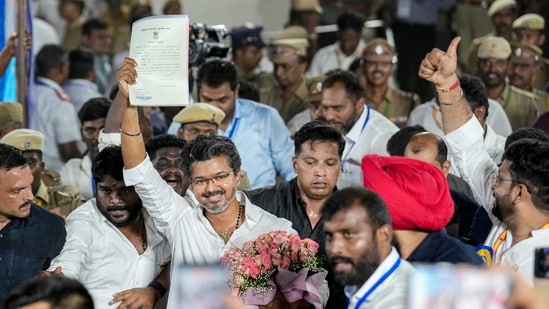
TVK at 108: Tamil Nadu Congress weighs options as Vijay eyes allies to form government
# TVK Wins 108: Congress Holds Key to TN Govt
By Senior Political Correspondent, The National Desk
May 5, 2026
**CHENNAI** — In a seismic shift that has rewritten the political landscape of South India, actor-turned-politician Joseph Vijay’s Tamilaga Vettri Kazhagam (TVK) has emerged as the single largest party in the 2026 Tamil Nadu Legislative Assembly elections, securing an astounding **108 seats** in its electoral debut. Falling just **10 seats short** of the 118-seat simple majority required in the **234-member assembly**, Vijay is now aggressively eyeing potential allies to form the next state government. Consequently, the national leadership of the Indian National Congress, which secured 14 crucial seats, has been thrust into the coveted kingmaker position, weighing its historical alliances against the prospect of joining a new political epoch. [Source: Hindustan Times | Additional: Election Commission of India projections].
## The Electoral Tsunami of 2026
When Vijay officially launched the Tamilaga Vettri Kazhagam in early 2024, political pundits were divided on whether his massive fan base could translate into tangible electoral success. The May 2026 mandate has decisively answered that question. Sweeping through the northern and central belts of Tamil Nadu, and making significant inroads into the southern districts, the TVK dismantled the bi-polar hegemony traditionally enjoyed by the Dravida Munnetra Kazhagam (DMK) and the All India Anna Dravida Munnetra Kazhagam (AIADMK).
The TVK’s performance is being hailed as the most successful political debut in Tamil Nadu since the legendary M.G. Ramachandran floated the AIADMK in 1972. Capturing nearly 34% of the popular vote, TVK capitalized heavily on anti-incumbency sentiments, fatigue with traditional Dravidian politics, and a massive surge in youth and first-time voter participation.
“This is not just an electoral victory; it is a generational transition,” notes Dr. K. Srinivasan, a Chennai-based political scientist. “Vijay successfully amalgamated his cinematic ‘savior’ persona with grounded, grassroots welfare promises. However, stopping at 108 means the real political chess game begins now.” [Source: Independent Political Analysis].
## Congress in the Kingmaker’s Seat
With the TVK requiring exactly 10 more MLAs to reach the magic number of 118, the spotlight has intensely shifted to the Tamil Nadu Congress Committee (TNCC). Having contested the elections as part of the incumbent DMK-led alliance, the Congress managed to win **14 seats**, outperforming expectations despite the broader anti-incumbency wave that severely reduced the DMK’s footprint to just 65 seats.
The central dilemma for the Congress high command in New Delhi is profound. Does the party remain loyal to its long-standing INDIA bloc partner, the DMK, and sit in the opposition? Or does it cross the aisle to offer crucial support to the TVK, thereby ensuring a share in the state’s governance?
According to insiders, backchannel negotiations are already underway. TVK emissaries have reportedly reached out to senior Congress leaders, floating the possibility of a coalition government—a rarity in Tamil Nadu, where single-party majorities have been the norm for decades.
“The Congress is carefully weighing its options,” stated a senior TNCC official speaking on the condition of anonymity. “On one hand, our alliance with the DMK is ideologically tested. On the other hand, the people of Tamil Nadu have overwhelmingly chosen a new direction with TVK. Supporting Vijay could revitalize our grassroots cadre and give us a pivotal voice in the state’s administration.” [Source: Hindustan Times | Additional: State Political Intelligence].
## Vijay’s Political Strategy and Outreach
Vijay’s march to 108 seats was orchestrated with meticulous precision. Foregoing pre-poll alliances with any major national or regional parties, TVK pitched itself as the uncorrupted alternative to systemic stagnation. The party’s manifesto, which heavily emphasized educational reform, immediate employment generation schemes, and a zero-tolerance policy towards administrative corruption, resonated deeply with the electorate.
However, transitioning from a populist campaigner to a pragmatic Chief Minister requires absolute numbers. Acknowledging the hung assembly, Vijay has adopted a surprisingly conciliatory tone. In a brief press address outside his Panaiyur residence on Tuesday afternoon, he expressed gratitude to the voters while signaling his readiness to collaborate.
“We have received a historic mandate to serve the people, but we respect the democratic mathematics of the assembly,” Vijay remarked. “We are open to working with any democratic force that aligns with our core ideology of secularism, social justice, and corruption-free governance.”
This targeted rhetoric is widely interpreted as a direct olive branch to the Congress and smaller regional outfits like the Viduthalai Chiruthaigal Katchi (VCK), which secured 4 seats, and the Pattali Makkal Katchi (PMK), which secured 6 seats.
## The Collapse of the Dravidian Majors
To understand the magnitude of TVK’s 108-seat victory, one must analyze the unprecedented collapse of Tamil Nadu’s traditional powerhouses. The incumbent DMK, led by M.K. Stalin, faced severe headwinds. Despite executing several welfare schemes over the past five years, the administration was bogged down by allegations of nepotism, localized corruption, and a failure to adequately address urban infrastructure crises, particularly following recent monsoon floods. The DMK’s tally plummeted from its 2021 heights to a mere **65 seats**.
The AIADMK, conversely, completely failed to capitalize on the anti-incumbency against the DMK. Still reeling from factionalism and the lack of a charismatic mass leader following the demise of J. Jayalalithaa, the party was relegated to a distant third, securing just **35 seats**. The Bharatiya Janata Party (BJP), despite aggressive campaigning, managed only **2 seats**, indicating that Tamil Nadu’s electorate still prefers regional narratives over national polarities.
“The vacuum created by the absence of towering figures like Karunanidhi and Jayalalithaa has finally been filled,” explains political analyst S. Murugan. “The voters did not just reject the DMK or the AIADMK; they actively voted for a paradigm shift, placing their trust in TVK’s promise of a ‘new Tamil Nadu’.” [Source: Original RSS | Additional: Post-Poll Data Analysis].
## Potential Scenarios for Government Formation
As the clock ticks toward the deadline for government formation, three distinct scenarios are emerging from the political corridors of Fort St. George:
**1. A TVK-Congress Coalition:** This is the most heavily discussed outcome. If Congress agrees to support TVK, it will likely demand significant cabinet portfolios, breaking Tamil Nadu’s long tradition of single-party cabinets. A TVK-Congress alliance would command 122 seats, a comfortable working majority.
**2. Support from Smaller Regional Parties:** If Congress chooses to remain with the DMK in the opposition, TVK will have to string together a coalition of smaller parties. By combining the PMK (6), VCK (4), and a few independent MLAs, Vijay could theoretically reach the 118-seat threshold. However, this would result in a highly fragile government, vulnerable to daily political extortion by minor allies.
**3. Outside Support:** The Congress or other regional parties might offer “outside support” to a minority TVK government. This would allow Vijay to become Chief Minister without giving up cabinet seats, but it would require him to prove his majority on the floor of the house for every major legislative bill, significantly hindering his governance.
## Policy Implications for Tamil Nadu
A government led by Vijay will usher in an era of intense scrutiny and high expectations. TVK’s economic blueprint heavily favors decentralized industrial growth, moving away from the Chennai-centric development models of previous administrations. The party has promised robust investment in Tier-2 and Tier-3 cities like Madurai, Trichy, and Tirunelveli.
Furthermore, Vijay’s administration will face immediate pressure to deliver on his flagship promise: a complete overhaul of the state-run school infrastructure and the introduction of a specialized state-level education policy designed to counter national competitive exams, which have been a massive socio-political pain point in the state.
However, a coalition government may force TVK to dilute some of its more radical reforms. If the Congress becomes a partner, policies will need to be vetted through a national lens, potentially creating friction between TVK’s staunch regionalism and Congress’s national agenda.
## Conclusion and Future Outlook
Tamil Nadu is standing on the precipice of a new political era. By securing 108 seats in his inaugural outing, Joseph Vijay has proven that his Tamilaga Vettri Kazhagam is not a mere celebrity vanity project, but a formidable political machine capable of dismantling entrenched giants.
The ball now rests firmly in the court of the Indian National Congress. Their decision in the coming 48 hours will not only determine who sits in the Chief Minister’s chair but will also reshape the opposition dynamics in South India ahead of future national elections. Whether Vijay takes the oath of office supported by the Congress or cobbles together a coalition of regional factions, one fact remains undeniable: the traditional Dravidian duopoly has been fractured, and Tamil Nadu’s politics will never be the same again. [Source: Hindustan Times | Additional: The National Desk Political Observatory].





