
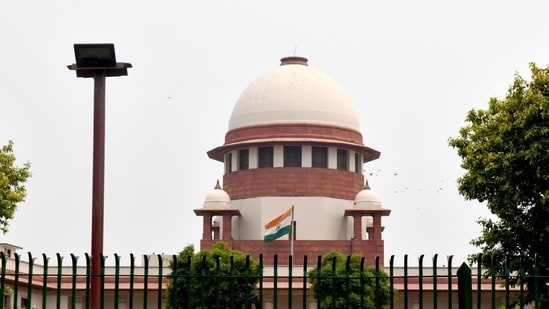
Cabinet approves expansion of Supreme Court strength from 33 to 37 judges to tackle case backlog
# Cabinet Clears SC Judge Expansion
By Legal Affairs Correspondent, The Daily Judiciary Review, May 06, 2026
**NEW DELHI** — In a major administrative move to combat the judiciary’s escalating case backlog, the Union Cabinet on Wednesday, May 6, 2026, approved a critical proposal to expand the sanctioned strength of the Supreme Court of India. The landmark decision will increase the number of Supreme Court judges from 33 to 37, excluding the Chief Justice of India (CJI). This strategic intervention clears the immediate path for the introduction of the Supreme Court (Number of Judges) Amendment Bill, 2026, in the upcoming parliamentary session. The legislative upgrade aims to fast-track justice delivery and reduce an overwhelming docket of pending litigations that has placed unprecedented strain on the nation’s highest constitutional court.
[Source: Hindustan Times | Additional: Ministry of Law and Justice, Government of India]
## The Mounting Crisis of Pendency
The Indian judicial system has long grappled with systemic delays, but the apex court’s docket has reached historic proportions in recent years. As of early 2026, data from the National Judicial Data Grid (NJDG) and the Supreme Court’s internal registry indicated that over 84,000 cases were pending before the highest court. This accumulation is largely driven by a combination of complex constitutional challenges, an influx of Special Leave Petitions (SLPs) under Article 136, and prolonged commercial disputes stemming from a rapidly growing economy.
**The anatomy of the backlog reveals structural challenges:**
* **Special Leave Petitions:** Over 40% of the Supreme Court’s time is absorbed by SLPs, effectively forcing the constitutional court to function as a regular court of appeal.
* **Constitutional Benches:** Matters requiring interpretation of the Constitution demand benches of five, seven, or nine judges, severely depleting the judicial resources available for regular two-judge and three-judge bench hearings.
* **Commercial and Bail Matters:** The post-pandemic surge in high-stakes corporate litigation and urgent bail applications has persistently crowded the daily causelists.
The Union Cabinet’s decision is a direct acknowledgment that the current working strength of 34 (33 puisne judges plus the CJI) is mathematically insufficient to simultaneously manage constitutional interpretation and the sheer volume of appellate matters.
## Legislative Mechanics: The Amendment Bill, 2026
To operationalize the Cabinet’s approval, the Ministry of Law and Justice will introduce the Supreme Court (Number of Judges) Amendment Bill, 2026. Article 124(1) of the Indian Constitution states that there shall be a Supreme Court of India consisting of a Chief Justice of India and, until Parliament by law prescribes a larger number, of not more than seven other Judges.
Parliament has historically exercised this power to adapt the court’s size to the growing population and corresponding litigation volume. The new bill will amend the principal Act of 1956, elevating the maximum cap of puisne judges to 37. Once passed by both houses of Parliament and assented to by the President, the total sanctioned strength of the Supreme Court, including the Chief Justice, will rise to 38.
The immediate introduction of this Bill signals the executive’s willingness to collaborate with the judiciary on infrastructural bottlenecks. Government sources suggest the Bill is likely to see bipartisan support, given that judicial pendency is universally recognized as a critical hurdle to social justice and economic growth.
## Historical Progression of Supreme Court Strength
The expansion of the Supreme Court’s bench has been a gradual, decades-long process reflecting the maturation of the Indian republic. The founders originally envisioned a compact, tight-knit constitutional court. However, the realities of an expanding statutory landscape necessitated periodic augmentations.
| Year | Sanctioned Strength (Including CJI) | Context of Expansion |
| :— | :— | :— |
| **1950** | 8 | Original Constitutional provision |
| **1956** | 11 | First amendment to address early appellate backlogs |
| **1960** | 14 | Rising civil litigation in newly formed states |
| **1977** | 18 | Post-Emergency surge in constitutional litigation |
| **1986** | 26 | Major expansion to tackle industrial and tax disputes |
| **2009** | 31 | Introduction of PILs and vast expansion of writ jurisdictions |
| **2019** | 34 | Pre-pandemic adjustment to cross the 60,000 pendency mark |
| **2026** | 38 (Proposed) | Modernization phase to balance constitutional and appellate duties |
[Source: Historical Data, Supreme Court of India Annual Reports]
The proposed 2026 expansion marks the largest proportional increase in nearly two decades, an essential calibration for a country whose population has surpassed 1.4 billion and whose legal frameworks have grown exponentially complex.
## Expert Perspectives on Judicial Efficiency
Legal scholars and veteran practitioners have largely welcomed the Cabinet’s move, though many caution that simply adding judges will not be a panacea for the deeper structural issues plaguing the justice system.
“Increasing the sanctioned strength to 37 judges is a pragmatic and urgently needed step,” noted Senior Advocate and constitutional law expert, Dr. Manish Venkataraman. “However, the true test of this reform lies in the speed of appointments. A sanctioned strength of 38 means nothing if vacancies are allowed to languish in procedural limbo between the Collegium and the Executive.”
Former High Court Chief Justice R.K. Desai echoed similar sentiments, pointing toward case management. “More judges mean more combinations of division benches. While this will accelerate the disposal of routine appeals, the Supreme Court must simultaneously implement stricter filtering mechanisms for Special Leave Petitions. The court must reclaim its primary identity as a Constitutional Court, rather than a final court of regular appeal.”
Furthermore, legal economists highlight the macroeconomic benefits. Delayed justice in commercial disputes traps billions of rupees in corporate litigation. Fast-tracking these cases through expanded benches could significantly improve India’s ‘Ease of Doing Business’ metrics, reassuring foreign investors of a robust, efficient contract enforcement mechanism.
## Infrastructure and Administrative Readiness
A critical subtext of the Cabinet’s decision is the requisite expansion of physical and digital infrastructure. Accommodating four additional Supreme Court judges requires not just new courtrooms, but extended secretariats, additional law clerks, enhanced library resources, and dedicated administrative staff.
The Supreme Court complex at Tilak Marg has undergone continuous spatial optimizations. However, integrating four new benches requires sophisticated logistical planning. Fortunately, the aggressive digitization push—spearheaded by the e-Courts Phase III project—has decentralized much of the administrative burden.
**Key infrastructural upgrades expected to accompany the expansion include:**
* **Virtual Courtroom Integration:** Enhanced hybrid hearing capabilities allow new judges to operate efficiently without immediate massive physical expansions.
* **AI-Assisted Legal Research:** The Supreme Court’s ongoing integration of Artificial Intelligence for translating regional languages, transcribing live proceedings, and initial case-law research will multiply the productivity of the newly expanded bench.
* **Advanced Registry Automation:** To prevent the newly formed benches from being starved of appropriately categorized cases, the registry’s algorithmic listing systems are undergoing an overhaul to ensure optimized docket distribution.
## The Collegium System and Future Appointments
While the legislative hurdle of expanding the court is easily cleared by a parliamentary majority, the operational challenge lies within the Supreme Court Collegium. The Collegium, comprising the CJI and the four senior-most judges, will now be tasked with identifying and recommending suitable candidates to fill the newly created vacancies, in addition to managing routine retirements.
The relationship between the Executive and the Judiciary regarding the Memorandum of Procedure (MoP) for judicial appointments has experienced periodic friction. The success of the 2026 Amendment Bill depends heavily on seamless coordination between these two pillars of democracy.
To fill the expanded roster, the Collegium is expected to look toward elevating distinguished Chief Justices of various High Courts, ensuring adequate regional, gender, and marginalized community representation. Additionally, there may be an opportunity to directly elevate exceptional legal academicians or distinguished members of the Bar, a constitutional provision that has been rarely utilized in the court’s history.
## Broader Structural Reforms: The Debate on Appellate Benches
The expansion of the Supreme Court also reignites a dormant, yet crucial, constitutional debate: the potential division of the apex court into Constitutional and Appellate wings.
For decades, Law Commissions have recommended establishing National Courts of Appeal (regional benches in the North, South, East, and West) to handle routine appeals from High Courts, thereby reserving the primary New Delhi bench exclusively for constitutional interpretation. While the Government and the Supreme Court have historically resisted fragmenting the apex court geographically, the continuous need to increase judge strength serves as a reminder that the centralized appellate model is under immense pressure.
By boosting the judge count to 37, the Supreme Court could internally restructure its rosters. For instance, the CJI could permanently allocate specialized benches dedicated solely to taxation, commercial arbitration, and criminal appeals, while reserving a standing Constitution Bench to hear complex matters of fundamental rights without interruption.
## Conclusion and Future Outlook
The Cabinet’s approval to expand the Supreme Court’s strength from 33 to 37 judges marks a decisive legislative intervention in India’s ongoing battle against judicial pendency. By paving the way for the Supreme Court (Number of Judges) Amendment Bill, 2026, the government has provided the judiciary with the numerical reinforcements necessary to tackle a modern, complex, and highly litigious society.
**Key Takeaways:**
* **Immediate Relief:** The addition of four judges will allow for the constitution of at least two more division benches, directly translating to higher daily disposal rates.
* **Constitutional Focus:** Increased strength may finally allow the Supreme Court to maintain permanent Constitutional Benches without stalling regular appellate justice.
* **Execution is Key:** The ultimate success of this expansion relies on the swiftness of the Collegium’s recommendations and the Executive’s subsequent notifications, avoiding the trap of prolonged vacancies.
As the Bill heads to Parliament, it serves as a testament to the evolving nature of Indian jurisprudence. However, it also serves as a stark reminder that numerical expansion must be paired with modernized procedural laws, stricter limitations on frivolous appeals, and an empowered lower judiciary to truly achieve the constitutional promise of swift and accessible justice for all citizens.





