
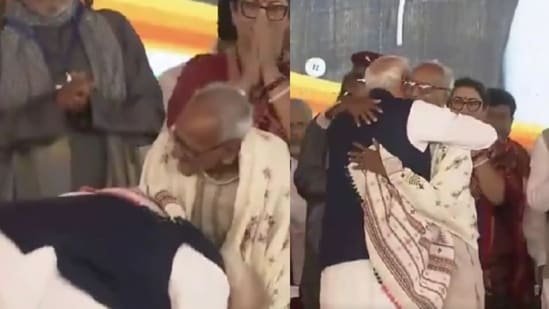
Who is Makhanlal Sarkar, 98-year old BJP worker whose feet PM Modi touched at Bengal oath ceremony
# Who is Makhanlal Sarkar? BJP Vet Honored by PM
**By Senior Correspondent, India Politics Desk** | May 9, 2026
Prime Minister Narendra Modi captivated the nation on Saturday when he broke security protocol to touch the feet of 98-year-old Makhanlal Sarkar during a historic swearing-in ceremony in Kolkata. The poignant gesture occurred just moments after Suvendu Adhikari officially took the oath as West Bengal’s first Bharatiya Janata Party (BJP) Chief Minister since Independence. For decades, Sarkar has been an unsung grassroots worker for the party in a state traditionally dominated by Leftist and regional politics. The Prime Minister’s public display of respect for the nonagenarian answered the question on millions of minds—who is Makhanlal Sarkar?—while simultaneously symbolizing the BJP’s long, arduous journey to political supremacy in Bengal. [Source: Hindustan Times | Additional: Regional Election Broadcasts, May 2026].
## A Historic Oath Ceremony in Kolkata
The sprawling expanse of Kolkata’s Brigade Parade Ground was awash in saffron on Saturday morning, marking a watershed moment in Indian political history. Suvendu Adhikari, the architect of the BJP’s decisive victory in the 2026 West Bengal Legislative Assembly elections, was sworn in as the Chief Minister. The ceremony was attended by a constellation of political heavyweights, including Union Home Minister Amit Shah, several BJP chief ministers, and prominent cultural figures from Bengal.
However, amidst the high-security protocols and the roar of thousands of supporters, the narrative of the day briefly shifted from the newly minted Chief Minister to an unassuming elderly man seated in the VIP enclosure. As Prime Minister Modi walked toward the dais to congratulate Adhikari, he spotted Makhanlal Sarkar. In a move that immediately went viral across social media and national television broadcasts, the Prime Minister paused, approached the frail 98-year-old, and bowed deeply to touch his feet in a traditional Indian gesture of profound respect (Pranam).
The visual of the nation’s most powerful leader seeking the blessings of an ordinary, khadi-clad party worker provided an indelible image for the inauguration. It underscored a message of humility and ideological continuity that the BJP leadership has frequently sought to project. [Source: Hindustan Times].
## Decades of Unseen Dedication: The Life of Sarkar
To understand the weight of the Prime Minister’s gesture, one must look at the remarkable life of Makhanlal Sarkar. Born in 1928 in the undivided Bengal Presidency, Sarkar came of age during the tumultuous years of India’s independence and the subsequent partition. Deeply influenced by the nationalist ideologies of Dr. Syama Prasad Mookerjee, a fellow Bengali who founded the Bharatiya Jana Sangh (the precursor to the BJP) in 1951, Sarkar joined the political movement in his early twenties.
For over seven decades, Sarkar operated in the political wilderness of West Bengal. While the state’s political landscape was dominated first by the Indian National Congress, followed by an uninterrupted 34-year rule by the Communist Party of India (Marxist)-led Left Front, and subsequently by Mamata Banerjee’s Trinamool Congress (TMC), Sarkar remained a steadfast proponent of the Jana Sangh and later the BJP.
Operating primarily out of the Nadia district, Sarkar never sought public office, an electoral ticket, or media attention. He spent his life organizing small community meetings, distributing party literature, and keeping the ideological flame alive during eras when associating with right-wing politics in Bengal often invited social ostracization and, frequently, severe political violence.
“Makhanlal-da is the living embodiment of our party’s struggle in Bengal,” noted a senior state BJP general secretary on the condition of anonymity. “He saw times when we couldn’t even find polling agents in his district. To have him here to witness a BJP Chief Minister taking the oath is the ultimate vindication of his life’s work.” [Additional: Historical Archives on BJP Bengal Unit].
## The Symbolism and Political Messaging
Prime Minister Modi’s decision to honor Sarkar on such a grand stage was undoubtedly spontaneous in its emotion, but it also served as a masterclass in political symbolism.
Dr. Ananya Sen, a Kolkata-based political sociologist and author of *The Saffron Tide in the East*, explains the dual significance of the act. “On one level, it is deeply rooted in Bengali and broader Indian cultural ethos—respecting one’s elders is a universally lauded virtue,” Dr. Sen observed. “But politically, the Prime Minister was sending a direct message to the millions of ‘karyakartas’ (workers) across the country. He was effectively saying, ‘The party sees your unseen labor, and the highest echelons of power bow to your grassroots dedication.'”
This messaging is particularly crucial in West Bengal, where the BJP has built its cadre base from the ground up over the last decade. The party has repeatedly highlighted the sacrifices of its local workers, many of whom faced severe intimidation and violence during the turbulent election cycles of 2018, 2021, and 2024. By elevating Sarkar, Modi legitimized the historical struggle of every worker who fought for the party when victory seemed impossible.
## The Long Road to Power in West Bengal
The swearing-in of Suvendu Adhikari and the honoring of Makhanlal Sarkar represents the culmination of a decades-long strategic project by the BJP. For much of its history, the BJP was viewed in Bengal as an outsider party with little cultural resonance among the Bengali-speaking electorate.
The turning point began around 2014, accelerating rapidly into the 2019 Lok Sabha elections, where the BJP stunned political observers by winning 18 out of 42 parliamentary seats in the state. Despite falling short of the majority in the highly polarized 2021 Assembly elections, the BJP firmly established itself as the principal opposition, decimating the Left and the Congress.
Between 2021 and 2026, the party recalibrated its strategy under Adhikari’s aggressive street-level leadership. They capitalized on mounting anti-incumbency, alleged administrative fatigue, and localized corruption scandals that plagued the outgoing Trinamool Congress government. The 2026 electoral triumph was built on massive consolidation in rural Bengal and significant inroads into urban constituencies—areas where pioneers like Sarkar had laid the invisible groundwork decades prior. [Additional: Election Commission of India Electoral Data 2019-2026].
## Suvendu Adhikari’s Vision and Challenges Ahead
While the emotional high of the oath ceremony resonated deeply with supporters, Chief Minister Suvendu Adhikari now faces the pragmatic challenges of governance. In his first press address following the ceremony, Adhikari emphasized a commitment to restoring law and order, industrializing the state to stop the brain drain of Bengali youth, and ensuring corruption-free delivery of welfare schemes.
“The blessing of veterans like Makhanlal Sarkar reminds us that we are here not for power, but for service,” Adhikari stated, echoing the emotional tenor of the morning’s events. “Our government will honor the sacrifices of our martyrs and veterans by building the ‘Sonar Bangla’ (Golden Bengal) they dreamed of.”
Political analysts note that Adhikari’s immediate challenge will be to manage the state’s significant debt burden while fulfilling the populist promises made during the high-octane 2026 campaign. Furthermore, transitioning the BJP from an aggressive opposition force into a measured, administrative governing body will require significant bureaucratic maneuvering and statecraft.
## Bridging the Past and the Future
As the dust settles on the Brigade Parade Ground and the new government takes charge at Nabanna (the state secretariat), the image of the Prime Minister and the 98-year-old worker will likely endure as the defining visual of this political transition.
Makhanlal Sarkar, visibly moved and overwhelmed by the media attention, offered only a few words to regional reporters as he was escorted to his vehicle. “I joined the Jana Sangh because I believed in the motherland. I never imagined I would live to see this day, let alone have the Prime Minister touch my feet. My life’s work is complete.”
## Conclusion and Future Outlook
The 2026 West Bengal oath ceremony will be recorded in political history books for its disruption of a decades-old regional hegemony. However, through the elevation of Makhanlal Sarkar, the BJP successfully humanized a massive electoral victory.
**Key Takeaways:**
* **Historic Shift:** Suvendu Adhikari’s ascension marks the first time the BJP has formed a government in West Bengal, signaling a massive geopolitical shift in Eastern India.
* **Optics of Humility:** PM Modi’s gesture toward 98-year-old Makhanlal Sarkar successfully highlighted the BJP’s appreciation for its foundational grassroots workers.
* **Generational Vindication:** Sarkar’s 70-year journey from a marginalized Jana Sangh worker to an honored guest at a BJP Chief Minister’s swearing-in reflects the party’s long-term ideological persistence in the state.
Looking forward, the Adhikari administration has a strict mandate to deliver on economic revival and systemic reform. If the new government can channel the lifelong dedication of workers like Sarkar into effective governance, West Bengal may be on the precipice of its most significant socio-economic transformation in a half-century.





