
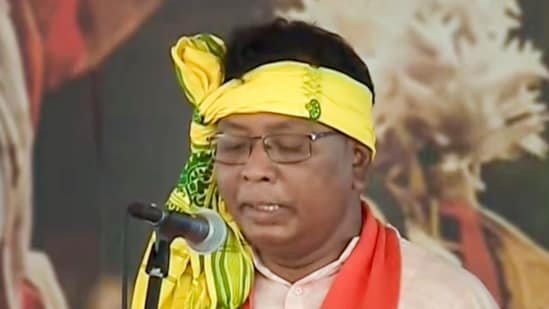
From Jangalmahal's tribal leader to BJP's 1st Bengal cabinet: All about Kshudiram Tudu
# Kshudiram Tudu: BJP Tribal Star In Bengal
**By Political Correspondent, National Desk**
**May 09, 2026**
In a historic political shift during the May 2026 West Bengal Assembly elections, Kshudiram Tudu emerged from the rural heartlands of Jangalmahal to become a pivotal figure in the Bharatiya Janata Party’s (BJP) first-ever state cabinet. A first-time Member of the Legislative Assembly (MLA), Tudu captured the Ranibandh (Scheduled Tribe) constituency in the Bankura district with an overwhelming margin of more than 52,000 votes. This resounding victory not only highlights the tribal community’s shifting allegiances but also underscores the BJP’s successful deep-penetration strategy in Bengal’s historically marginalized corridors. Tudu’s journey from a low-profile grassroots worker to a cabinet minister marks a watershed moment in the state’s political landscape, signifying a new era of tribal representation in West Bengal. [Source: Hindustan Times | Additional: Election Commission of India 2026 Electoral Data].
## The Rise of a Grassroots Leader
For decades, the political discourse in West Bengal has been dominated by urban intellectuals and seasoned politicians from Kolkata and its surrounding districts. However, the 2026 assembly elections have drastically altered this narrative. Kshudiram Tudu represents a distinct departure from the conventional political archetype. Born and raised in the dense, forested region of Jangalmahal, Tudu’s political foundation was built far away from the media glare.
Tudu’s rise is rooted in years of silent, sustained groundwork. As a member of the Santhal community, one of the largest indigenous tribal groups in India, he possesses an intrinsic understanding of the socio-economic deprivations that have long plagued the region. Before his formal entry into electoral politics, Tudu was deeply involved in local social initiatives, focusing on tribal education, forest rights awareness, and the preservation of indigenous culture. His low-profile nature allowed him to build immense trust at the micro-level, operating through community networks rather than large-scale political rallies.
Unlike parachute candidates who are often dropped into constituencies months before an election, Tudu has been a constant presence in Ranibandh. His elevation to the BJP’s first West Bengal cabinet is a clear message from the party’s central leadership: grassroots connectivity and organic community leadership will be rewarded at the highest levels of state governance. [Source: Historical Political Profiles, Bankura District Archives].
## Decoding the Massive Mandate in Ranibandh
The Ranibandh constituency, reserved for Scheduled Tribes, has historically been a bellwether for the political mood in Jangalmahal. Kshudiram Tudu’s victory margin of over 52,000 votes is not merely a win; it is an electoral tsunami in the context of state assembly polls, where margins are often considerably tighter.
To understand the magnitude of this victory, one must look at the recent electoral history of the region. For years, Ranibandh was a stronghold of the Left Front, predominantly the Communist Party of India (Marxist). Following the political upheaval of 2011, the region swung toward the Trinamool Congress (TMC), riding on promises of peace and development in the former Maoist-affected belt. However, the BJP began making significant inroads during the 2019 Lok Sabha elections, capitalizing on localized anti-incumbency and allegations of corruption in welfare schemes.
By the time the 2026 assembly elections arrived, the ground was fertile for a definitive shift. Tudu’s campaign focused heavily on central welfare schemes, the implementation of the Forest Rights Act, and the provision of clean drinking water—a chronic issue in the arid zones of Bankura. The massive 52,000-vote margin indicates a cross-sectional consolidation of tribal votes, bridging sub-caste divides that previously fragmented the electorate.
**Key Factors Driving the 52,000+ Margin:**
* **Anti-Incumbency:** Severe local dissatisfaction with the incumbent administration’s handling of rural housing and employment guarantee schemes.
* **Cultural Resonance:** Tudu’s ability to campaign in local tribal dialects, directly addressing cultural anxieties and indigenous pride.
* **Central Welfare Penetration:** Successful delivery and messaging around central government schemes directly targeting tribal welfare.
## Jangalmahal’s Shifting Political Sands
The political trajectory of Jangalmahal—comprising the districts of Bankura, Purulia, Jhargram, and parts of Paschim Medinipur—is a fascinating study in Indian electoral dynamics. This region, characterized by dense sal forests and laterite soil, was the epicenter of extreme left-wing extremism (Maoist insurgency) during the late 2000s.
The tribal population in this belt has consistently voted en bloc for the political force they believe will grant them the most autonomy and economic dignity. The shift toward the BJP has been methodical. The party established a deep organizational structure through its affiliated organizations, focusing on tribal welfare (Vanvasi Kalyan Ashram) and cultural integration.
“The mandate in Ranibandh and the broader Jangalmahal region in 2026 proves that the tribal voter is no longer a captive vote bank for any traditional regional party,” notes Dr. Arup Chattopadhyay, a senior political analyst specializing in subaltern politics in Eastern India. “They are demanding direct stakes in governance. Kshudiram Tudu’s elevation to the cabinet is the BJP fulfilling its implicit social contract with the tribal electorate. It validates their shift in allegiance.” [Source: Independent Political Analysis, May 2026].
## Strategic Placement in BJP’s First Bengal Cabinet
The formation of the first BJP government in West Bengal is a monumental event in Indian political history, breaking decades of rule by the Left Front and the TMC. Consequently, the composition of this inaugural cabinet was scrutinized intensely. The inclusion of Kshudiram Tudu, a first-time MLA, bypassing several veteran leaders, is a masterstroke in social engineering.
Historically, the BJP has faced accusations of being an upper-caste, urban-centric party. In recent years, however, the party has aggressively worked to shed this image, most notably by elevating Droupadi Murmu, a tribal leader from neighboring Odisha, to the Presidency of India. Tudu’s appointment is a continuation of this macro-level strategy applied to the micro-dynamics of West Bengal.
By placing a Santhali leader from Bankura in the cabinet, the BJP achieves several strategic objectives:
1. **Reward and Retention:** It rewards the Jangalmahal region for its overwhelming electoral support, ensuring this crucial vote bank remains loyal for future parliamentary elections.
2. **Aspirational Representation:** It signals to marginalized communities across Bengal that the highest echelons of power are accessible to grassroots workers.
3. **Counter-Narrative:** It effectively counters opposition narratives that frame the new government as elitist or detached from rural realities.
## Economic and Social Implications for Bankura
While the political optics of Tudu’s cabinet berth are excellent, the real test lies in governance. The Ranibandh constituency and the broader Bankura district face severe infrastructural and developmental deficits. The region suffers from acute water scarcity during the summer months, a lack of heavy industry, and limited employment opportunities, which frequently forces the youth to migrate to other states for manual labor.
Furthermore, human-animal conflict is a pressing issue. The elephant corridors passing through Bankura often result in the destruction of crops and loss of life, creating immense distress among the agrarian tribal communities.
As a cabinet minister, Tudu will be expected to leverage his position to channel state and central funds directly into resolving these endemic issues. The electorate’s expectations are sky-high, given the massive mandate they have provided.
“A 52,000-vote margin is a mandate of immense hope, but it also comes with immense pressure,” explains socio-economist Rina Hembram. “The people of Ranibandh did not just vote for a change in government; they voted for tangible changes in their daily lives—better schools, functioning healthcare centers, and sustainable agriculture. Minister Tudu has the unique advantage of knowing exactly what his people need, but navigating the bureaucratic labyrinth of a newly formed state government will be his biggest challenge.” [Source: Regional Socio-Economic Review, April 2026].
## Looking Ahead: The Future of Tribal Politics in Bengal
Kshudiram Tudu’s transition from a low-profile grassroots organizer to a powerful state minister is emblematic of the changing tides in Indian democracy, where marginalized voices are increasingly finding space at the center table of governance. His success in the newly formed cabinet will be closely monitored, not just by his constituents in Ranibandh, but by political observers nationwide.
If Tudu can successfully translate his deep local knowledge into effective state policy, he has the potential to emerge as one of the most prominent tribal leaders in Eastern India. His performance will likely dictate the long-term political allegiance of the Jangalmahal region, serving as a crucial litmus test for the BJP’s governance model in its newly acquired eastern bastion.
Ultimately, Kshudiram Tudu’s story is a testament to the power of democratic mandates. It reinforces the idea that an unassuming leader from a remote, heavily forested district can rise to the pinnacle of state power, armed with nothing but the overwhelming trust of his people—52,000 votes strong.





