
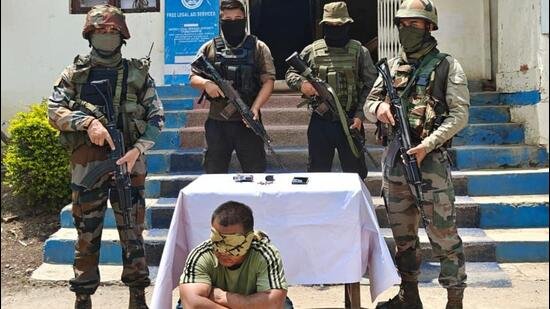
Militants, drug peddlers among nine arrested in Manipur; arms and drugs seized: Police
# Manipur Raids: 9 Arrested, Arms & Drugs Seized
By Staff Reporter, India Security Desk, May 9, 2026
On Saturday, May 9, 2026, joint security forces in Manipur conducted a series of highly coordinated, multi-district raids resulting in the arrest of nine individuals, including suspected militants and active drug peddlers. Acting on precise intelligence inputs, law enforcement units successfully recovered a substantial cache of illicit arms, live ammunition, and commercial quantities of brown sugar. Spanning across several volatile districts, these targeted operations underscore a renewed, aggressive push by authorities to dismantle the deeply entrenched narco-terrorism nexus that has threatened the internal stability of the northeastern state. [Source: Hindustan Times].
## Coordinated Multi-District Crackdown
The comprehensive raids executed over the weekend represent one of the most significant tactical sweeps in Manipur this year. Conducted jointly by the Manipur Police, the Assam Rifles, and specialized anti-narcotics task forces, the operations were the culmination of weeks of digital surveillance and human intelligence gathering. Authorities launched simultaneous search operations in pre-identified vulnerability zones, effectively preventing the suspects from alerting one another or destroying evidence.
According to preliminary briefings from police headquarters, the nine arrested individuals belong to a sophisticated syndicate that bridges underground insurgent outfits with transnational drug trafficking cartels. The simultaneous nature of these multi-district raids highlights a shift in strategy by state security apparatuses—moving away from reactive policing toward proactive, intelligence-driven disruption. This methodology is specifically designed to sever the logistical supply chains that keep illicit regional networks operational.
## Anatomy of the Seizure: Contraband and Ordnance
The material seized during the weekend operations paints a stark picture of the resources at the disposal of local syndicates. While exact quantities are still being cataloged for judicial proceedings, the operational haul included an alarming mix of lethal hardware and highly addictive narcotics.
**Key recoveries reported by the authorities include:**
* **Unlicensed Firearms:** Several sophisticated assault rifles and locally modified semi-automatic weapons.
* **Ammunition:** Hundreds of rounds of live ammunition, alongside tactical gear and communication devices.
* **Narcotics:** Substantial brick-packs of brown sugar, a highly addictive adulterated form of heroin that commands a massive price in regional black markets.
* **Financial Assets:** Significant amounts of unaccounted cash, believed to be the proceeds of recent drug transactions.
The presence of both heavy arms and high-value narcotics in the same operational sweep provides concrete evidence of the operational overlap between drug cartels and armed militant groups. The brown sugar, likely processed in clandestine laboratories hidden in the dense topography of the region, was reportedly packaged for outward distribution to other Indian states. [Source: Hindustan Times | Additional: Regional law enforcement records].
## Deciphering the Narco-Terrorism Nexus
The arrests bring critical attention to the “narco-terrorism” ecosystem that has plagued India’s Northeast. Manipur’s geographic proximity to the infamous Golden Triangle—the borders of Myanmar, Laos, and Thailand—makes it a natural transit route for illicit contraband. However, over the past decade, the state has transitioned from being a mere transit corridor to an active manufacturing hub, particularly for derivatives of illicit poppy cultivation.
Security analysts point out that underground militant factions increasingly rely on the drug trade to finance their operations, purchase arms, and sustain their ranks. “What we are witnessing is the corporatization of insurgency,” notes Dr. Arunav Sharma, a New Delhi-based defense and security analyst specializing in Northeast geopolitics. “Ideological conflicts are increasingly serving as a smokescreen for highly lucrative organized crime. The money generated from brown sugar trafficking directly funds the procurement of the very weapons seized in these raids. Disrupting one inevitably cripples the other.”
The recent instability in neighboring Myanmar has further complicated the security matrix. With weakened state control across the border, insurgent groups and drug cartels have found a permissive environment to scale up their operations, subsequently pushing massive volumes of narcotics across the porous Indo-Myanmar border.
## Contextualizing Manipur’s Post-2023 Security Landscape
To fully grasp the magnitude of Saturday’s raids, one must view them through the lens of Manipur’s recent history. Following the severe ethnic unrest that erupted in May 2023, the state’s law-and-order machinery was stretched to its absolute limits. The socio-political fragmentation provided a fertile breeding ground for opportunistic crime syndicates and rogue militant factions, who capitalized on the distraction of state forces to fortify their trafficking routes.
By early 2026, intensive efforts by both the central and state governments have been directed toward restoring absolute normalcy. A cornerstone of this stabilization strategy has been the uncompromising “War on Drugs” campaign. The government has consistently maintained that lasting peace in the region is impossible without completely uprooting the illegal narcotics economy, which artificially sustains local conflicts and funds illicit arms races among rival factions.
Saturday’s multi-district arrest is a testament to the fact that intelligence networks, which were severely disrupted during the height of the 2023 crisis, have been painstakingly rebuilt and are functioning with high efficacy. [Source: Public security policy records, 2023-2026].
## Technological Upgrades in Border Surveillance
The successful apprehension of the nine suspects was not merely a result of traditional boots-on-the-ground policing. It reflects a massive technological pivot by the Ministry of Home Affairs (MHA) regarding border management. Following the strategic suspension of the Free Movement Regime (FMR) and the initiation of advanced smart-fencing projects along the Myanmar border, authorities have heavily integrated modern surveillance tech into daily operations.
“Our forces are now utilizing thermal imaging drones, AI-driven communications intercepts, and centralized data mapping to predict cartel movements,” explained a senior official from the state internal security department, who wished to remain anonymous. “The syndicates use the difficult terrain to their advantage, moving drugs and weapons on foot through dense jungles. Technology is bridging the gap, allowing us to strike precisely when the contraband reaches the distribution nodes in the districts.”
These technological force multipliers are essential in a state where geographical challenges often hinder rapid response. By tracking the financial footprints and communication signals of suspected peddlers, security forces were able to pinpoint the exact locations of the hideouts raided this weekend.
## The Social Cost: Communities Fighting the Drug Menace
Beyond the geopolitical and security implications, the seizure of brown sugar highlights a tragic, localized epidemic. The spillover of the drug trade has inflicted a heavy toll on the local demographic, with substance abuse rates among the youth of Manipur reaching alarming levels in recent years. The easy availability of brown sugar—often sold in cheap, micro-quantities locally—has devastated countless families across both valley and hill districts.
In response, a parallel civic movement has gained incredible momentum. Mothers’ associations, local youth clubs, and civil society organizations have become vital, albeit unarmed, allies to law enforcement. These community groups frequently conduct neighborhood watches, provide tip-offs to the police, and manage grassroots rehabilitation centers. The weekend arrests are widely viewed as a victory for these local communities, who have long demanded stricter enforcement against the kingpins poisoning their neighborhoods.
Public health advocates emphasize that while arresting armed peddlers is a crucial step, it must be matched with robust healthcare policies. Expanding accessible rehabilitation infrastructure, providing psychological counseling, and creating alternative economic opportunities for vulnerable youth are essential long-term strategies to ensure that the void left by arrested peddlers is not immediately filled by new recruits.
## Conclusion: A Long Road to Enduring Peace
The arrest of nine individuals and the successful seizure of weapons and brown sugar mark a definitive operational success for Manipur’s security forces. It is a clear demonstration that the state apparatus is aggressively dismantling the infrastructure of narco-terrorism that has hindered regional progress.
**Key Takeaways:**
* The integration of local police and central paramilitary forces is yielding actionable, high-impact results against organized crime.
* The undeniable link between drug trafficking and militant financing remains the primary target for long-term state stabilization.
* Continuous vigilance and technological investment at the border are essential to stem the influx of illicit materials from neighboring territories.
Looking ahead, the road to absolute enduring peace in Manipur will require sustained pressure on these syndicates. Occasional raids, while impactful, must evolve into a permanent state of deterrence. Furthermore, addressing the economic root causes that drive individuals into the illicit drug economy will be just as crucial as the kinetic operations launched by security forces. As authorities continue their interrogations of the nine arrested suspects, further raids and strategic dismantling of broader criminal networks are highly anticipated in the coming weeks.





