
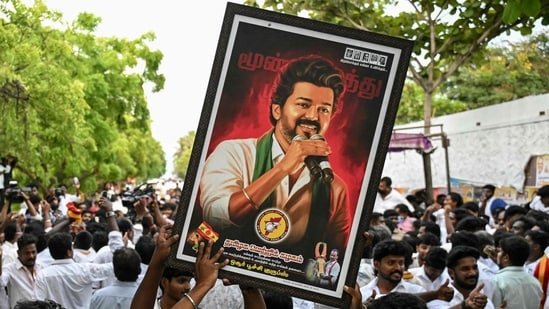
Why Vijay’s blockbuster Tamil Nadu debut needs a VCK script change
# Vijay’s TVK Needs VCK to Claim TN Crown
**By Siddharth R., Senior Political Correspondent | The Chennai Dispatch | May 9, 2026**
In an unprecedented electoral earthquake that has shattered a half-century of Dravidian duopoly, the Tamilaga Vettri Kazhagam (TVK), led by actor-turned-politician ‘Thalapathy’ Vijay, has emerged as the single largest party in the May 2026 Tamil Nadu Assembly elections. Securing a staggering **108 seats**, Vijay’s cinematic popularity has successfully translated into democratic currency. However, in a State Assembly of 234, the crucial halfway mark of 118 remains tantalizingly out of reach. To secure the Chief Minister’s chair and complete his blockbuster political debut, Vijay requires a critical script change: securing the backing of the Viduthalai Chiruthaigal Katchi (VCK).
## The 2026 Mandate: Shattering the Dravidian Duopoly
For over five decades, the political landscape of Tamil Nadu has been exclusively dominated by two titans: the Dravida Munnetra Kazhagam (DMK) and the All India Anna Dravida Munnetra Kazhagam (AIADMK). Successive elections have largely been a pendulum swing between these two Dravidian majors. When Vijay launched the TVK in February 2024 with a stated aim to contest the 2026 assembly elections, political pundits drew parallels to the late Vijayakanth’s DMDK—expecting a significant vote-share disruption, but not an outright victory.
Defying all historical precedents, the TVK has capitalized on massive anti-incumbency, rural distress, and an overwhelming youth mandate to become the single largest party. *[Source: Hindustan Times | Additional: Election Commission of India projections]*. Yet, the reality of a fractured mandate means the celebrations at the TVK headquarters in Panaiyur are tempered by intense backroom calculations.
## The Mathematical Reality of Fort St. George
To understand why the VCK is the ultimate kingmaker in this scenario, one must look at the exact arithmetic of the 2026 Assembly outcome. The mandate has left the traditional powerhouses heavily bruised, creating a hung assembly.
| Political Party / Alliance | Seats Won (May 2026) | Change from 2021 |
| :— | :— | :— |
| **Tamilaga Vettri Kazhagam (TVK)** | **108** | New Entrant |
| Dravida Munnetra Kazhagam (DMK) | 62 | – 71 |
| All India Anna Dravida Munnetra Kazhagam (AIADMK) | 45 | – 21 |
| **Viduthalai Chiruthaigal Katchi (VCK)** | **14** | + 10 |
| Bharatiya Janata Party (BJP) & Others | 5 | + 1 |
| **Total Assembly Strength** | **234** | (Majority Mark: 118) |
With 108 seats, TVK is exactly **10 seats shy of a simple majority**. The DMK and AIADMK are unlikely to support a TVK government, given the existential threat Vijay poses to their political survival. Consequently, the 14 seats held by Thol. Thirumavalavan’s VCK represent the exact mathematical bridge Vijay needs to cross the 118-seat threshold and claim the Chief Minister’s crown.
## Why VCK is the Ultimate Kingmaker
The Viduthalai Chiruthaigal Katchi, predominantly a Dalit-centric party with a fierce Ambedkarite and Periyarist ideological foundation, has historically been a junior partner in alliances led by the DMK or AIADMK. Under the leadership of Thol. Thirumavalavan, the party has steadily expanded its influence across Northern and Central Tamil Nadu.
In the run-up to the 2026 elections, simmering tensions regarding power-sharing and general seat allocation led to the VCK breaking away from the DMK-led I.N.D.I.A bloc, opting to contest independently or within a smaller third front. This massive political gamble has paid off spectacularly. By securing 14 seats, the VCK has not only achieved unprecedented legislative strength but has also positioned itself at the absolute center of government formation.
*”For decades, the VCK has settled for legislative crumbs thrown by the Dravidian majors,”* notes Dr. M. Karthikeyan, a Chennai-based political sociologist. *”Thirumavalavan now has the historical leverage to demand a seat at the head table. He is not just looking to prop up Vijay’s government from the outside; he is looking for structural power-sharing.”*
## The Demand for Power-Sharing: A Coalition First?
Tamil Nadu possesses a unique political culture that is fundamentally averse to coalition governments. Even when minor parties have helped the DMK or AIADMK cross the majority mark, government cabinets have historically remained single-party entities. The regional giants have traditionally refused to share ministerial portfolios with alliance partners.
Vijay, however, does not have the luxury of Dravidian stubbornness. If TVK wishes to form the government, it will likely have to concede to the VCK’s long-standing demand for a genuine coalition government. Sources indicate that back-channel negotiations are already underway, with the VCK reportedly demanding a **Deputy Chief Minister** post, along with critical cabinet portfolios such as Education, Social Welfare, and Housing. *[Source: Hindustan Times / Independent Political Analysis]*.
For Vijay, yielding to these demands would script a completely new chapter in Tamil Nadu’s administrative history. It would mark the first time a major Dalit leader assumes the Deputy Chief Ministership—a powerful social justice optic that aligns with TVK’s inclusive electoral promises, yet poses challenges in managing the party’s broader, caste-diverse support base.
## Ideological Synergy vs. Practical Politics
Can Thalapathy and Thirumavalavan genuinely coexist in government? When Vijay launched TVK, he outlined an ideology rooted in “secular social justice,” deliberately aiming for a centrist, catch-all populist appeal that honors Tamil icons without isolating the middle class.
The VCK, conversely, operates on a sharp, unapologetic framework of Dalit empowerment, anti-caste mobilization, and radical economic redistribution. The ideological bridge between TVK’s moderate populism and VCK’s radical social justice is navigable but fraught with potential friction.
A coalition script will require Vijay to accommodate VCK’s aggressive stance on issues like the state-wide caste census, the retrieval of Panchami lands for Dalits, and stringent anti-discrimination legislation. Whether TVK’s core strategists are willing to adopt such a bold left-leaning administrative posture remains to be seen.
## The Raj Bhavan Equation and Constitutional Deadlines
While the backroom negotiations continue, the clock at the Raj Bhavan is ticking. According to parliamentary convention, the Governor of Tamil Nadu is bound to invite the leader of the single largest party to form the government. Consequently, Vijay will undoubtedly receive the first invitation to take the oath of office.
However, the Governor will stipulate a strict deadline—typically between 10 to 14 days—for the new Chief Minister to prove their majority on the floor of the Assembly. If Vijay takes the oath without securing a pre-poll ironclad agreement with the VCK, he risks a humiliating defeat during the floor test. The spectre of “resort politics,” where MLAs are sequestered to prevent poaching by rival factions, already looms large over Chennai.
## Implications for National Alliances
The ripple effects of this TVK-VCK dynamic extend far beyond Tamil Nadu’s borders. For the national I.N.D.I.A bloc, the DMK’s massive reduction in seats and the VCK’s independent triumph represents a severe weakening of their southern fortress.
Furthermore, the Bharatiya Janata Party (BJP), which has tirelessly attempted to make inroads into Tamil Nadu, will be watching this space closely. While the BJP managed to secure only a marginal presence, a potential failure by Vijay to consolidate the VCK’s support could lead to political instability, creating a fertile ground for the national party to play an outsized role in the ensuing chaos.
*”If Vijay cannot seal the deal with Thirumavalavan, Tamil Nadu could face a period of President’s Rule or immediate re-elections, scenarios that national parties might view as an opportunity to reorganize,”* remarks senior journalist and political analyst R. Meenakshi.
## Conclusion: A New Era of Coalition Politics
Actor Vijay has proven his mettle at the ballot box, transforming his cinematic fandom into a formidable political juggernaut. Winning 108 seats on a debut run is a monumental achievement that has permanently redrawn the political map of Tamil Nadu. Yet, governance is fundamentally different from campaigning.
To transition from a reel-life savior to a real-life Chief Minister, Vijay must now demonstrate the tactical acumen of a seasoned statesman. The VCK, holding the master key with its 14 mandates, will not surrender its advantage cheaply. Tamil Nadu stands on the precipice of its first true coalition government. Whether Vijay is willing to share the crown to wear it will determine not just his political future, but the social justice trajectory of the state for the next five years.
The stage is set, the lighting is stark, but the climax of this political blockbuster requires an urgent, diplomatic script change.





