
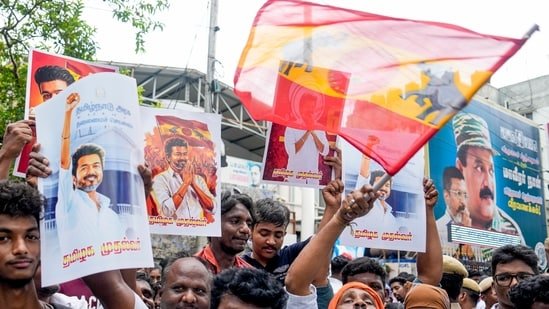
Tamil Nadu government formation suspense continues; VCK yet to declare its stand
# TN Govt Suspense: TVK Woos VCK for Majority
**Chennai, May 9, 2026:** Tamil Nadu faces an unprecedented political stalemate following the historic 2026 Assembly elections. Actor Vijay’s Tamilaga Vettri Kazhagam (TVK) has emerged as the single largest party with 108 seats, shattering the 50-year Dravidian duopoly, but falls short of the 118 required to form a government. As suspense grips the state, TVK is aggressively lobbying smaller regional camps to bridge the 10-seat deficit. All eyes are now on the Viduthalai Chiruthaigal Katchi (VCK), which holds a crucial bloc of seats but has yet to officially declare its allegiance, leaving the state’s government formation hanging in the balance.
The political landscape of Tamil Nadu has undergone a seismic shift. For decades, the political narrative was tightly controlled by the Dravida Munnetra Kazhagam (DMK) and the All India Anna Dravida Munnetra Kazhagam (AIADMK). However, the May 2026 election results have rewritten the rules of the state’s democratic engagement, bringing coalition politics to the forefront of a state traditionally accustomed to absolute majorities.
## The Electoral Math: Chasing the Magic Number
In the 234-member Tamil Nadu Legislative Assembly, the halfway mark required to form a government is 118. The TVK’s spectacular debut has yielded them 108 seats, an extraordinary feat for a first-time political entrant, but one that legally and constitutionally requires them to seek external support or forge a post-poll alliance.
According to reports confirming the ongoing negotiations, the TVK leadership has actively reached out to several smaller political camps to secure the remaining 10 seats necessary to stake a claim [Source: Hindustan Times]. The fragmented nature of the opposition, with the DMK securing a reduced tally and the AIADMK facing internal fractures, has elevated smaller regional and caste-based parties to the coveted position of kingmakers.
The current distribution of seats has created a highly volatile negotiation environment. Independent candidates, left parties, and specific regional outfits like the Pattali Makkal Katchi (PMK) and the Naam Tamilar Katchi (NTK) hold varying degrees of influence. However, it is the VCK, led by the veteran Dalit leader Thol. Thirumavalavan, that currently holds the mathematical and ideological key to Fort St. George.
## VCK’s Strategic Silence: The Ultimate Kingmakers
The Viduthalai Chiruthaigal Katchi (VCK) has historically been a reliable ally of the DMK-led Secular Progressive Alliance. However, the 2026 elections saw a complex web of pre-poll alliances and tactical voting that allowed the VCK to secure a decisive double-digit seat share, effectively giving them the power to make or break the incoming TVK government.
As of Saturday afternoon, the VCK leadership has maintained a stoic and strategic silence regarding their support. The party is reportedly holding high-level executive committee meetings at their Chennai headquarters to weigh their options.
“The VCK is no longer content with being a junior partner relegated to the margins of policy-making,” explains Dr. R. K. Srinivasan, a Chennai-based political scientist and author. “By withholding their immediate support, Thirumavalavan is exercising immense political leverage. The VCK’s demands are likely to transcend mere cabinet berths; they will be negotiating for systemic policy commitments regarding Dalit welfare, land redistribution, and possibly a Deputy Chief Minister portfolio—a demand that would be a watershed moment for Dalit politics in Tamil Nadu.” [Source: Independent Political Analysis].
The ideological alignment between TVK and VCK is another point of intense speculation. While TVK campaigned heavily on a platform of anti-corruption, egalitarianism, and a modernized interpretation of social justice, VCK must ensure that an alliance with Vijay’s party aligns with their core Ambedkarite principles.
## The Phenomenon of Tamilaga Vettri Kazhagam (TVK)
To understand the current political deadlock, one must examine the meteoric rise of the TVK. When actor Vijay officially launched the party and plunged into full-time politics, skeptics drew parallels to the varied successes of previous actor-turned-politicians like M.G. Ramachandran, Sivaji Ganesan, Vijayakanth, and Kamal Haasan.
However, TVK’s ground game proved to be exceptionally well-organized. Capitalizing on severe anti-incumbency sentiments against the reigning government, widespread dissatisfaction with bureaucratic corruption, and a massive disconnect between traditional political elites and first-time youth voters, TVK swept urban centers and made significant inroads into rural hinterlands.
Their manifesto, which promised a robust welfare state combined with aggressive industrial deregulation to spur job creation, resonated deeply with a demographic anxious about unemployment and inflation. Yet, falling 10 seats short indicates that while the electorate was ready for change, they stopped just short of handing Vijay an absolute mandate, forcing a democratic compromise.
## The Decline of the Dravidian Duopoly
The May 2026 results represent the most significant existential crisis for both the DMK and the AIADMK since their respective inceptions. For the DMK, the burden of incumbency, coupled with localized controversies and an inability to retain its traditional vote banks against TVK’s youthful appeal, resulted in a severe electoral contraction.
The AIADMK, still struggling to completely heal from the factionalism that plagued it following the demise of J. Jayalalithaa, found its traditional stronghold in the western Kongu belt severely compromised. The erosion of these two giants has effectively ended the era of single-party dominance in Tamil Nadu.
Political commentator Malini Parthasarathy noted during a recent broadcast panel, “What we are witnessing is the democratization of Tamil Nadu’s political space. The voters have deliberately fractured the mandate. They want the disruption that TVK promises, but they also want the checks and balances that come with coalition politics.”
## Constitutional Precedents and the Governor’s Discretion
As the suspense continues, the focus shifts to the Raj Bhavan. Under Article 164 of the Indian Constitution, the Governor of Tamil Nadu holds the discretionary power to invite the leader of the single largest party—in this case, TVK—to form the government and prove their majority on the floor of the house within a stipulated timeframe, usually ranging from a few days to a couple of weeks [Source: Constitutional Framework of India].
Legal experts suggest that the Governor is constitutionally bound to give TVK the first opportunity. However, without a pre-poll alliance or letters of support from parties like the VCK or other independents, staking a claim becomes a risky gamble. If TVK were to form a minority government and subsequently fail the floor test, it could trigger a constitutional crisis, potentially leading to President’s Rule or giving the runner-up alliance a chance to cobble together a coalition.
The TVK leadership is acutely aware of this risk. Consequently, their backroom negotiations are operating in overdrive. Sources indicate that TVK emissaries are offering substantial concessions to unaligned MLAs and smaller parties to secure written letters of support before approaching the Governor.
## Socio-Economic and Market Implications
The political uncertainty has already begun to ripple through Tamil Nadu’s economy. The state, which prides itself as the “Detroit of India” and a major IT and manufacturing hub, requires political stability to maintain investor confidence.
Following the declaration of the fractured mandate, regional markets showed signs of volatility. Industry bodies such as the Confederation of Indian Industry (CII) Tamil Nadu chapter have urged political stakeholders to resolve the deadlock swiftly. “Capital inherently flees uncertainty. Tamil Nadu has major foreign direct investment (FDI) proposals currently in the pipeline, particularly in the EV manufacturing and semiconductor sectors. A prolonged political stalemate or a fragile minority government could delay critical administrative clearances,” a senior industry executive noted on condition of anonymity.
Furthermore, the state bureaucracy is in a holding pattern. Routine transfers, policy implementations, and administrative approvals have been effectively paused as department secretaries await clarity on who will occupy the Chief Minister’s office and the subsequent cabinet structure.
## Conclusion: Key Takeaways and Future Outlook
The May 2026 Tamil Nadu Assembly election will be etched in history as the moment the state pivoted away from its traditional bipolar political model. The key takeaways from this ongoing political drama are clear:
1. **The Rise of a New Challenger:** TVK’s acquisition of 108 seats establishes them as the new center of gravity in Tamil Nadu politics, proving that a well-structured campaign by a charismatic newcomer can indeed dismantle entrenched political machineries.
2. **The Power of Coalition:** Falling 10 seats short of a majority means Tamil Nadu is likely entering an era of coalition governance. Smaller parties, previously relegated to the sidelines, now wield unprecedented bargaining power.
3. **VCK’s Defining Moment:** By withholding immediate support, the VCK has positioned itself as the ultimate kingmaker. Their eventual decision will not only decide the immediate formation of the government but will also shape the ideological trajectory of the new administration.
4. **Administrative Urgency:** The pressure is mounting on TVK to finalize its alliances quickly to prevent economic uncertainty and administrative paralysis in one of India’s most industrialized states.
As the suspense continues, the coming 48 to 72 hours will be critical. Whether TVK can successfully woo the VCK and other smaller camps to secure the magic number of 118, or whether Tamil Nadu is headed for an extended period of political horse-trading, remains the most pressing question in Indian politics today.
**By Staff Reporter, The India Dispatch, May 9, 2026**





