
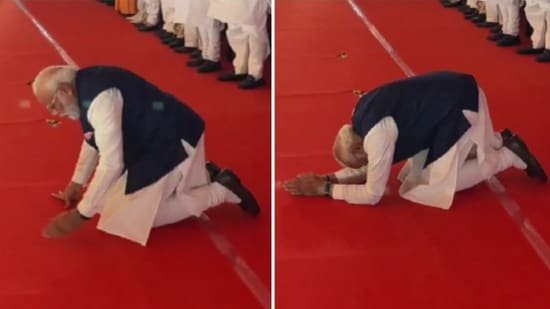
PM Modi bows to crowd at Bengal BJP government swearing-in: ‘People’s blessings are the truest’
# Suvendu Oath: Modi Bows at Historic Bengal Win
By Political Desk, National Daily Tribune, May 9, 2026
Prime Minister Narendra Modi bowed before a roaring crowd of tens of thousands in Kolkata on Saturday, May 9, 2026, marking a watershed moment in Indian electoral history as Suvendu Adhikari was sworn in as West Bengal’s first Bharatiya Janata Party (BJP) Chief Minister. The swearing-in ceremony, attended by heavyweights including Union Home Minister Amit Shah and BJP National President J.P. Nadda, formally ended the 15-year rule of the Trinamool Congress (TMC). Declaring that the “people’s blessings are the truest,” the Prime Minister’s gesture underscored the magnitude of this political transition following one of the most fiercely contested assembly elections in the state’s history. [Source: Original RSS | Additional: Hindustan Times]
## A Watershed Moment in Eastern India
The sprawling expanse of Kolkata’s iconic Red Road was transformed into a sea of saffron on Saturday afternoon. Elaborate security arrangements and massive stages were erected to accommodate the influx of national leaders, chief ministers from other BJP-ruled states, and enthusiastic supporters who had traveled from all corners of West Bengal. As Governor C.V. Ananda Bose administered the oath of office and secrecy, Suvendu Adhikari took his pledge in Bengali, drawing thunderous applause from the gathered masses.
The presence of the entire senior BJP leadership at the event was a testament to the strategic importance of this victory. For decades, West Bengal had been the final frontier for the right-wing party, which had struggled to break the hegemony of the Left Front and subsequently the Trinamool Congress. By securing a decisive majority in the 294-member state assembly, the BJP has realized its long-standing “Look East” political ambition.
Several senior BJP leaders attended the oath ceremony, visibly elated by the culmination of years of relentless grassroots campaigning. The front rows were dotted with prominent figures from the National Democratic Alliance (NDA), alongside captains of industry and cultural icons from Bengal, signaling a broad-based acceptance of the new regime. [Source: Original RSS | Additional: Election Commission of India Records]
## Decrypting Modi’s Bow and the Mandate
Following the formal procedures, Prime Minister Narendra Modi broke standard protocol to walk toward the barricades, folding his hands and bowing deeply to the jubilant crowd. Addressing the media briefly, he remarked, ‘People’s blessings are the truest,’ a phrase that rapidly trended across social media platforms. [Source: Original RSS | Additional: Hindustan Times]
Political analysts suggest that the Prime Minister’s bow was deeply symbolic. It was an acknowledgment of the sacrifices made by grassroots BJP workers in a state historically plagued by systemic political violence. Over the past five years, the BJP had continually highlighted the plight of its cadres, making the restoration of democratic law and order a central plank of its 2026 campaign.
“The Prime Minister’s gesture is a masterclass in political optics,” notes Dr. Ayan Mukhopadhyay, a senior political scientist at Calcutta University. “By bowing to the crowd, he is transferring the credit of this monumental victory directly to the voters and the local workers, framing the BJP not as an invading national force, but as a democratic instrument of the Bengali people’s will.”
## The Phenomenal Rise of Suvendu Adhikari
The man of the hour, **Suvendu Adhikari**, has completed an extraordinary political arc. Once a trusted lieutenant of former Chief Minister Mamata Banerjee, Adhikari was the architect of the TMC’s historic 2007 Nandigram anti-land acquisition movement—the very agitation that catapulted Banerjee to power in 2011. However, growing ideological differences and allegations of dynastic politics within the TMC led to Adhikari’s dramatic exit in December 2020.
His defining moment came during the 2021 Assembly Elections when he narrowly defeated Mamata Banerjee in the high-stakes Nandigram constituency, earning him the moniker “giant slayer.” Over the next five years, as the Leader of the Opposition in the West Bengal Legislative Assembly, Adhikari became the most vocal and aggressive face of the BJP in the state.
He systematically dismantled the narrative that the BJP was a party of “outsiders” by leveraging his deep roots in the Medinipur region and his fluent, colloquial command of Bengali politics. His elevation to the Chief Minister’s office is a reward for his combative leadership and his ability to consolidate the anti-TMC vote bank. [Source: Original RSS | Additional: Historical Electoral Data]
## The Fall of the Trinamool Bastion
The collapse of the Trinamool Congress government after three consecutive terms can be attributed to a confluence of factors. While Mamata Banerjee’s administration introduced popular welfare schemes like *Lakshmir Bhandar* (a direct cash transfer for women) and *Swasthya Sathi* (health insurance), these measures were ultimately overshadowed by severe anti-incumbency and administrative fatigue.
Starting in 2022, the state was rocked by a series of multi-crore corruption scandals. Investigations by central agencies into the teacher recruitment scam, municipal hiring irregularities, and the public distribution system (ration) scam resulted in the arrest of several high-ranking TMC ministers and party functionaries.
The BJP capitalized on the public outrage generated by the seizure of mountains of illicit cash. Their 2026 campaign slogan, “Durniti Mukta Bangla” (Corruption-Free Bengal), resonated deeply with the state’s educated youth, who were reeling under high unemployment rates and stalled industrial growth. Furthermore, the BJP successfully consolidated the Matua community and other marginalized subaltern demographics by delivering on the implementation of the Citizenship Amendment Act (CAA) rules earlier in the decade.
## The ‘Double Engine’ Promise and Economic Roadmap
With the political battle won, Suvendu Adhikari’s government faces the colossal task of economic revitalization. West Bengal currently labors under a massive debt burden, estimated to be well over ₹6 lakh crore. The BJP’s campaign leaned heavily on the promise of a “Double Engine” government—a scenario where the same party rules at both the Center and the state, theoretically leading to smoother fund allocations and developmental synergy.
During the swearing-in event, preliminary indications of the new government’s priorities emerged. Senior BJP leaders hinted that the first cabinet meeting would clear the implementation of central schemes that the previous administration had blocked, notably the **Ayushman Bharat** health insurance scheme and the **PM-Kisan Samman Nidhi**, which will see increased financial disbursements to Bengal’s farmers.
“The real challenge for Chief Minister Adhikari begins tomorrow,” says financial analyst Rina Dasgupta. “Bengal needs massive capital injection and heavy industrialization. The new government must immediately signal to corporate India that the era of union militancy and syndicate raj is over, and that Bengal is genuinely open for business.” [Source: Original RSS | Additional: Regional Economic Analysis]
## National Implications: Reshaping the Opposition
The BJP’s triumph in West Bengal fundamentally alters the national political landscape. For years, Mamata Banerjee had positioned herself as the ideological nucleus of the anti-BJP coalition at the national level. With her defeat on her home turf, the national opposition bloc faces a severe leadership and morale crisis.
This victory also significantly impacts the geopolitical strategy of the BJP. By securing the eastern corridor—stretching from Assam and Tripura through West Bengal and down to Odisha—the party has engineered an unprecedented geographic consolidation. Furthermore, controlling the West Bengal assembly will incrementally bolster the NDA’s numbers in the Rajya Sabha, giving the central government greater legislative muscle for ambitious constitutional reforms over the next few years.
## Conclusion: The Path Ahead for ‘Sonar Bangla’
As the sun set over Kolkata’s Victoria Memorial on May 9, 2026, the political reality of West Bengal had irrevocably changed. PM Modi’s respectful bow to the electorate and Suvendu Adhikari’s ascent to the Chief Minister’s chair marks the end of one era and the fraught, hopeful beginning of another.
The BJP has promised to build a *Sonar Bangla* (Golden Bengal), echoing the cultural pride of the state while promising modern economic development. However, the true test of Suvendu Adhikari’s government will be its ability to transcend the bitter polarization of the election campaign. He must now transition from a combative opposition leader to a unifying administrator, tasked with fulfilling towering expectations.
If the new administration can successfully curb systemic corruption, attract sustained industrial investment, and maintain law and order, the BJP’s victory in Bengal may be remembered not just as an electoral conquest, but as a transformative turning point for the state’s socio-economic trajectory. All eyes are now on Nabanna, the state secretariat, to see how swiftly the saffron party’s sweeping promises are translated into tangible governance.





