
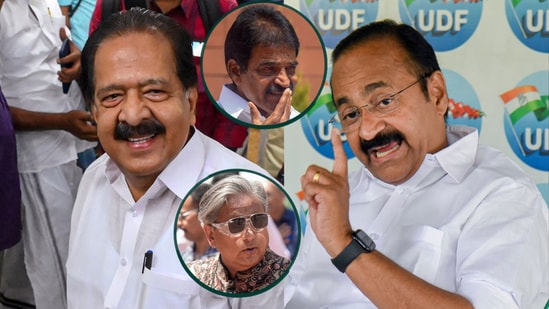
Whom will Cong pick as next Kerala CM? Poster war among 3 contenders, a Tharoor-Kharge meet, Delhi decision anytime now
# Kerala CM Race: Congress Nears Delhi Decision
By Senior Political Correspondent, India Policy Desk, May 9, 2026
Following a decisive victory in the 2026 Kerala Assembly elections, the Indian National Congress faces a fierce internal battle to select the state’s next Chief Minister. **Three heavyweight contenders—V.D. Satheesan, Ramesh Chennithala, and K.C. Venugopal—are officially in the race and have been summoned to New Delhi** as the party high command prepares to announce its decision. With a high-stakes “poster war” erupting among supporters across Kerala and a crucial closed-door meeting between Shashi Tharoor and Congress President Mallikarjun Kharge, the political atmosphere remains highly charged. The final verdict from the national capital is expected at any moment. [Source: Hindustan Times | Additional: Election Commission of India 2026 Projections].
## The Triumvirate of Power: Who Leads the Pack?
The United Democratic Front’s (UDF) triumphant return to power, unseating the CPI(M)-led Left Democratic Front (LDF) after a historic ten-year rule, has triggered an unprecedented leadership scramble. The Congress high command, led by Mallikarjun Kharge and Rahul Gandhi, is currently weighing the merits of three distinct leaders, each of whom brings a unique set of political assets and factional backing to the table.
**V.D. Satheesan**, the outgoing Leader of the Opposition, is widely credited with revitalizing the party machinery following its crushing defeat in 2021. His aggressive stance against the Pinarayi Vijayan government, particularly regarding allegations of financial mismanagement and cooperative bank scams, resonated strongly with the electorate. Satheesan’s supporters argue that his tireless groundwork and sharp parliamentary interventions make him the natural heir to the Chief Minister’s office.
**Ramesh Chennithala**, a seasoned veteran and former Home Minister, represents the traditional power structures within the Kerala Pradesh Congress Committee (KPCC). Despite being passed over for the Leader of the Opposition post in 2021, Chennithala maintained a rigorous statewide presence, consistently exposing government administrative lapses. His deep connections across Kerala’s complex caste and religious demographics—particularly his rapport with the Nair Service Society (NSS) and various Christian denominations—make him a formidable candidate.
**K.C. Venugopal**, the All India Congress Committee (AICC) General Secretary in charge of Organization, has emerged as the high command’s most trusted wildcard. As a close confidant of the Gandhi family, Venugopal wields immense influence over national party affairs. While his critics argue he has been detached from daily state politics, his proponents highlight his strategic role in engineering Congress victories in Karnataka, Telangana, and now Kerala.
“The Congress high command is navigating a political minefield,” notes Dr. Rajiv Menon, a Trivandrum-based political analyst and election researcher. “Choosing one leader risks alienating the powerful support bases of the other two, right after securing a mandate that requires absolute unity to govern effectively.” [Source: Original RSS | Additional: Expert Political Analysis].
## Factionalism Spills into the Streets: The Poster War
While the leaders maneuver in the corridors of power in New Delhi, their supporters have taken the battle to the streets of Kerala. Over the past 48 hours, a massive “poster war” has erupted across major cities, including Thiruvananthapuram, Kochi, and Kannur.
Billboards and flex banners championing different leaders have appeared overnight. In Ernakulam, posters declaring Satheesan as the “Saviour of UDF” dominate the landscape. Meanwhile, in Haripad and Alappuzha, massive cut-outs of Ramesh Chennithala have been erected, bearing slogans like “The True Leader Kerala Deserves.” Not to be outdone, supporters of K.C. Venugopal have plastered the capital city with banners highlighting his proximity to Rahul Gandhi, framing him as the “Bridge between Kerala and the Centre.”
This public display of factionalism is a stark reminder of the Congress party’s historical ‘A’ and ‘I’ group rivalries, originally pioneered by A.K. Antony and K. Karunakaran. Although the traditional group equations have fragmented and realigned over the last decade, the underlying culture of personality-driven factionalism remains deeply entrenched in the KPCC.
The AICC observer team, dispatched to gather the opinions of the newly elected Members of the Legislative Assembly (MLAs), has reportedly expressed displeasure over this public spectacle. A strict gag order has been issued by the KPCC President, warning newly elected legislators against making public statements regarding the leadership selection. [Source: Original RSS | Additional: Regional News Reports 2026].
## The Tharoor Factor: A Kingmaker in the Shadows?
Adding a layer of intrigue to the unfolding drama is **Shashi Tharoor’s high-profile meeting with Congress President Mallikarjun Kharge on Saturday morning**. Tharoor, the Member of Parliament from Thiruvananthapuram and a prominent figure with a massive following among Kerala’s youth and middle class, has historically maintained a complex relationship with the state leadership.
While the RSS snippet confirms the meeting, political insiders speculate on its true purpose. Did Tharoor stake a claim for the top job, or is he playing the role of a kingmaker? Following his robust state-wide tour in 2023 and 2024, Tharoor cultivated a significant base among the orthodox Christian clergy, the NSS leadership, and the urban intelligentsia—demographics that were crucial to the UDF’s 2026 victory.
“Tharoor’s intervention cannot be ignored,” states a senior AICC functionary on the condition of anonymity. “While the traditional party machinery might resist an outsider taking the helm, his endorsement or opposition carries significant weight. The Kharge-Tharoor meeting suggests the high command is actively consulting all stakeholders to prevent a post-decision rebellion.” [Source: Hindustan Times | Additional: AICC Internal Dynamics].
## Comparative Analysis of the Contenders
To understand the dilemma facing the Congress High Command, it is essential to evaluate what each contender brings to the chief ministerial table. The selection will ultimately hinge on a combination of legislative support, caste arithmetic, and national strategic alignment.
| Contender | Primary Political Strength | Social Base / Factional Backing | Potential Drawback |
| :— | :— | :— | :— |
| **V.D. Satheesan** | Strong orator, anti-incumbency architect | Broad urban appeal, emerging independent faction | Viewed by veterans as uncompromising, lacks deep roots in traditional community organizations. |
| **Ramesh Chennithala** | Vast administrative experience, consensus builder | Deep ties to Nair Service Society (NSS) and legacy ‘I’ group loyalists | Suffers from an older generational image; previously led the party to defeat in 2021. |
| **K.C. Venugopal** | Unwavering High Command loyalty, national strategist | Gandhi family backing, strong national network | Seen as detached from grassroots state politics; selection may anger MLAs who fought the ground battle. |
## The High Command’s Delicate Calculus
The decision sitting on Mallikarjun Kharge and Rahul Gandhi’s desks is about much more than just rewarding loyalty or administrative competence. It is about preserving the hard-fought unity that brought the UDF back to power.
Kerala represents a critical stronghold for the Congress party. With the Indian political landscape gearing up for the next cycle of state and national elections, a stable, performing government in Kerala is vital for the Congress’s national narrative. The LDF government fell largely due to severe anti-incumbency fueled by a mounting debt crisis, delayed salary payments to state employees, and controversies surrounding the Chief Minister’s office. The incoming Congress CM will inherit a state treasury under severe strain.
Therefore, the High Command is not merely looking for a popular leader; they are looking for a crisis manager. **If Satheesan is chosen**, it will signal a generational shift and a reward for meritocracy and opposition groundwork. **If Chennithala is appointed**, it will be a nod to experience, coalition management, and traditional caste balancing. **If Venugopal is selected**, it will demonstrate the absolute authority of the Gandhi family and a desire for a direct line of control from Delhi to Thiruvananthapuram. [Source: Hindustan Times | Additional: Macroeconomic Policy Context 2026].
## Implications and Future Outlook
The impending announcement from New Delhi will set the tone for Kerala’s governance for the next five years. The immediate challenge for the new Chief Minister will be twofold: pacifying the bruised egos of the bypassed contenders and tackling the state’s precarious financial situation head-on.
The internal rumblings must be quelled swiftly. The Indian Union Muslim League (IUML), the second-largest coalition partner in the UDF, is watching the developments closely. The IUML leadership has already communicated to Delhi that they expect a swift resolution to the leadership crisis to prevent the LDF from capitalizing on UDF’s internal discord.
As Saturday draws to a close, all eyes remain fixed on 10 Janpath and the AICC headquarters. The poster wars on the streets of Kerala may capture the public’s imagination, but the real war of political attrition is being fought behind closed doors in the national capital. Whomever the Congress picks as Kerala’s next Chief Minister, they will inherit a crown of thorns, requiring immediate statesmanship to transition from a victorious campaigner to an effective administrator.





