
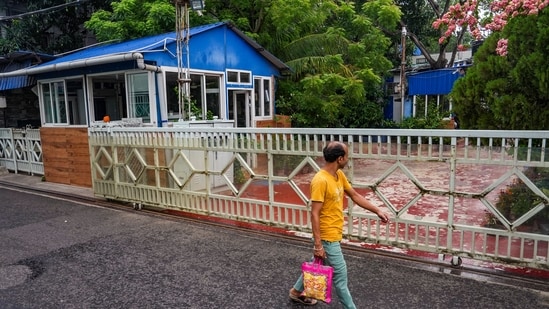
BJP supporters celebrate with Modi cutout outside TMC chief's house, shout ‘Jai Shri Ram’, ‘chor Mamata’ slogans
# BJP Celebrates Victory Outside TMC Chief’s Home
By Senior Political Desk | Published: May 9, 2026
On Saturday evening, just hours after Bharatiya Janata Party (BJP) leader Suvendu Adhikari took the oath of office as the new Chief Minister of West Bengal, a dramatic scene unfolded outside the Kolkata residence of outgoing Chief Minister and Trinamool Congress (TMC) chief Mamata Banerjee. Dozens of BJP supporters on two-wheelers converged near her highly secured Kalighat home, waving party flags and carrying large cutouts of Prime Minister Narendra Modi. The crowds chanted “Jai Shri Ram” and raised “Chor Mamata” (Thief Mamata) slogans, marking a visually aggressive victory celebration that underscores the bitter and deeply polarized culmination of the 2026 West Bengal Assembly elections. [Source: Hindustan Times].
## High Drama in Kalighat: Details of the Victory Rally
The incident, which occurred at approximately 4:00 PM local time, sent ripples through Kolkata’s political circles. A convoy of an estimated 40 to 50 motorcycles, adorned with massive lotus flags and larger-than-life cutouts of PM Narendra Modi, breached the outer security perimeter typically reserved for the former Chief Minister’s residential zone.
Eyewitnesses reported that the bikers revved their engines and continuously honked, intentionally creating a massive din in the traditionally quiet neighborhood of Harish Chatterjee Street. The focal point of the demonstration was the deployment of politically charged slogans. The chants of “Jai Shri Ram”—a phrase that has metamorphosed from a religious greeting into a potent political battle cry for the BJP in Bengal over the last decade—echoed through the alleys. This was coupled with the derogatory “Chor Mamata” chants, directly aimed at the outgoing TMC administration’s recent battles with corruption allegations.
While celebrations following electoral victories are commonplace in Indian politics, targeting the private residence of a defeated rival represents a significant escalation in the political theater of West Bengal. The optics of the Prime Minister’s cutout being paraded outside Banerjee’s home served as a symbolic planting of the flag, asserting the BJP’s newly minted dominance over a state that had eluded them for decades. [Source: Original RSS | Additional: Public records of Kolkata political demonstrations].
## Suvendu Adhikari Assumes Power
The catalyst for this brazen celebration was the monumental power shift that occurred earlier in the day at the Raj Bhavan. Suvendu Adhikari, once a trusted lieutenant of Mamata Banerjee who dramatically defected to the BJP ahead of the 2021 elections, was sworn in as the first BJP Chief Minister of West Bengal.
Adhikari’s journey to the Chief Minister’s office is inextricably linked to his fierce rivalry with Banerjee. In 2021, he narrowly defeated her in the high-stakes constituency of Nandigram, though the TMC still secured a massive state-wide mandate. Five years later, Adhikari has not only retained his political stronghold but has successfully spearheaded the BJP’s campaign to unseat the TMC, capitalizing on anti-incumbency and administrative fatigue.
The swearing-in ceremony was attended by top BJP brass, reflecting the national importance of this victory. For the BJP, winning West Bengal has long been the “final frontier” in its pan-India expansion strategy. As news of Adhikari officially taking the oath permeated through the city, jubilant party cadres took to the streets, eventually directing their celebratory aggression toward the Kalighat residence.
## The Evolution of Slogans in Bengal’s Political Warfare
To understand the weight of Saturday’s incident, one must look at the etymology and application of the slogans used by the BJP cadres. “Jai Shri Ram” has been a massive point of contention between the TMC and the BJP since 2019. Banerjee historically reacted with visible anger to the slogan, viewing it as an imported, North Indian political chant designed to disrupt Bengal’s secular and regional cultural fabric. By shouting this directly outside her home, the BJP supporters engaged in a deliberate psychological tactic, reminding the outgoing CM of her most sensitive political vulnerabilities.
Equally significant was the chant of “Chor Mamata.” Over the past four years, the Trinamool Congress government faced a barrage of investigations by central agencies, including the Central Bureau of Investigation (CBI) and the Enforcement Directorate (ED). High-profile arrests of senior TMC ministers and leaders over alleged scams involving teacher recruitments, municipal hiring, and ration distribution critically damaged the party’s “Maa, Mati, Manush” (Mother, Earth, People) image. The BJP’s 2026 election campaign leaned heavily on these anti-corruption narratives, and the grassroots supporters outside Banerjee’s house were echoing the central theme of their winning manifesto. [Source: Additional historical context on West Bengal politics].
## Security Breaches and Police Interventions
The arrival of the motorcycle rally at Kalighat raised immediate questions regarding the security protocols for the outgoing Chief Minister. Mamata Banerjee enjoys Z-plus security cover, and the perimeter around her residence is generally heavily guarded by a contingent of the Kolkata Police and state armed forces.
However, the political transition of power often creates a brief administrative vacuum. Reports indicate that local police units were momentarily hesitant to forcefully disperse the ruling party’s cadres on the very day their leader assumed command of the state’s Home Ministry.
“The sudden shift in power dynamics always puts the state police in a precarious position,” notes a senior retired IPS officer formerly associated with the Kolkata Police, requesting anonymity. “The officers on the ground are acutely aware that the people protesting belong to the party that now controls their transfers and postings. However, allowing a mob to reach a Z-plus protectee’s residence is a severe lapse in standard operating procedures, regardless of the political climate.”
Eventually, rapid action forces were deployed to form a human chain, gently pushing the two-wheelers back toward the main arterial roads and preventing any physical confrontation or vandalism. No arrests were immediately reported, and the crowd dispersed after establishing their presence for roughly thirty minutes.
## End of a 15-Year Era: Why Trinamool Congress Fell
The taunts directed at the TMC chief’s home signify the close of a defining era in West Bengal’s history. Mamata Banerjee came to power in 2011, dismantling the 34-year-old Left Front regime through a massive populist wave. For 15 years, she ruled the state with an iron grip, implementing numerous welfare schemes like ‘Kanyashree’ and ‘Lakshmir Bhandar’ that cemented a massive female voter base.
However, the 2026 mandate highlights the limitations of populist welfare in the face of structural economic stagnation, high youth unemployment, and systemic corruption allegations. The BJP successfully consolidated the anti-TMC votes, aggressively expanding its footprint from North Bengal and the tribal belts into the TMC’s urban and semi-urban strongholds in the southern districts.
Furthermore, the defection of key grassroots organizers over the past few years severely weakened the TMC’s organizational machinery, leaving them vulnerable to the highly disciplined election management of the BJP under the guidance of Amit Shah and J.P. Nadda.
## Expert Analysis: A Deeply Divided Mandate
Political scientists warn that the incident at Kalighat may be a precursor to a volatile administrative term. The transition of power in West Bengal has historically been marred by political violence, first during the Congress-Left transition in the 1970s, and later during the Left-TMC transition in 2011.
Dr. Ananya Sen, a political sociologist based in Kolkata, suggests that the BJP’s immediate challenge will be controlling its own triumphant cadres. “What we saw outside Mamata Banerjee’s residence is a manifestation of pent-up political hostility. The BJP cadres have faced severe opposition and, in many cases, violence, over the last decade in Bengal. Their electoral victory is being viewed internally not just as a democratic win, but as a conquest.”
Dr. Sen adds, “If Chief Minister Suvendu Adhikari wants to project a ‘Double Engine’ government focused on development and investment, he cannot afford optics of lawlessness. The state’s economy desperately needs corporate confidence, which will evaporate if street-level vindictive politics continues.”
Rajat Das, an independent election analyst, echoed these sentiments, noting the strategic implications. “The TMC is down, but not out. Mamata Banerjee remains a formidable street fighter. Humiliating her at her residence might energize the BJP base today, but it risks generating sympathy for the TMC tomorrow. The BJP must pivot from campaign mode to governance mode immediately.” [Source: Independent political analysis on state transitions].
## Economic and Policy Implications for the New Government
As the dust settles on the motorcycle rallies and victory chants, the incoming Adhikari administration faces immense administrative hurdles. West Bengal’s debt burden remains exceptionally high, and industrial growth has lagged behind national averages.
The BJP campaigned heavily on the promise of industrial revival, job creation, and the eradication of the ‘cut-money’ (extortion) culture that allegedly plagued local municipal governance under the previous regime. Investors and business chambers in Kolkata are watching closely. Establishing law and order is the primary prerequisite for the economic turnaround promised by the BJP. Incidents like the impromptu protest at a former Chief Minister’s residence, while politically symbolic, send mixed signals about the new administration’s grip on general discipline.
Furthermore, the new government will have to navigate the complex bureaucratic realignment within the state secretariat, Nabanna. Bringing a bureaucracy that has worked under the TMC for a decade and a half into alignment with the new ruling party’s vision will require deft political handling rather than brute force.
## Conclusion: A Tense Political Horizon
The gathering of BJP supporters outside Mamata Banerjee’s Kalighat residence serves as a stark visual representation of West Bengal’s new political reality. The chanting of “Jai Shri Ram” and “Chor Mamata” just hours after Suvendu Adhikari took the oath of office highlights a triumphant, yet aggressively assertive BJP ready to dismantle the remnants of the TMC era.
**Key Takeaways:**
* **Symbolic Dominance:** The rally at the defeated leader’s home was a calculated move to demoralize the TMC base and assert the BJP’s newly acquired authority.
* **Security Vulnerabilities:** The event highlighted potential hesitations within the state police machinery during a sensitive transition of political power.
* **Governance Challenge:** Chief Minister Suvendu Adhikari’s immediate test will be transitioning his party from an aggressive opposition force into a responsible governing body capable of maintaining law and order.
As West Bengal enters uncharted political territory under its first BJP government, the echoes outside Harish Chatterjee Street serve as a reminder that while the electoral battle is over, the ideological war in the state is far from finished. The coming months will determine whether the BJP can translate its historic electoral sweep into stable governance, or if the state will remain mired in the retaliatory street politics that has long defined its democratic landscape.





