
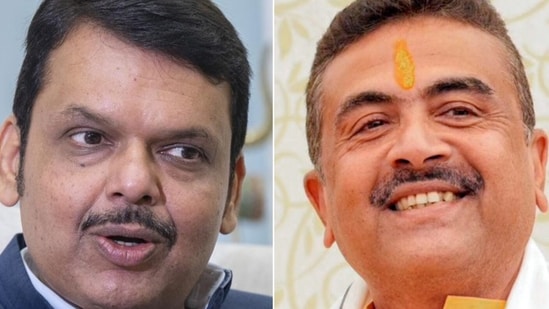
Maharashtra CM Devendra Fadnavis calls Suvendu Adhikari’s swearing-in a ‘victory for India’
# Adhikari Sworn In As Bengal’s First BJP CM
**By Special Political Correspondent** | **The National Desk** | May 9, 2026
On Saturday, May 9, 2026, West Bengal witnessed a seismic political transition as Suvendu Adhikari was sworn in as the state’s first-ever Bharatiya Janata Party (BJP) Chief Minister at a historic ceremony in Kolkata. Administered by the State Governor in the sweeping presence of Prime Minister Narendra Modi, the high-profile oath-taking marks the culmination of the BJP’s decade-long electoral crusade to capture the eastern stronghold. Maharashtra Chief Minister Devendra Fadnavis, who attended the massive event alongside the top brass of the National Democratic Alliance (NDA), unequivocally hailed the monumental transition of power as a “victory for India.” This historic mandate officially ends the 15-year rule of the Trinamool Congress (TMC), signaling a profound realignment of political forces between New Delhi and Bengal. [Source: Hindustan Times]
## A Saffron Dawn at Red Road
The atmosphere at Kolkata’s iconic Red Road was electric, awash with saffron banners and resonating with the sounds of traditional *dhaak* (drums) and conch shells. Unprecedented security measures were put in place as tens of thousands of supporters gathered to witness what is arguably the most significant geopolitical shift in Eastern India’s modern electoral history.
Prime Minister Narendra Modi, Union Home Minister Amit Shah, and BJP National President J.P. Nadda led the central delegation, underscoring the vital importance the BJP high command placed on this victory. They were joined by a formidable contingent of BJP Chief Ministers, including Yogi Adityanath of Uttar Pradesh, Himanta Biswa Sarma of Assam, and Devendra Fadnavis of Maharashtra.
When **Suvendu Adhikari** stepped up to the podium to take his oath in Bengali, the roar from the crowd echoed across the Maidan. For the BJP, taking the reins of West Bengal—a state historically dominated by Leftist ideologies and regional populism—represents the final frontier in its pan-India expansion strategy.
## “A Victory for India”: The National Resonance
Speaking to reporters on the sidelines of the ceremony, Maharashtra Chief Minister Devendra Fadnavis contextualized the win far beyond the borders of Bengal. According to the RSS news dispatch, Fadnavis enthusiastically called Adhikari’s swearing-in a “victory for India” [Source: Hindustan Times].
Fadnavis elaborated on this sentiment, emphasizing that bringing West Bengal into the “double-engine government” fold (where the same party governs at both the state and central levels) would catalyze unprecedented infrastructural and economic integration.
“What we are witnessing today is not merely a change in government, but the reintegration of Bengal into the broader developmental narrative of India,” Fadnavis stated during a brief press interaction. “For decades, the state was held back by confrontational politics. Today’s mandate is a victory for cooperative federalism, economic progress, and the democratic ethos of the nation.”
His remarks underline a coordinated national strategy. By connecting the industrial wealth of the West (Maharashtra and Gujarat) with the untapped potential of the East (Bengal and Odisha), the ruling party aims to create a unified economic corridor stretching from Mumbai to Kolkata.
## The Architect of the Upset: Suvendu Adhikari’s Journey
Suvendu Adhikari’s ascent to the highest office in the state is a narrative of intense political rivalry and grassroots mobilization. Once considered the right-hand man of TMC supremo Mamata Banerjee, Adhikari played a pivotal role in the anti-land acquisition movement in Nandigram in 2007, which catapulted the TMC to power in 2011.
However, citing an increasingly centralized party structure and the rise of dynastic politics, Adhikari defected to the BJP in December 2020. In the highly charged 2021 Assembly Elections, he achieved giant-killer status by narrowly defeating Chief Minister Mamata Banerjee in the Nandigram constituency, despite the TMC winning a statewide landslide.
From 2021 to 2026, serving as the Leader of the Opposition in the West Bengal Legislative Assembly, Adhikari relentlessly cornered the state government. He spearheaded campaigns against alleged systemic corruption, localized violence, and bureaucratic apathy. His elevation to Chief Minister is widely viewed as a reward for his aggressive, unrelenting ground-level campaigning that successfully consolidated the anti-TMC vote.
## Decoding the Trinamool Congress’s Collapse
The 2026 assembly election mandate was decisive. The Trinamool Congress, which had governed with absolute majorities for three consecutive terms, finally succumbed to massive anti-incumbency.
Several intersecting factors contributed to the collapse of the TMC fortress:
* **Systemic Corruption Allegations:** Prolonged central agency investigations into the school jobs scam, the ration distribution irregularities, and municipal recruitment scams heavily dented the party’s clean image among the rural poor and the urban middle class.
* **Voter Fatigue:** Fifteen years is a long time in modern politics. Despite robust welfare schemes like *Lakshmir Bhandar*, a significant portion of the electorate exhibited an appetite for change, seeking industrialization and private-sector job creation over cash-transfer policies.
* **Law and Order Concerns:** Frequent reports of localized political violence and syndicates operating at the village level alienated a large demographic of peace-seeking voters.
“The 2026 election wasn’t just won by the BJP; it was simultaneously lost by the TMC due to sheer organizational hubris,” notes Dr. Anirban Chatterjee, a prominent political sociologist and visiting fellow at the Institute for Eastern Political Dynamics. “Welfare schemes can buffer a government for only so long when structural employment issues remain unaddressed.” [Additional Source: Regional Political Analysis Data]
## Demographic Shifts and Voting Patterns
The electoral data from the 2026 polls reveals a dramatic shift in traditional voting blocs, allowing the BJP to secure a comfortable majority in the 294-member assembly. The party managed to not only sweep the tribal belts of Jangalmahal and the tea gardens of North Bengal but also made unprecedented inroads into the urban constituencies of South Bengal, including the Greater Kolkata region.
**Estimated Vote Share Shift (2021 vs. 2026)**
| Demographic/Region | 2021 Dominant Party | 2026 Dominant Party | Key Driver for Shift |
| :— | :— | :— | :— |
| **North Bengal** | BJP | BJP (Consolidated) | Ethnic identity recognition, CAA implementation |
| **Jangalmahal** | Split (TMC/BJP) | BJP | Rural distress, anti-corruption sentiment |
| **Matua Belt** | Split (TMC/BJP) | BJP | Finalization of citizenship frameworks |
| **Urban South Bengal** | TMC | BJP (Narrow Lead) | White-collar job stagnation, anti-incumbency |
The successful execution of the Citizenship Amendment Act (CAA) rules prior to the elections galvanized the Matua and Namasudra communities, turning them into a solid voting bloc for the saffron party. Furthermore, the complete marginalization of the Left-Congress alliance turned the election into a direct bipartite contest, where the anti-TMC vote consolidated entirely behind Adhikari’s BJP.
## The Economic Blueprint: Reviving Bengal’s Industry
Now that the political dust has settled, the true challenge for Chief Minister Suvendu Adhikari begins: governance. West Bengal has historically struggled to attract large-scale private investment, earning a reputation for militant trade unionism during the Left era, which transitioned into “syndicate raj” under the TMC.
Adhikari’s inaugural address outlined a bold, pro-business economic blueprint. He has promised to release a “White Paper” on the state’s finances within his first 30 days. Key pillars of his proposed economic agenda include:
1. **Single-Window Clearance System:** Completely digitizing industrial approvals to root out localized extortion.
2. **Special Economic Zones (SEZs):** Reviving dormant industrial parks in Singur and Haldia to attract manufacturing conglomerates.
3. **MSME Revitalization:** Providing easy credit access to traditional handloom, jute, and agro-processing industries to curb the outward migration of blue-collar labor to states like Kerala and Maharashtra.
By pointing out these goals, Fadnavis’s earlier comment about the victory being “for India” gains economic substance. States like Maharashtra and Gujarat rely heavily on migrant labor from Bengal. If Adhikari successfully industrializes Bengal, it will rebalance India’s internal economic migration patterns, leading to more equitable national development.
## A New Chapter for Eastern India
The swearing-in of Suvendu Adhikari signifies more than just a change of guard in the state secretariat, Nabanna; it fundamentally alters the national political map. With Assam, Tripura, Odisha, and now West Bengal under the BJP or NDA umbrella, the party has successfully built an impenetrable eastern corridor.
For the national opposition, the loss of Bengal is a devastating blow. The TMC was a vital pillar of the anti-BJP national alliance, providing crucial numbers in the Lok Sabha and the Rajya Sabha. The fall of this bastion forces opposition parties to drastically rethink their strategies leading up to the 2029 general elections.
## Conclusion: Delivery Over Rhetoric
As Prime Minister Narendra Modi departed Kolkata following the historic ceremony, the focus immediately shifted from celebration to administration. Suvendu Adhikari takes charge of a deeply polarized state burdened with massive public debt and high youth unemployment.
While leaders like Devendra Fadnavis rightly view this as a monumental ideological and political triumph for the BJP [Source: Hindustan Times], the electorate of Bengal is known to be demanding and unforgiving. The “double-engine” government must now prove its mettle. The people of West Bengal have voted decisively for a cultural and economic renaissance, and the onus is entirely on Chief Minister Adhikari to translate this historic political mandate into tangible, on-the-ground progress.
The saffron flag now flies over Bengal, but the real test of this “victory for India” will be measured by the jobs created, the industries established, and the rule of law restored over the next five years.





