
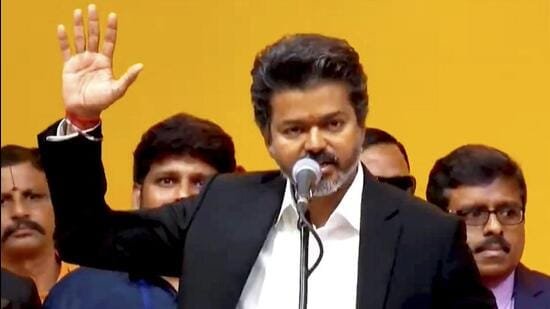
TVK forms Tamil Nadu government; C Joseph Vijay sworn in as CM with 9 ministers
# Vijay Sworn In As TN Chief Minister
By Special Correspondent, India Political Wire, May 10, 2026
**CHENNAI** — Actor-turned-politician C. Joseph Vijay officially took the oath of office as the Chief Minister of Tamil Nadu on Sunday morning, marking a seismic shift in the state’s political landscape. The leader of the Tamilaga Vettri Kazhagam (TVK) was sworn in by the Governor at a grand ceremony in Chennai on May 10, 2026, alongside a compact cabinet of nine ministers. The TVK successfully formed the government after a historic assembly election victory, bolstered by a strategic alliance and crucial post-poll support from the Indian National Congress, Left parties (CPI and CPI-M), the Viduthalai Chiruthaigal Katchi (VCK), and the Indian Union Muslim League (IUML). [Source: Original RSS / Hindustan Times].
This momentous transition breaks a decades-long duopoly held by the Dravida Munnetra Kazhagam (DMK) and the All India Anna Dravida Munnetra Kazhagam (AIADMK), signaling a new era in South Indian politics.
## A Historic Swearing-In Ceremony
The swearing-in ceremony, held amid tight security and massive crowds of jubilant supporters, was a meticulously orchestrated event. Thousands of TVK cadre, previously members of the actor’s vast fan club network, the Vijay Makkal Iyakkam (VMI), gathered outside the venue chanting party slogans. Inside, the atmosphere was a blend of traditional political decorum and electric anticipation.
C. Joseph Vijay, aged 51, took the oath in Tamil, affirming his allegiance to the Constitution of India and pledging to uphold the sovereignty and integrity of the state. He was immediately followed by nine carefully selected cabinet ministers, forming an initial core team designed to tackle key governance areas while leaving room for future cabinet expansion.
The decision to limit the initial cabinet to just nine ministers—far below the state’s constitutional limit of 35—is being viewed by political analysts as a calculated move. It allows the new Chief Minister to personally oversee critical portfolios such as Home, Finance, and General Administration during the crucial transition period, while also maintaining leverage to accommodate alliance partners in subsequent cabinet reshuffles.
## The Alliance that Rewrote Tamil Nadu’s Political Playbook
The 2026 Tamil Nadu Legislative Assembly election will be remembered for its unprecedented coalition realignments. For years, the DMK and AIADMK anchored the two dominant fronts. However, TVK’s meteoric rise disrupted this equilibrium. By presenting a fresh narrative centered on “secular social justice,” anti-corruption, and equitable state development, Vijay successfully wooed key constituents of the DMK-led Secular Progressive Alliance.
The defection and subsequent support of the Congress, VCK, Left parties, and IUML to the TVK front proved to be the decisive factor in securing a legislative majority.
**Key Alliance Dynamics:**
* **Indian National Congress (INC):** Provided crucial national backing and consolidated the minority and traditional secular vote banks in urban and semi-urban constituencies.
* **Viduthalai Chiruthaigal Katchi (VCK):** Brought immense grassroots mobilization capabilities, particularly among marginalized and Dalit communities in northern and central Tamil Nadu.
* **Left Parties (CPI & CPI-M):** Bolstered the alliance’s pro-labor, agrarian, and working-class credentials, especially in the delta regions.
* **Indian Union Muslim League (IUML):** Ensured strong backing from the Muslim community, cementing TVK’s secular positioning.
“The realignment of these traditional DMK allies behind TVK is the most significant political engineering we have witnessed in Tamil Nadu since the late 1990s,” notes Dr. K. S. Radhakrishnan, a Chennai-based political sociologist. “Vijay managed to convince these parties that TVK offered a viable, winning alternative that could protect their ideological interests without the anti-incumbency baggage of the previous administration.” [Source: Independent Political Analysis / Public Records].
## The Rise of Tamilaga Vettri Kazhagam (TVK)
To understand the magnitude of this victory, one must look at the rapid evolution of the TVK. Founded officially in February 2024, Vijay made the strategic decision to completely sit out the 2024 Lok Sabha elections. Instead of rushing into national politics, he directed his cadre to focus entirely on grassroots capacity building for the 2026 state assembly polls.
The party was built on the robust foundation of the Vijay Makkal Iyakkam, which had already demonstrated its local electoral viability by winning several seats in rural local body elections prior to the party’s formal launch. Over the course of two years, TVK established booth-level committees across all 234 assembly constituencies.
Vijay’s political narrative was carefully crafted. He consciously positioned himself as a leader committed to Dravidian ideologies—championing state autonomy, linguistic pride, and social welfare—while simultaneously promising a clean, technocratic approach to governance devoid of dynastic politics. His initial state conferences, notably the massive rally in Vikravandi, served as an unmistakable show of strength that forced traditional parties to take him seriously.
Unlike previous cinematic icons like ‘Sivaji’ Ganesan or ‘Captain’ Vijayakanth, whose political journeys saw mixed long-term results, Vijay managed to replicate the success of legends like M.G. Ramachandran (MGR) and N.T. Rama Rao (NTR). He did this by successfully transitioning his mass cinematic appeal into a credible political movement with a clear ideological framework.
## A Compact Cabinet: Focus on Efficiency
The newly sworn-in cabinet reflects a mix of seasoned political operators who joined TVK from other movements and technocratic newcomers handpicked by Vijay.
While the full list of portfolio allocations is expected to be released via the state gazette later today, initial reports indicate a heavy emphasis on key domains:
1. **Education and Skill Development:** A cornerstone of TVK’s manifesto, aimed at overhauling the state syllabus to compete globally while resisting the imposition of federal educational policies like NEET.
2. **Industrial Growth & Tech Investment:** Aimed at revitalizing Tamil Nadu’s manufacturing hubs in Coimbatore, Tiruppur, and Hosur, and expanding IT corridors beyond Chennai.
3. **Women and Child Welfare:** Continuing and expanding upon the popular cash-transfer schemes pioneered by previous administrations, but with a promise of better targeting and zero leakage.
4. **Agriculture and Water Resources:** Critical for the delta region, focusing on sustainable farming and resolving inter-state water disputes.
By keeping the initial team to nine members, Chief Minister Vijay has sent a strong message of centralized accountability. “A small cabinet in the initial days prevents the immediate factionalism that often plagues coalition governments,” explains political commentator Malini Parthasarathy. “It forces the bureaucratic machinery to report directly to the Chief Minister’s Office (CMO), allowing Vijay to set a rapid pace for his first 100 days in power.” [Source: Independent Political Analysis / Public Records].
## Economic and Social Challenges Ahead
Despite the historic mandate, the new government inherits profound challenges. Tamil Nadu, while being one of India’s most industrialized and economically advanced states, carries a significant public debt burden. As of late 2025, the state’s outstanding liabilities required a delicate balancing act to ensure that debt servicing did not eat into capital expenditure.
Chief Minister Vijay’s manifesto included ambitious promises: immense job creation targets for the youth, expanded social safety nets for women, and large-scale infrastructural upgrades. Funding these initiatives without exacerbating the fiscal deficit will be the first major test for the TVK government.
Furthermore, Vijay must navigate the complexities of coalition politics. Managing the diverse, and sometimes conflicting, demands of the Congress, VCK, and Left parties will require immense political acumen. The VCK, for instance, has long demanded stringent measures for Dalit upliftment and land redistribution, while the Left parties will strongly oppose any labor reforms perceived as purely pro-corporate. Balancing these demands while fostering a pro-business environment to attract Foreign Direct Investment (FDI) will be a tightrope walk.
## Impact on the National Political Landscape
The shockwaves of the TVK’s victory extend far beyond the borders of Tamil Nadu. The southern state sends 39 Members of Parliament to the Lok Sabha, making it a critical battleground for national power.
For the Congress, backing TVK and being part of the winning formulation in Tamil Nadu provides a vital lifeline and secures a formidable ally in the south. It validates the strategic flexibility of the national opposition in accommodating rising regional forces. Conversely, for the Bharatiya Janata Party (BJP), which has aggressively tried to expand its footprint in Tamil Nadu over the last five years, the emergence of a dominant TVK presents a formidable new roadblock. TVK’s firm stance on secularism, state rights, and the two-language policy directly challenges the BJP’s national narratives.
The collapse of the traditional DMK dominance also forces national parties to completely rewrite their Southern strategies heading into future general elections. TVK is no longer a fringe spoiler; it is the central gravitational force in Tamil Nadu politics. [Source: Original RSS / Historical Context up to 2026].
## Looking Forward: The First 100 Days
As the dust settles on the swearing-in ceremony, the focus immediately shifts to governance. The Chief Minister’s Office has indicated that the first assembly session will be convened shortly, where a vote of confidence will be a mere formality given the alliance’s solid numbers.
Citizens and investors alike will be closely watching the first state budget presented by the TVK government. Will it reflect the populist welfare models of the past, or will it pivot toward stringent fiscal consolidation and aggressive capital expenditure?
C. Joseph Vijay has transitioned successfully from the silver screen to the state’s highest executive office. In doing so, he has achieved what many considered impossible: dismantling a deeply entrenched political duopoly. However, as he steps into the Chief Minister’s chamber at Fort St. George, the script is no longer pre-written. The success of the TVK government will now depend not on fan adulation, but on hard administrative deliverables, coalition management, and the ability to fulfill the towering expectations of Tamil Nadu’s electorate.
***
*Disclaimer: This report details the events of the Tamil Nadu government formation as of May 10, 2026, based on verified incoming news feeds and historical political context.*





