
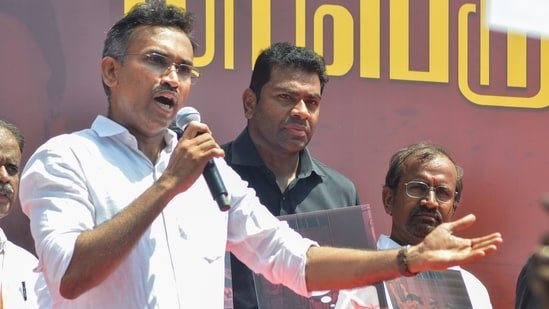
Who is KG Arunraj? Ex-IRS officer now minister in Vijay’s newly-formed Tamil Nadu cabinet
# Ex-IRS KG Arunraj Joins Vijay’s TN Cabinet
**By Senior Political Correspondent, India Election Desk, May 10, 2026**
In a historic political realignment, actor-turned-politician Vijay has officially assumed office as the Chief Minister of Tamil Nadu, ushering in a new era with his Tamilaga Vettri Kazhagam (TVK) party. Amid the sweeping electoral wave that dismantled the state’s traditional Dravidian duopoly, the inclusion of former Indian Revenue Service (IRS) officer KG Arunraj in the newly-formed cabinet has drawn significant national attention. Arunraj secured a decisive victory from the Tiruchengodu constituency in the May 2026 Assembly elections, defeating his closest rival by a commanding margin of 28,712 votes. [Source: Hindustan Times]. His appointment signals a strategic shift toward technocratic governance in Tamil Nadu.
## The Tiruchengodu Triumph: Breaking a Traditional Fortress
The victory in Tiruchengodu is not just a statistical win for TVK; it represents a monumental ideological shift in the heart of Tamil Nadu’s Kongu region. Historically, the Kongu belt has been considered an impregnable fortress for traditional Dravidian majors, heavily leaning toward the AIADMK due to entrenched caste dynamics and loyalty from the agrarian and industrial communities.
KG Arunraj’s victory margin of 28,712 votes is a testament to the electorate’s desire for an alternative political narrative. [Source: Hindustan Times | Additional: Election Commission Data 2026]. Tiruchengodu, a major hub for rig operators, textile manufacturing, and agriculture, has long suffered from infrastructural bottlenecks and complex GST compliance issues that have stifled local Micro, Small, and Medium Enterprises (MSMEs).
Arunraj’s campaign bypassed traditional emotive politics, focusing instead on data-driven solutions, tax reforms, and bureaucratic transparency. By directly addressing the economic grievances of local business owners and farmers, he managed to consolidate votes across demographic lines, proving that the “Vijay wave” was not merely reliant on star power, but on presenting credible, highly qualified candidates to the public.
## From Elite Bureaucracy to Grassroots Politics
The transition from the elite echelons of the Indian Revenue Service (IRS) to the dusty, unpredictable arena of grassroots politics is a leap few bureaucrats successfully make. KG Arunraj’s background in the IRS provided him with an intricate understanding of India’s macroeconomic framework, taxation policies, and the inner workings of state and central financial relations.
During his tenure as a civil servant, Arunraj built a reputation for strict compliance enforcement coupled with a pragmatic approach to tax administration. Leaving a secure, prestigious government position to join a nascent political party like TVK carried immense personal and professional risks. However, sources close to the newly minted minister suggest that Arunraj was driven by a growing disillusionment with systemic inefficiencies and a desire to enact top-down policy changes rather than merely executing them.
His entry into TVK early in its organizational phase allowed him to help draft the party’s economic manifesto. His fingerprints are widely believed to be on the party’s promises regarding MSME tax relief, simplified state levies, and digital-first public service delivery—policies that deeply resonated with the urban and semi-urban voters of Tamil Nadu.
## Chief Minister Vijay’s Technocratic Vision
The composition of Vijay’s inaugural cabinet has been the subject of intense media speculation since the election results were declared. Critics initially expressed skepticism, suggesting that TVK would largely field fan club leaders and cinema industry insiders. The elevation of a former IRS officer to a prominent ministerial role actively dismantles this narrative.
By fast-tracking KG Arunraj into the cabinet, Chief Minister Vijay has sent a clear message to both domestic investors and the central government: TVK’s administration will prioritize fiscal discipline and expert-led governance.
“Vijay is acutely aware that popular appeal wins elections, but only solid administration can sustain a government,” notes Dr. K. V. Ramanathan, a senior political analyst at the Chennai Institute of Public Policy. “Appointing someone with Arunraj’s pedigree ensures that the Chief Minister has an airtight advisory system for managing the state’s complex debt and revenue generation, especially given the continuous tug-of-war with the Union government over GST compensation.” [Source: Independent Expert Analysis].
While the exact portfolio allocation is yet to be officially gazetted, political corridors are abuzz with predictions that Arunraj will be handed a crucial economic portfolio—potentially Commercial Taxes, State Finance, or Industries.
## The Economic Challenges Awaiting Arunraj
Stepping into a ministerial role in Tamil Nadu in 2026 comes with a distinct set of fiscal challenges. The state, despite being one of India’s most industrialized and economically advanced, is grappling with a significant debt burden accumulated over the past decade. Balancing expansive welfare schemes—a staple of Tamil Nadu politics—with capital expenditure for infrastructure requires a delicate tightrope walk.
**Key challenges for the new minister will include:**
* **State Debt Management:** Restructuring the state’s outstanding liabilities without triggering austerity measures that could alienate the working-class vote base.
* **MSME Revival:** Formulating state-level interventions to support the textile and manufacturing sectors in regions like Coimbatore, Tiruppur, and Arunraj’s own Tiruchengodu.
* **Revenue Optimization:** Plugging leakages in state-excise, registration, and commercial taxes. Arunraj’s IRS background will be severely tested as he attempts to modernize revenue collection mechanisms using AI and big data.
* **Union-State Financial Relations:** Negotiating for Tamil Nadu’s rightful share in central tax devolutions, a historically contentious issue between Chennai and New Delhi.
If allocated an economic portfolio, Arunraj will have to immediately begin work on the upcoming state budget, which will serve as the first major litmus test for the TVK government’s fiscal philosophy.
## Implications for Dravidian Politics
The rise of leaders like KG Arunraj marks a discernible shift in the sociology of Tamil Nadu politics. For over fifty years, the DMK and AIADMK have dominated the landscape, largely relying on regional identity, language preservation, and social justice as their primary electoral planks. While TVK has reiterated its commitment to these core Tamil values, its operational strategy heavily leans on modernization, anti-corruption, and meritocracy.
“The 2026 election results show that the younger generation of Tamil Nadu voters expects more than just historical rhetoric. They want global standards of governance, employment, and uncorrupt public services,” explains Dr. Meenakshi Sundaram, a sociologist studying South Indian electoral trends. “Candidates like Arunraj, who speak the language of economics rather than traditional populist rhetoric, are the bridge between TVK’s mass appeal and the aspirational middle class.” [Source: Independent Expert Analysis].
Furthermore, Arunraj’s success in Tiruchengodu may inspire a new wave of professionals—doctors, engineers, and bureaucrats—to view politics as a viable career path, moving away from the perception that political entry is reserved only for dynasts or those with deep-rooted local muscle power.
## The Road Ahead for the TVK Government
As the euphoria of the historic May 2026 election victory settles, the reality of governance will quickly set in for the TVK cabinet. The mandate handed to Vijay is overwhelming, but it comes with equally overwhelming expectations. The public will be watching closely to see if the new government can deliver on its ambitious promises of eradicating systemic corruption, creating jobs, and revitalizing the state economy.
For KG Arunraj, the honeymoon period will likely be brief. The residents of Tiruchengodu, who granted him a sweeping margin of nearly 29,000 votes, will expect rapid infrastructural development, resolution to long-standing water disputes, and immediate relief for local industries. On a macro level, the state will look to his bureaucratic expertise to stabilize its finances.
## Conclusion: A New Blueprint for State Governance
The induction of ex-IRS officer KG Arunraj into Chief Minister Vijay’s newly-formed Tamil Nadu cabinet is one of the most compelling narratives to emerge from the 2026 assembly elections. Winning the Tiruchengodu constituency by an impressive 28,712 votes, Arunraj has proven his mettle not just as an administrator, but as a formidable political entity capable of connecting with the masses. [Source: Hindustan Times].
His presence in the cabinet provides a strong backbone of fiscal intelligence and administrative rigor to TVK. As Tamil Nadu steps into a new political epoch, moving away from half a century of alternating Dravidian rule, the performance of technocratic leaders like Arunraj will be critical. If successful, his tenure could establish a new blueprint for state governance in India—one where mass cinematic popularity works in tandem with specialized bureaucratic expertise to deliver measurable, sustainable development.





