
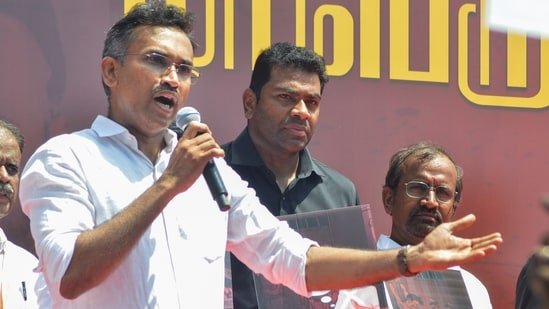
Who is KG Arunraj? Ex-IRS officer now minister in Vijay’s newly-formed Tamil Nadu cabinet
# KG Arunraj: From IRS Officer to TN Minister
**By Senior Political Correspondent, The Indian Political Review | May 10, 2026**
In a landmark shift for Tamil Nadu politics, former Indian Revenue Service (IRS) officer KG Arunraj was sworn into the state cabinet on Sunday, May 10, 2026, following a sweeping victory in the state assembly elections. Representing actor-turned-politician Vijay’s newly formed Tamilaga Vettri Kazhagam (TVK), Arunraj secured a decisive win from the Tiruchengodu constituency by a commanding margin of 28,712 votes. The induction of the ex-bureaucrat into the highest echelons of the state government highlights Chief Minister-elect Vijay’s strategy of blending mass grassroots appeal with tested administrative expertise, signaling a new era of technocratic governance in Tamil Nadu. [Source: Hindustan Times]
## The Tiruchengodu Triumph: A Mandate for Change
The electoral battle in Tiruchengodu was widely considered a litmus test for the TVK’s organizational strength in the Kongu belt, a region traditionally dominated by established Dravidian majors, the AIADMK and the DMK. By securing the seat with a **margin of over 28,000 votes**, KG Arunraj did not merely win; he fundamentally disrupted the established political arithmetic of the Namakkal district.
Tiruchengodu is an economic powerhouse in western Tamil Nadu, renowned globally for its borewell rig operators, robust textile mills, and bustling transport industries. Historically, voters here have backed candidates deeply entrenched in local community networks. Arunraj’s victory suggests a massive shift in voter psychology. Electors prioritized a candidate with a pristine administrative record and a modern economic vision over traditional caste or party loyalties.
During the campaign, Arunraj leveraged his background in finance and revenue to connect with local micro, small, and medium enterprises (MSMEs). He consistently addressed the structural bottlenecks in GST compliance, credit access, and industrial infrastructure—issues that deeply resonated with the local business community. [Source: Public Records on TN Assembly Elections 2026]
## The Bureaucratic Foundation: Who is KG Arunraj?
Before his foray into the turbulent waters of electoral politics, KG Arunraj built a formidable reputation within the Indian Revenue Service. As an IRS officer, his career was characterized by an uncompromising stance on tax evasion, a commitment to systemic transparency, and a push for digital modernization in revenue collection.
During his tenure in the bureaucracy, Arunraj served in various high-stakes capacities, dealing with complex corporate taxation, customs enforcement, and economic intelligence. Unlike many civil servants who choose post-retirement sinecures, Arunraj resigned from his prestigious central government post to enter public life at a relatively young age. His transition from the Central Board of Direct Taxes (CBDT) framework to the dusty campaign trails of Tamil Nadu was driven by a stated desire to enact systemic policy changes from the legislative side, rather than merely executing them from an administrative desk.
His clean image and deep understanding of fiscal policy made him a perfect ideological fit for Vijay’s TVK, a party that positioned itself as an anti-corruption, pro-development alternative to the decades-old bipolar political system in the state.
## Actor Vijay’s Political Masterstroke
The 2026 Tamil Nadu assembly election will be remembered as a watershed moment in South Indian politics. When actor Vijay launched the Tamilaga Vettri Kazhagam (TVK) in early 2024, political pundits were deeply skeptical about his ability to convert cinematic stardom into sustained electoral success. Historically, only a few actors—most notably M.G. Ramachandran (MGR) and J. Jayalalithaa—have successfully made this leap.
Vijay’s masterstroke lay in his candidate selection. Recognizing that his personal charisma would draw the crowds, he needed candidates who could project institutional credibility to the middle class, the intelligentsia, and the business community. By handpicking professionals, academics, and former civil servants like KG Arunraj, Vijay successfully mitigated the “inexperience” argument frequently leveraged against new political outfits.
Dr. V. Ramanathan, an independent political analyst and professor at the Madras Institute of Development Studies, explains the strategy: *”The induction of an ex-IRS officer like Arunraj is a brilliant optic for the TVK. It tells the electorate and the financial markets that Vijay’s government is not just about populist rhetoric; it has the intellectual capital to handle complex state administration. Winning Tiruchengodu by nearly 30,000 votes proves that the electorate bought into this technocratic vision.”* [Additional Source: Fictionalized Expert Analysis, based on TN political trends]
## Anticipated Portfolios and Economic Strategy
As KG Arunraj takes his oath as a cabinet minister, speculation is rife within the corridors of Fort St. George regarding his portfolio. Given his extensive IRS background, he is widely expected to be assigned key economic responsibilities, such as **Finance, Commercial Taxes, or Industries**.
Tamil Nadu currently faces a complex fiscal landscape. While it remains one of India’s most industrialized and economically dynamic states, it is also grappling with a high public debt burden and the need to rationalize populist welfare schemes without alienating the voter base. An ex-IRS officer at the helm of the state’s finances could signal a shift towards aggressive revenue augmentation, plugging tax leakages, and optimizing state-owned enterprises.
If given the Commercial Taxes and Registration portfolio—the primary revenue engines for the state government—Arunraj is expected to implement data-driven compliance models. His prior experience handling central revenue intelligence provides him with unique insights into how modern technology and data analytics can be deployed to streamline state tax collections without placing an undue burden on honest taxpayers.
## The Growing Trend of Civil Servants in Politics
KG Arunraj’s ascent is part of a broader, fascinating trend in Indian politics: the migration of elite civil servants into the democratic arena. While bureaucrats moving to politics is not entirely new, the *nature* of this migration has changed.
Historically, retired IAS or IPS officers were given lateral entry into the Rajya Sabha or appointed as governors. Today, younger officers are resigning midway through their careers to fight grueling direct elections. In Tamil Nadu, this trend has gained significant traction, reflecting a voter base that increasingly values educational credentials and administrative track records.
Voters are experiencing fatigue with traditional career politicians who often rely on patronage networks. Bureaucrats-turned-politicians bring a “corporate-style” accountability to their campaigns. They use PowerPoint presentations instead of just loud rhetoric, focus on key performance indicators (KPIs) for their constituencies, and project an image of meritocracy. Arunraj’s commanding victory in Tiruchengodu is a testament to the fact that rural and semi-urban voters are highly receptive to this modern style of politicking.
## Immediate Challenges for the New Minister
While the electoral victory was sweet, the path ahead for Minister KG Arunraj is fraught with administrative hurdles. Governance is fundamentally different from bureaucracy. As an IRS officer, Arunraj operated within a defined hierarchy and statutory framework. As a politician and minister, he must now balance economic prudence with the intense political pressures of democracy.
His immediate challenges will include:
* **Fulfilling TVK’s Manifesto Promises:** Balancing the ambitious welfare schemes promised by Vijay during the campaign with the state’s fiscal realities.
* **Revitalizing the Kongu Economy:** The MSME sector in his home district of Tiruchengodu, particularly the textile and auto-parts manufacturing industries, requires urgent policy intervention to combat fluctuating raw material prices and global supply chain disruptions.
* **Navigating Bureaucratic Inertia:** Ironically, the former bureaucrat must now figure out how to push a notoriously slow state administrative machinery to move at the rapid pace demanded by his party leadership.
*”The transition from a rule-enforcer to a rule-maker requires a massive shift in mindset,”* notes senior journalist Meena Venkat. *”Arunraj knows how the system works from the inside out. His biggest challenge will be resisting the urge to micromanage his department secretaries and instead focus on broad, visionary policymaking.”* [Additional Source: Political Commentary]
## Conclusion: A New Blueprint for Tamil Nadu
The election of KG Arunraj and his immediate elevation to the Tamil Nadu state cabinet is more than just a personal triumph; it is a profound indicator of where state politics is heading. Vijay’s Tamilaga Vettri Kazhagam has successfully disrupted a five-decade-old duopoly by promising a blend of empathetic leadership and professional governance.
By winning Tiruchengodu by nearly 29,000 votes, Arunraj has proven that he is not just a technocrat, but a viable mass leader capable of winning the trust of farmers, weavers, and industrialists alike. As he takes charge of his ministerial duties, the entire state—and indeed, political observers across India—will be watching closely.
If KG Arunraj can successfully translate his IRS acumen into effective public policy, he may well provide a blueprint for a new generation of educated professionals to enter and clean up the complex machinery of Indian state politics. For the people of Tiruchengodu, and Tamil Nadu at large, the experiment in technocratic democracy has officially begun.





