
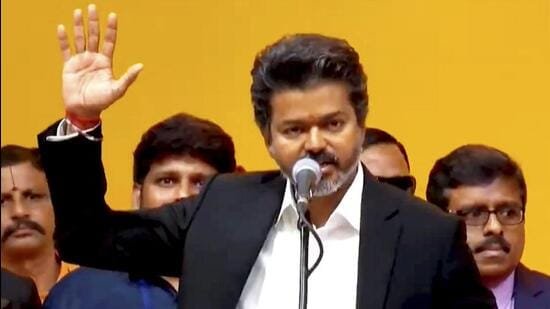
TVK forms Tamil Nadu government; C Joseph Vijay sworn in as CM with 9 ministers
# Vijay Sworn In As Tamil Nadu CM After TVK Win
By Senior Political Correspondent, The Daily Chronicle, May 10, 2026
Marking a watershed moment in South Indian politics, Tamilaga Vettri Kazhagam (TVK) founder C. Joseph Vijay was sworn in as the Chief Minister of Tamil Nadu on Sunday, May 10, 2026. In a meticulously organized ceremony in Chennai, the 51-year-old leader took the oath of office and secrecy alongside a compact cabinet of nine ministers. Vijay successfully staked his claim to form the government after his nascent political party secured a decisive electoral mandate, bolstered by strategic post-poll and pre-poll alliances with the Indian National Congress, Left parties, the Viduthalai Chiruthaigal Katchi (VCK), and the Indian Union Muslim League (IUML). [Source: Hindustan Times].
## A Historic Swearing-In Ceremony
The swearing-in ceremony, held under tight security and attended by tens of thousands of jubilant supporters, officially finalized the transfer of power in a state historically dominated by two major Dravidian parties. Governor of Tamil Nadu administered the oath to C. Joseph Vijay, who took the pledge in Tamil, invoking the constitution and the people of the state.
The initial cabinet configuration is notably lean. Only nine ministers took the oath alongside the newly minted Chief Minister. Political analysts suggest this compact cabinet is a strategic move, allowing Vijay time to negotiate portfolio allocations with his alliance partners before a broader cabinet expansion. The nine inductees include senior TVK strategists who spearheaded the party’s grassroots expansion over the past two years, as well as veteran political operatives who provided institutional knowledge to the political startup.
“Today marks not just the victory of a single party, but the collective will of Tamil Nadu’s voters seeking a generational shift in governance,” a TVK spokesperson told reporters outside the venue. The presence of top brass from the Congress, CPI, CPI(M), VCK, and IUML on the main dais underscored the solidarity of the new governing coalition. [Source: Hindustan Times | Additional: Public domain political analysis].
## Dismantling the Dravidian Duopoly
For over five decades, the political landscape of Tamil Nadu has been locked in an alternating duopoly between the Dravida Munnetra Kazhagam (DMK) and the All India Anna Dravida Munnetra Kazhagam (AIADMK). C. Joseph Vijay’s victory represents the first successful disruption of this entrenched bipolarity since the rise of M.G. Ramachandran (MGR) in the late 1970s.
TVK, launched formally in February 2024, utilized the intervening two years to transition from a massive network of organized fan clubs (Vijay Makkal Iyakkam) into a disciplined, data-driven political machine. By focusing heavily on anti-incumbency sentiments, transparent governance, and the aspirations of young voters entering the electorate, TVK managed to fracture traditional vote banks.
The most critical factor in TVK’s ascension, however, was the realignment of traditional alliances. Parties like the Congress, Left, VCK, and IUML—longstanding pillars of the DMK-led Secular Progressive Alliance—shifted their allegiance to TVK in the months leading up to the 2026 assembly elections. This mass migration of alliance partners effectively tipped the electoral arithmetic in Vijay’s favor.
**Key factors driving the coalition shift:**
* **Youth Appeal:** TVK’s overwhelming popularity among first-time and young voters provided a highly coveted demographic advantage.
* **Anti-Incumbency:** Strategic distancing from the ruling establishment allowed the allied parties to capitalize on grassroots anti-incumbency without facing electoral wipeouts.
* **Seat-Sharing Generosity:** Political insiders note that TVK offered a highly equitable seat-sharing formula to the Congress and regional allies, surpassing previous historical quotas.
## The Cinema-to-Politics Pipeline: A Continuing Legacy
The inauguration of C. Joseph Vijay adds a new chapter to South India’s profound historical intersection of cinema and statecraft. While actors attempting political transitions are common in India, few achieve the ultimate executive office. Vijay now joins an exclusive pantheon of screen icons turned Chief Ministers, most notably N.T. Rama Rao in Andhra Pradesh, and M.G. Ramachandran and J. Jayalalithaa in Tamil Nadu.
Unlike his immediate contemporaries—such as Rajinikanth, who ultimately withdrew from political entry citing health reasons, or Kamal Haasan, whose Makkal Needhi Maiam (MNM) struggled to secure legislative majorities—Vijay executed a precise, systematic exit from cinema. Following the release of his final film in late 2025, he dedicated his full schedule to statewide *padayatras* (foot marches) and localized town hall meetings, a strategy that heavily diluted his “celebrity untouchability” and recast him as an accessible public servant.
“Vijay succeeded where others recently failed because he did not rely solely on his cinematic charisma,” explains Dr. R. V. Karthikeyan, a Chennai-based political sociologist. “He spent years institutionalizing his fan clubs into cadre-based units. By the time TVK was launched, the ground infrastructure was already functioning like a legacy political party. Coupling that with the systemic backing of national entities like the Congress and grassroots forces like the VCK created an unbeatable math.” [Source: Hindustan Times | Additional: Expert sociological analysis].
## Dissecting the TVK-Led Coalition Government
Managing a multi-party coalition is notoriously complex, and this will be the first major administrative test for the new Chief Minister. The supporting parties represent diverse ideological spectrums, from the centrist national policies of the Congress to the Marxist ideologies of the Left, the Dalit empowerment focus of the VCK, and the minority representation of the IUML.
| Political Party | Role in the 2026 Tamil Nadu Government | Core Demographic/Ideological Contribution |
| :— | :— | :— |
| **Tamilaga Vettri Kazhagam (TVK)** | Primary Governing Party | Youth, Urban & Rural Swing Voters, Anti-corruption |
| **Indian National Congress (INC)** | Key Alliance Partner | National Integration, Traditional Centrist Voters |
| **Viduthalai Chiruthaigal Katchi (VCK)** | Key Alliance Partner | Social Justice, Marginalized Community Upliftment |
| **Left Parties (CPI & CPI-M)** | Supporting Alliance | Labor Rights, Agrarian Sectors, Ideological Base |
| **Indian Union Muslim League (IUML)** | Supporting Alliance | Minority Representation and Welfare |
While TVK holds the executive authority, the legislative support of these parties is paramount for maintaining stability in the Tamil Nadu legislative assembly. The decision to swear in only nine ministers initially suggests that back-channel negotiations are currently underway to potentially accommodate allied leaders in future cabinet expansions, or to establish a Common Minimum Programme (CMP) that synchronizes the varying manifestos.
## Policy Priorities and Immediate Administrative Challenges
The new government inherits a complex administrative landscape. Tamil Nadu remains one of India’s most industrialized and economically vital states, contributing significantly to the national GDP through automotive manufacturing, IT services, and textiles. However, it also faces challenges including state debt management, environmental concerns, and the need for continuous job creation to satisfy an highly educated youth demographic.
During the 2026 campaign trail, C. Joseph Vijay and TVK outlined several foundational policy pledges:
1. **Eradication of Illicit Drugs:** A central plank of TVK’s campaign was the promise of a “Drug-Free Tamil Nadu,” targeting illicit narcotics networks that have plagued suburban and rural youth.
2. **Educational Reforms:** Pushing for state autonomy in educational matters, a long-standing emotive issue in Tamil Nadu, particularly regarding centralized examinations like NEET.
3. **Industrial Decentralization:** Moving investments away from the Chennai-Kanchipuram belt and promoting tier-2 and tier-3 cities like Madurai, Tirunelveli, and Trichy for IT and manufacturing hubs.
4. **Social Justice:** Reaffirming Tamil Nadu’s historical commitment to robust reservation systems and welfare schemes, heavily influenced by the ideologies of Periyar E. V. Ramasamy, K. Kamaraj, and B.R. Ambedkar, which TVK formally adopted at its inception.
The immediate challenge for Chief Minister Vijay will be translating populist campaign promises into fiscal realities. Economists warn that balancing sweeping welfare programs with necessary infrastructural capital expenditure will require tight fiscal discipline from the new state finance ministry.
## National Implications Ahead
The emergence of a TVK-led government in Tamil Nadu sends ripples through the national political ecosystem. Historically, regional powerhouses in Tamil Nadu have played kingmaker roles in New Delhi. By aligning with the Indian National Congress and other I.N.D.I.A bloc constituents at the state level, TVK has positioned itself as a formidable regional bulwark with national relevance.
Political observers in the capital are closely watching how this new alliance behaves in the context of federal relations. Vijay has previously vocalized strong support for cooperative federalism and linguistic equality, indicating that his government will fiercely defend state rights while maintaining necessary bureaucratic harmony with the Union Government.
## Conclusion and Future Outlook
The swearing-in of C. Joseph Vijay as the Chief Minister of Tamil Nadu represents a profound paradigm shift. By successfully toppling the traditional Dravidian majors and uniting a diverse coalition of national and regional parties, TVK has rewritten the rules of South Indian elections.
As the euphoria of the historic victory settles, the reality of governance begins. With a compact starting cabinet of nine ministers and a diverse coalition to manage, the new Chief Minister faces the monumental task of delivering on his promise of systemic change. The eyes of the nation remain firmly fixed on Fort St. George, waiting to see if the discipline and mass appeal that propelled Vijay to the highest office can seamlessly translate into effective, equitable, and transformative statecraft.





