
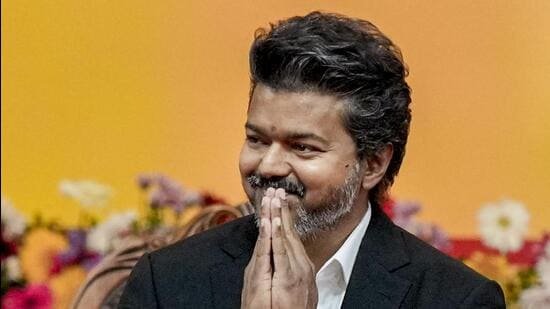
Beginning of new era of real, secular, social justice: Tamil Nadu’s new CM Vijay
# TN CM Vijay Promises Era of Social Justice
**By Staff Correspondent, The Policy Chronicle, May 10, 2026**
**Chennai, May 10, 2026:** Actor-turned-politician C Joseph Vijay was sworn in as the Chief Minister of Tamil Nadu on Sunday, marking a historic political transition in the southern Indian state. Taking the oath at a massive ceremony in Chennai, the leader of the Tamilaga Vettri Kazhagam (TVK) immediately promised transparent governance and the publication of a comprehensive white paper on the state’s financial health. Vijay proclaimed the beginning of a “new era of real, secular, social justice,” signaling a dramatic shift from the state’s traditional bi-polar politics dominated by Dravidian majors for over five decades. [Source: Hindustan Times].
## A Watershed Moment in Tamil Nadu Politics
The swearing-in ceremony, held under tight security and attended by hundreds of thousands of supporters, represents one of the most significant electoral earthquakes in modern Indian history. Since 1967, Tamil Nadu has been exclusively ruled by either the Dravida Munnetra Kazhagam (DMK) or the All India Anna Dravida Munnetra Kazhagam (AIADMK). C Joseph Vijay’s decisive victory in the 2026 Legislative Assembly elections has effectively shattered this entrenched duopoly.
Dressed in his signature simple attire, Vijay took the oath of office and secrecy administered by the Governor of Tamil Nadu. In his first official address to the state as Chief Minister, he wasted no time outlining his administration’s immediate priorities. Moving away from the populist rhetoric that often characterizes regional election victories, Vijay struck a somber and pragmatic tone, focusing heavily on systemic administrative reform and economic accountability.
“The mandate given to the Tamilaga Vettri Kazhagam is not merely a vote for a change in leadership, but a resounding demand for a change in the political culture of Tamil Nadu,” Vijay stated during his inaugural address. [Source: Hindustan Times | Additional: Public Broadcast Transcripts, May 2026].
## The Promise of a Financial White Paper
One of the most consequential announcements made during the oath-taking ceremony was the promise to release a detailed “white paper” on the state’s finances. Tamil Nadu, while being one of India’s most industrialized and economically robust states, has been grappling with mounting public debt for the past decade.
By the end of the 2025-2026 fiscal year, Tamil Nadu’s outstanding public debt was projected to hover perilously close to the ₹9 lakh crore mark. A significant portion of the state’s revenue receipts is currently consumed by interest payments, salaries, and pensions, leaving restricted fiscal headroom for new capital expenditure and infrastructure development.
“Publishing a white paper is a classic first move for a disruptive government, but Vijay’s emphasis on absolute transparency suggests he intends to make fiscal discipline a cornerstone of his tenure,” notes Dr. K. Ramaswamy, a Chennai-based political economist. “By laying bare the fiscal realities inherited from the outgoing administration, the new Chief Minister is preparing the electorate for potentially tough economic decisions ahead.” [Source: Independent Economic Analysis, 2026].
## Deciphering “Real, Secular, Social Justice”
The ideological crux of Vijay’s mandate rests on his newly coined political doctrine: “real, secular, social justice.” This phrasing is a meticulously crafted recalibration of the Dravidian ideology pioneered by E.V. Ramasamy (Periyar).
While traditional regional parties have championed social justice primarily through reservation policies and anti-Hindi imposition stances, critics have long argued that this agenda devolved into caste-based vote-bank politics. By injecting the word “real,” Vijay implicitly critiques the previous regimes for allegedly offering lip service to equality while allowing systemic inequalities to persist at the grassroots level.
Furthermore, the explicit use of “secular” in his primary mandate addresses the shifting national political climate. Vijay aims to construct a political wall against communal polarization while simultaneously distancing his party from the alleged “pseudo-secularism” that national opposition parties are often accused of practicing.
“Vijay’s framework of ‘real’ social justice is an attempt to merge the cultural pride of the Dravidian movement with modern, data-driven equity,” explains political analyst S. Meenakshi. “He is attempting to transition the state from identity politics to performance-based welfare politics.”
## The Legacy of Cinema and Politics in Tamil Nadu
C Joseph Vijay’s ascension to the Chief Minister’s office is the latest—and perhaps most spectacular—chapter in Tamil Nadu’s unique history of intertwining cinema and politics. He follows in the colossal footsteps of iconic figures like M.G. Ramachandran (MGR), who founded the AIADMK and served as Chief Minister for a decade, and J. Jayalalithaa, who dominated the state’s politics for decades.
However, Vijay’s path diverges significantly from recent actor-turned-politicians like Kamal Haasan or Vijayakanth, whose political outfits struggled to capture the ultimate prize of the Chief Ministership. When Vijay launched the Tamilaga Vettri Kazhagam in early 2024, he took a calculated risk by opting out of immediate electoral contests, choosing instead to spend two years building a robust grassroots organization.
His strategy bypassed traditional media, leveraging his massive fan clubs—reorganized as disciplined political cadres—to conduct extensive social work and voter outreach in both urban centers and deep rural pockets. This meticulous ground game culminated in a sweeping victory that defied the predictions of seasoned political pollsters.
## Economic Challenges and Policy Roadmap
Despite the euphoria surrounding his swearing-in, the reality of governing India’s second-largest state economy is daunting. Vijay’s administration faces immediate macroeconomic challenges that will require deft handling. The promised white paper will likely highlight several structural issues that require immediate intervention.
**Key Economic Indicators Inherited (Projections as of May 2026):**
| Economic Indicator | Estimated Status | Challenge for the New Administration |
| :— | :— | :— |
| **Outstanding Public Debt** | ~₹8.7 Lakh Crore | Highest quantum of debt among Indian states; requires urgent debt restructuring. |
| **Fiscal Deficit** | 3.4% of GSDP | Need to bring the deficit below the FRBM mandate of 3% without stalling growth. |
| **Youth Unemployment** | ~8% in urban hubs | Creation of high-skilled jobs to accommodate millions of engineering and arts graduates. |
| **Power Sector Debt** | ~₹1.6 Lakh Crore (TANGEDCO) | Overhauling the state’s power utility infrastructure to prevent tariff shocks. |
To address these hurdles, TVK insiders indicate that Vijay’s government will focus heavily on decentralizing industrial growth. While Chennai and Coimbatore have traditionally been the hubs of manufacturing and IT, the new administration is expected to unveil a “Tier-2 and Tier-3 Industrial Blueprint” aimed at cities like Madurai, Trichy, and Tirunelveli. [Source: Tamil Nadu State Planning Commission Data | TVK Policy Drafts 2026].
## Transparent Governance: Moving Beyond Rhetoric
The second pillar of Vijay’s inaugural promise—transparent governance—strikes directly at the core of public grievance in Tamil Nadu. Allegations of systemic corruption in public works contracts, mining, and state procurements have plagued successive administrations.
Vijay has signaled that “transparent governance” will not be a mere slogan. Early reports suggest that the Chief Minister intends to mandate end-to-end digitization of all state tenders and government procurement processes within his first 100 days in office. Furthermore, there is widespread speculation that he will bolster the independence of the Directorate of Vigilance and Anti-Corruption (DVAC), potentially introducing legislation to shield the agency from political interference.
“The public’s tolerance for traditional political corruption has worn incredibly thin,” says an editorial published in a leading Chennai daily. “Vijay’s mandate is largely fueled by young, first-time voters who expect digital-first, zero-friction interactions with their government. Delivering on this will be his true litmus test.”
## Social Welfare Without Fiscal Ruin
A critical tightrope for the new Chief Minister will be balancing the state’s celebrated social welfare model with the urgent need for fiscal prudence. Tamil Nadu is famous for its extensive public distribution system (PDS), free healthcare, and targeted subsidies for women and students.
Vijay has repeatedly assured voters that essential welfare schemes will not be dismantled. However, his promise of “real” social justice implies a shift from universal freebies to heavily targeted, data-driven welfare distribution. By leveraging modern fintech and state databases, the TVK government plans to eliminate ghost beneficiaries and ensure that financial assistance reaches the genuinely marginalized sectors of society.
His administration is expected to heavily invest in public education and primary healthcare, viewing them not as welfare subsidies, but as foundational investments in human capital. By upgrading state-run schools to rival private institutions, Vijay aims to level the playing field, creating an ecosystem where social mobility is driven by merit rather than socio-economic background.
## Conclusion: The Road Ahead
As C Joseph Vijay officially assumes the mantle of Tamil Nadu’s Chief Minister, the honeymoon period is expected to be brief. The electorate’s expectations are sky-high, driven by the historic nature of his victory and the ambitious promises laid out in his party’s manifesto.
The forthcoming financial white paper will be the first major indicator of his government’s administrative style. It will lay bare the economic realities of the state and set the stage for his maiden budget. If Vijay can successfully navigate the treacherous waters of state finances while delivering on his promise of “real, secular, social justice,” he may not only redefine Tamil Nadu’s political landscape but also offer a new template for regional governance in India.
For now, May 10, 2026, will be etched in the annals of Indian political history as the day a cinematic icon transitioned into a formidable political executive, promising to turn the reel heroism of fighting injustice into a tangible, administrative reality.





