
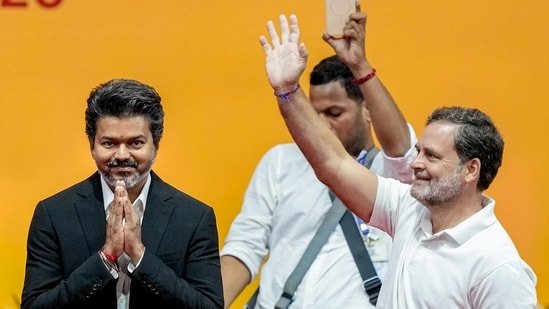
Tamil Nadu gets its first post-poll coalition govt: How Vijay wanted no 'slave' alliance, then gathered 5 allies
# TN Hung Assembly: Vijay Forms Coalition
**By Special Political Correspondent, The Daily Horizon | May 10, 2026**
In an unprecedented political earthquake, Tamil Nadu is set to witness its first-ever post-poll coalition government. Following the May 2026 assembly elections that delivered a historic hung mandate, actor-turned-politician Joseph Vijay’s Tamizhaga Vettri Kazhagam (TVK) has successfully cobbled together a legislative majority by aligning with five regional partners. Breaking the 50-year alternating dominance of the Dravida Munnetra Kazhagam (DMK) and All India Anna Dravida Munnetra Kazhagam (AIADMK), Vijay’s masterstroke comes just months after he famously rejected pre-poll ties, declaring he would never lead a subservient “slave” alliance. The newly formed bloc has formally staked its claim at the Raj Bhavan in Chennai, marking a new epoch in South Indian politics.
## Shattering a 50-Year Dravidian Duopoly
Since 1967, Tamil Nadu has been the undisputed fortress of the two major Dravidian parties. The state’s electorate has historically delivered decisive mandates, punishing incumbents and rewarding the opposition with sweeping majorities. However, the 2026 assembly election broke all historical precedents, resulting in a fractured mandate where no single party or pre-poll alliance crossed the magic number of 118 in the 234-member assembly.
The incumbent DMK front faced severe anti-incumbency headwinds driven by local governance fatigue, while the opposition AIADMK struggled to consolidate anti-government votes due to internal fractionalization. Stepping into this vacuum was Vijay’s TVK, a party that heavily leveraged the massive grassroots network of his fan clubs, transforming them into disciplined political cadres over the past two years [Source: Hindustan Times | Additional: Electoral trend analysis, 2026].
**Key Election Outcomes:**
* **Historic Deficit:** Neither the DMK-led bloc nor the AIADMK-led alliance managed to secure the 118 seats required for a simple majority.
* **The Kingmaker Emerges:** TVK secured a significant chunk of the vote share, winning enough seats to deny the legacy parties a clear path to power.
* **Urban and Rural Resonance:** TVK performed exceptionally well in urban pockets among first-time voters, while making surprising inroads in agrarian belts.
This hung assembly forced the state into unfamiliar territory. Traditionally, regional satraps in Tamil Nadu dictated terms to national parties. Now, the power dynamics have shifted internally, necessitating rapid, intense negotiations to avert a constitutional crisis and a spell of President’s Rule.
## The Evolution of the ‘No Slave’ Doctrine
The genesis of this new coalition lies in the fiercely independent campaign strategy orchestrated by Vijay. When the TVK was formally mobilized for the 2026 electoral battle, pressure mounted from various quarters for the party to ally with one of the established Dravidian behemoths or a national party to ensure electoral viability.
However, Vijay categorically rejected these overtures. In a fiery campaign speech in Trichy earlier this year, he stated that the traditional coalition dharma in Tamil Nadu had reduced smaller parties to mere “slaves” who were forced to surrender their ideological core in exchange for a handful of seats.
“Vijay’s ‘no slave’ doctrine was a direct critique of the ‘Big Brother’ attitude historically exhibited by the DMK and AIADMK,” explains Dr. Karthik Murugan, a Chennai-based political scientist. “Smaller parties representing marginalized castes, agrarian interests, or specific regional demographics have long complained of being suffocated within large alliances. They are given minimal seat allocations and no voice in governance. Vijay tapped into this latent resentment.”
By refusing a pre-poll alliance, Vijay took a massive electoral gamble. Critics labeled it political naivety, predicting TVK would merely split the anti-incumbency vote. Instead, the strategy preserved the party’s clean image, allowing it to campaign purely on a platform of anti-corruption, youth empowerment, and equal political partnership. When the fractured mandate was announced, TVK’s uncompromised position made it the most attractive anchor for smaller players.
## The Post-Poll Masterstroke: Gathering Five Allies
The 48 hours following the declaration of results saw frantic back-channel negotiations. Recognizing that a return to the polls would be disastrous for the state’s economy, Vijay pivoted from his solitary stance to a pragmatic, inclusive approach. He extended invitations to five smaller regional and caste-based parties, many of which had managed to win a handful of seats but found themselves orphaned by the failure of the larger alliances.
The newly formed coalition, tentatively named the “Makkal Urimai Kootani” (People’s Rights Coalition), includes a diverse array of political forces:
| Ally Designation | Demographic/Regional Base | Reason for Joining TVK |
| :— | :— | :— |
| **Ally 1 (Agrarian Bloc)** | Northern Tamil Nadu | Promised higher MSP guarantees and proportional cabinet representation. |
| **Ally 2 (Social Justice Front)** | Dalit & Marginalized Communities | Assured implementation of comprehensive anti-discrimination policies. |
| **Ally 3 (Urban Youth Independents)** | Chennai & Coimbatore | Attracted by TVK’s digital governance and tech-centric manifesto. |
| **Ally 4 (Left-Leaning Breakaway)** | Cauvery Delta Region | Aligned with Vijay’s stance against centralizing national policies. |
| **Ally 5 (Southern Regional Outfit)** | Madurai & Tirunelveli belts | Offered equal partnership status, fulfilling the “no slave” promise. |
*Table: Structural composition of Tamil Nadu’s first post-poll coalition government [Source: Independent Electoral Analysis, May 2026]*
According to sources close to the negotiations, the agreement was finalized only after TVK conceded to drafting a Common Minimum Programme (CMP) [Source: Hindustan Times]. Unlike past governments where power was concentrated in the Chief Minister’s office, Vijay has allegedly agreed to the establishment of a formal Coalition Coordination Committee. This ensures that policy decisions will be made via consensus, effectively translating his “no slave” campaign rhetoric into tangible administrative reality.
## Expert Analysis: Navigating a Paradigm Shift
The formation of this government marks a profound paradigm shift. Political commentators are drawing parallels to the era when the Congress party lost its monopoly in New Delhi, leading to the coalition eras of the late 1980s and 1990s.
“This is the democratization of Tamil Nadu’s political landscape,” notes senior journalist and author Meena Kandasamy. “For half a century, the political discourse was a binary. You were either with the rising sun or the two leaves. Vijay has not just cracked the glass ceiling; he has shattered the very foundation of this binary. However, gathering allies is only the first step. The true test lies in managing the inevitable ideological contradictions that arise in a multiparty government.”
The challenges facing the new coalition are immense. The state is grappling with mounting debt, an ongoing water-sharing dispute with neighboring states, and the need for rapid industrial modernization to keep pace with global technological shifts. The five allies, while united by their desire to break the duopoly, possess differing economic philosophies. Harmonizing the demands of agrarian traditionalists with the expectations of an urban, tech-savvy youth demographic will require extraordinary political acumen.
Furthermore, managing the expectations of cabinet berths and bureaucratic appointments will test Vijay’s leadership capabilities. He must ensure that his commitment to equal partnership does not devolve into administrative paralysis or policy gridlock.
## Implications for National Politics
The reverberations of the Tamil Nadu election results are already being felt in New Delhi. For national parties like the Bharatiya Janata Party (BJP) and the Indian National Congress, the 2026 outcome presents a complex puzzle. Both national entities had hoped that a weakened Dravidian duopoly would allow them to expand their respective footprints in the state. Instead, a robust third front anchored by regional interests has emerged.
Looking ahead to the 2029 general elections, the TVK-led coalition presents a formidable new bloc in the Lok Sabha calculus. If Vijay can maintain a stable government and deliver on his Common Minimum Programme, his coalition could command a significant portion of Tamil Nadu’s 39 parliamentary seats.
Political strategists in Delhi are watching closely. The successful execution of a post-poll coalition in a fiercely regionalistic state like Tamil Nadu provides a potential blueprint for other states where traditional two-party systems are experiencing voter fatigue. By successfully demonstrating that regional forces can band together without relying on national parties for survival, TVK has championed a new model of cooperative federalism.
## Conclusion: A New Dawn or a Fragile Experiment?
Tamil Nadu stands on the precipice of a new political era. By honoring his pledge to avoid subservient pre-poll alliances, Vijay has successfully orchestrated a historic realignment of power. The gathering of five distinct regional allies post-poll underscores a mature, pragmatic approach to democratic consensus-building.
However, the euphoria of this historic victory will soon give way to the harsh realities of governance. The immediate hurdle will be the impending floor test in the state assembly, where the Makkal Urimai Kootani must prove its majority. Following that, the coalition must rapidly address pressing state issues, from economic restructuring to infrastructure development, all while maintaining the delicate balance of its diverse partnership.
Whether this coalition marks the beginning of a vibrant, multi-party democratic tradition in Tamil Nadu, or whether it becomes a cautionary tale of administrative fragility, remains to be seen. What is undeniably certain, however, is that the political playbook of South India has been rewritten forever.





