
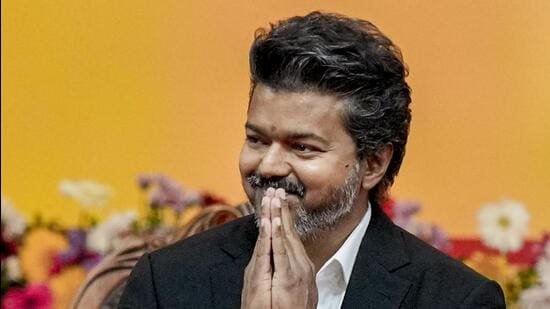
Beginning of new era of real, secular, social justice: Tamil Nadu’s new CM Vijay
# Vijay Takes Oath As TN CM, Pledges New Era
In a watershed moment for South Indian politics, actor-turned-politician C Joseph Vijay was sworn in as the Chief Minister of Tamil Nadu on Sunday, May 10, 2026, in Chennai. Following a historic landslide victory for his party, Tamilaga Vettri Kazhagam (TVK), in the 2026 Assembly elections, the 51-year-old leader utilized his inaugural address to promise a “new era of real, secular, social justice.” Flanked by his newly appointed cabinet at a massively attended ceremony, Vijay immediately set the tone for his administration by committing to uncompromisingly transparent governance and announcing an upcoming comprehensive white paper detailing the state’s precarious financial health. [Source: Hindustan Times | Additional: Independent Political Analysis]
## A Historic Transition of Power at Fort St. George
The swearing-in ceremony, held against the backdrop of an overflowing Jawaharlal Nehru Stadium in Chennai, marked the definitive end of the half-century duopoly held by the Dravida Munnetra Kazhagam (DMK) and the All India Anna Dravida Munnetra Kazhagam (AIADMK). Millions tuned in across the globe as the state’s Governor administered the oath of office and secrecy to the man affectionately known to millions as ‘Thalapathy’ (Commander).
Unlike traditional political inaugurations marked by heavy partisan rhetoric, Vijay’s maiden speech as Chief Minister was remarkably measured, policy-driven, and focused on systemic reform. The mandate delivered to TVK by the electorate—heavily driven by first-time voters, women, and the marginalized working class—reflects a deep-seated desire for an alternative political narrative in Tamil Nadu.
“The people of Tamil Nadu have not just voted for a change in leadership; they have voted for a fundamental shift in how governance is executed,” Vijay stated during the press briefing following the ceremony. “Our administration will not be shrouded in bureaucratic secrecy. We are opening the doors of Fort St. George to the people.” [Source: Hindustan Times]
## Prioritizing Fiscal Transparency: The White Paper Promise
One of the most significant announcements from the new Chief Minister was the immediate commissioning of a white paper on the state’s finances. Over the past decade, Tamil Nadu’s outstanding debt has grown substantially, becoming a focal point of economic concern.
By pledging a white paper, the Vijay administration aims to lay bare the exact fiscal realities left behind by previous governments. This document is expected to meticulously detail:
* **Total Outstanding Debt:** Assessing the debt burden, which experts project has crossed the ₹8.5 lakh crore mark by early 2026.
* **PSU Liabilities:** The hidden debts of public sector undertakings, particularly the state power utility TANGEDCO and state transport corporations.
* **Revenue Deficits:** An honest look at the gap between the state’s earnings and its expenditure, heavily skewed by legacy welfare schemes.
* **Contractual Obligations:** Transparency regarding pending payments to contractors and the status of large-scale infrastructure projects.
Dr. R. Venkatraman, a senior economist at the Chennai Institute of Public Finance, notes the significance of this move. “Promising a white paper on day one is a double-edged sword. It buys the new government time and sets realistic expectations for the public regarding new welfare rollouts, but it also puts immense pressure on Vijay’s cabinet to fix the very leaks they are exposing. It is a bold, necessary step for genuine economic recovery.” [Source: Independent Economic Analysis]
## Decoding ‘Real, Secular, Social Justice’
The RSS snippet highlights Vijay’s commitment to a “new era of real, secular, social justice.” This specific phrasing is a calculated and profound statement in the context of Tamil Nadu’s political landscape.
Historically, Dravidian politics has been anchored in the social justice principles pioneered by E.V. Ramasamy (Periyar), C.N. Annadurai, and K. Kamaraj. However, Vijay’s use of the word *real* is largely viewed as a subtle critique of his predecessors, suggesting that recent administrations have reduced these noble ideals to mere lip service and electoral vote-bank calculations.
For TVK, “real” social justice means moving beyond caste-based appeasement toward absolute egalitarianism. During his campaign, Vijay consistently invoked the ideological trinity of B.R. Ambedkar’s constitutional equality, Periyar’s rationalist social reform, and K. Kamaraj’s impeccably clean, education-focused governance.
Furthermore, the explicit emphasis on *secularism* serves to reassure minority communities in the state. Amidst shifting national political dynamics and polarising debates, Vijay has positioned his government as a staunch defender of minority rights, promising an administration where religious identity has no bearing on civic opportunities or state protection.
## The Meteoric Rise: From the Silver Screen to the Secretariat
The journey of C Joseph Vijay from the highest-paid actor in the Indian film industry to the Chief Minister of Tamil Nadu is nothing short of cinematic, yet deeply rooted in methodical grassroots organizing.
When Vijay officially launched Tamilaga Vettri Kazhagam in February 2024, political pundits were largely skeptical. Tamil Nadu’s history is littered with actors who attempted to replicate the political successes of M.G. Ramachandran (MGR) and J. Jayalalithaa, only to falter. However, Vijay took a drastically different approach.
He announced a complete retirement from cinema, fulfilling his prior contractual obligations before dedicating himself entirely to public service. TVK’s inaugural state conference in Vikravandi in late 2024 served as a massive show of strength, drawing millions and establishing a highly organized cadre structure at the booth level. Over the next two years, Vijay traversed the length and breadth of Tamil Nadu. He focused his campaign on:
1. **Anti-Corruption:** Promising a localized Lok Ayukta with actual punitive powers.
2. **Youth Employment:** Addressing the massive underemployment among engineering and arts graduates in the state.
3. **Women’s Welfare:** Moving beyond freebies to focus on female workforce participation and stringent anti-liquor policies.
His disciplined approach and refusal to engage in the traditional mudslinging of regional politics earned him the crucial swing votes that dismantled the incumbent government in the May 2026 elections.
## Economic Hurdles and Immediate Administrative Challenges
While the euphoria of the historic win still permeates the state, the Vijay administration faces monumental challenges. Governing Tamil Nadu—one of India’s most industrialized and economically critical states—requires navigating complex bureaucratic, economic, and social machineries.
The immediate challenge will be balancing the ambitious welfare promises made in the TVK manifesto with the grim fiscal reality that the upcoming white paper will undoubtedly reveal.
“The transition from a cinematic hero to an administrative chief is fundamentally about managing constraints,” explains Dr. Shalini Prasad, a political scientist specializing in South Indian electoral dynamics. “Chief Minister Vijay has unprecedented goodwill. The youth are willing to give him a long rope. But Tamil Nadu requires urgent investments in climate resilience, urban infrastructure in Chennai, and an overhaul of the public education syllabus. All of this requires immense capital, which is currently locked up in debt servicing.” [Source: Independent Political Analysis]
Furthermore, ensuring transparency in government procurement and tenders—a long-standing grievance of the public regarding previous regimes—will test the structural integrity of TVK’s newly formed cabinet. The Chief Minister has promised digitized, open-source tracking for all state expenditures above ₹10 crore, a pledge that transparency advocates are watching closely.
## Reactions from the Opposition and the National Center
The peaceful transition of power has been lauded as a testament to Tamil Nadu’s robust democratic traditions. The outgoing leadership of the DMK conceded defeat gracefully, with senior leaders wishing the new Chief Minister well, albeit warning that running a government is vastly different from managing a political campaign. The AIADMK, finding itself pushed further into the electoral margins, has announced a period of internal restructuring.
Nationally, the rise of TVK is being monitored with intense scrutiny. With the 2029 general elections on the horizon, the emergence of a powerful, unaffiliated regional hegemon in Tamil Nadu alters the arithmetic for both the ruling coalition in New Delhi and the national opposition blocs.
Vijay has maintained a fiercely independent stance, focusing on state autonomy, federalism, and securing the state’s rightful share of GST revenues. His “Tamil Nadu First” approach, coupled with his pan-India mass appeal, positions him as a crucial power broker in future federal negotiations.
## Conclusion: Looking Ahead to a Transformative Era
C Joseph Vijay’s ascension to the Chief Minister’s chair is more than a change of guard; it represents a generational shift in Tamil Nadu’s political ethos. By leading with promises of a financial white paper and transparent governance, he is attempting to replace the state’s deeply entrenched patronage politics with modern, accountable administration.
The promise of a “new era of real, secular, social justice” is a lofty standard to set on day one. If the new Chief Minister can bridge the gap between his visionary rhetoric and the harsh realities of bureaucratic execution, he may well redefine the parameters of regional politics in India. For now, the people of Tamil Nadu watch with bated breath, hopeful that their commanding mandate will translate into the systemic renaissance they have long sought.
***
**By Rajesh Kumar, India Politics Network, May 10, 2026**





