
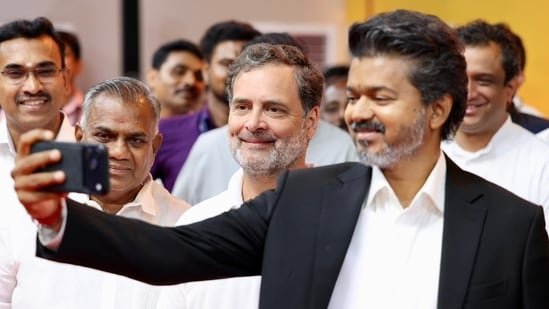
In Cong support for Vijay in TN, an AAP echo from Delhi and a ’90s redux: How the party backs own replacements
# Cong Backs TVK: A Risky Strategy Repeated
**By Senior Political Editor, The News Pulse, May 10, 2026**
In May 2026, the Indian National Congress formalized a pivotal pre-poll alliance with actor-turned-politician Vijay’s Tamilaga Vettri Kazhagam (TVK) ahead of the high-stakes Tamil Nadu assembly elections. While this strategic coalition ensures the Grand Old Party remains a vital power-broker in the southern state, it mirrors a historical, double-edged pattern. By throwing its weight behind emerging regional forces, Congress frequently nurtures the very political entities that eventually consume its voter base. From the meteoric rise of the Aam Aadmi Party (AAP) in Delhi to the regional satraps of the 1990s, the new TVK partnership raises fundamental questions about the party’s long-term survival strategy.
[Source: Hindustan Times | Additional: General Political Analysis up to May 2026]
## The Tamil Nadu Gambit: Navigating New Political Waters
Tamil Nadu politics has historically been a fortress dominated by the Dravidian duopoly—the Dravida Munnetra Kazhagam (DMK) and the All India Anna Dravida Munnetra Kazhagam (AIADMK). For decades, national parties like the Congress and the Bharatiya Janata Party (BJP) have had to play second fiddle, aligning with one of these two giants to secure electoral relevance.
However, the 2026 assembly elections have introduced a massive disruption in the form of **Actor Vijay’s Tamilaga Vettri Kazhagam (TVK)**. Launching a high-octane campaign built on anti-corruption, youth empowerment, and an alternative to traditional Dravidian politics, TVK has quickly captured the imagination of the state’s young demographic.
For the Congress, aligning with TVK marks a dramatic pivot. Departing from its traditional reliance on the DMK, the Congress has calculated that riding the anti-incumbency wave alongside a charismatic fresh face is its best ticket to state power. According to reports from the *Hindustan Times*, this coalition means the party remains a formidable force in Tamil Nadu’s governance structure. But political observers point out the latent danger: by validating and empowering a new regional alternative, Congress is providing TVK the exact legitimacy it needs to render national parties obsolete in the state.
“Congress is essentially renting out its institutional legacy to a startup political party,” notes Dr. Meenakshi Sriram, a senior political scientist specializing in Southern Indian politics. “It keeps them in the headlines and likely in the state cabinet, but it mortgages their long-term ability to ever rebuild an independent cadre in Tamil Nadu.”
## The AAP Echo: Lessons from Delhi
To understand the peril of the Congress-TVK alliance, one must look back to the political earthquake of the 2013 Delhi Legislative Assembly elections. The parallels are striking and offer a cautionary tale for the Grand Old Party.
In 2013, Arvind Kejriwal’s newly formed Aam Aadmi Party (AAP) stunned the nation by winning 28 seats in the 70-member Delhi assembly. Falling short of a majority, AAP was offered outside support by the Congress—which had been reduced to just 8 seats after ruling the capital for 15 years. The Congress’s rationale was tactical: keep the BJP (which had 31 seats) out of power and attempt to tame the anti-corruption upstarts by forcing them into the messy reality of governance.
The result was a tactical suicide. AAP used the platform provided by Congress to launch highly visible, populist welfare schemes. When fresh elections were called in 2015, AAP decimated the competition, winning an unprecedented 67 out of 70 seats. Congress was reduced to zero.
**Key takeaways from the Delhi miscalculation:**
* **Voter Base Erosion:** AAP successfully cannibalized Congress’s core voter base, including minority communities, the urban poor, and marginalized castes.
* **Narrative Hijacking:** By supporting AAP, Congress inadvertently validated the anti-establishment narrative that AAP had built *against* the Congress-led UPA government.
* **Permanent Displacement:** Over a decade later, Congress has yet to win a single assembly seat in Delhi, completely replaced by the very party it helped install.
The current alignment with TVK in Tamil Nadu risks an identical echo. By backing a new, populist outsider to counter established rivals, Congress may find itself permanently evicted from the state’s political centerstage.
[Source: Hindustan Times | Additional: Election Commission of India Historical Data]
## A ’90s Redux: Outsourcing the Heartland
While the AAP parallel is the most recent, the strategy of “backing own replacements” dates back to the massive political realignments of the 1990s. As the *Hindustan Times* aptly characterizes it, the TVK alliance is a distinct ’90s redux.
During the post-Mandal era and the rise of the Ram Janmabhoomi movement, Congress faced intense pressure in the Hindi heartland states of Uttar Pradesh and Bihar. Instead of aggressively rebuilding its ideological base to counter the rising BJP and regional caste-based parties, the Congress opted for pragmatic alliances.
**The Uttar Pradesh Surrender:**
In UP, Congress repeatedly yielded space to the Samajwadi Party (SP) and the Bahujan Samaj Party (BSP). In the name of “secular alliances” to defeat the BJP, Congress willingly contested fewer seats. Over consecutive electoral cycles, the SP absorbed Congress’s Muslim and OBC support base, while the BSP consolidated the Dalit vote. Today, Congress struggles to achieve even a double-digit vote share in India’s most populous state.
**The Bihar Compromise:**
A similar script played out in Bihar. Congress outsourced its political heavy lifting to Lalu Prasad Yadav’s Rashtriya Janata Dal (RJD). Content with a handful of ministerial berths at the Center and token representation in the state, Congress allowed its local organizational machinery to rust.
“The 1990s strategy of piggybacking on regional strongmen transformed Congress from a national hegemon into a marginal coalition partner,” explains Rajan Venkatesh, a veteran political analyst. “They traded structural integrity for immediate electoral survival. The TVK alliance suggests that the high command has not unlearned this habit.”
## Electoral Survival vs. Long-term Growth
The underlying philosophy driving the Congress’s continued reliance on emerging regional forces is an intense internal debate between pragmatism and ambition.
In the immediate term, aligning with TVK is politically astute. It guarantees that Congress will not be left out in the cold during a highly volatile election year in Tamil Nadu. The presence of actor Vijay provides a massive ground-level mobilization advantage that Congress lacks organically in the state. If the TVK-Congress alliance comes to power, Congress gets to claim a massive victory in South India, bolstering its national optics ahead of the next parliamentary elections.
However, the long-term implications are severe. By constantly acting as the junior partner, Congress communicates to the electorate that it lacks the leadership and vision to govern independently. It stifles the growth of local Congress leaders, who are often forced to surrender their constituencies to alliance partners.
### The Cost of the Coalition Dharma
* **Cadre Demoralization:** Grassroots workers lose motivation when their party refuses to contest independently.
* **Ideological Dilution:** Congress frequently has to compromise on its core national policies to accommodate the hyper-local demands of regional partners.
* **The “Replacement” Factor:** Voters who want an alternative to the BJP or established state parties bypass Congress entirely, opting instead for the fresh regional player that Congress itself has legitimized.
[Source: Hindustan Times | Additional: Expert Analysis on Coalition Politics]
## The TVK Phenomenon and Tamil Nadu’s Future
The specific dynamics of the TVK party make this alliance particularly fascinating. Actor Vijay, often referred to as “Thalapathy” (Commander) by his millions of fans, has meticulously planned his entry into politics. Unlike previous actor-turned-politicians who entered the fray impulsively, TVK has focused on building a robust structural foundation, engaging in extensive grassroots welfare programs before officially facing the ballot.
Tamil Nadu is currently experiencing a generational transition. With the titans of the past—M. Karunanidhi and J. Jayalalithaa—gone, the electorate has shown a willingness to look beyond the DMK and AIADMK. The BJP has aggressively tried to fill this vacuum, making deep inroads in certain pockets. For Congress, allying with TVK is as much about blocking the BJP’s expansion in the South as it is about defeating the Dravidian majors.
Yet, TVK’s core ideology—which blends Tamil nationalism with progressive welfarism—occupies the exact center-left space that Congress traditionally claims. If TVK succeeds in consolidating this vote, Tamil Nadu could see the emergence of a new dominant regional power, leaving Congress as an easily disposable stepping stone.
## What This Means for the Grand Old Party
The decision to back TVK in Tamil Nadu is a testament to the Congress party’s current geopolitical reality: it is a party that must increasingly rely on the strength of others to project its own power.
As the *Hindustan Times* highlighted, the alliance guarantees immediate relevance. If the coalition triumphs, Congress leaders will be sworn in, and the party will claim a mandate against regional incumbents. But history is an unforgiving teacher. The echoes of Delhi in 2013 and the Hindi heartland in the 1990s are loud and clear.
By continuing to embrace emerging disruptors, the Congress Party plays a dangerous game of political roulette. It keeps the party breathing in the short term, but it simultaneously accelerates the erosion of its own foundations. Whether TVK becomes a reliable long-term ally or the latest in a long line of regional forces to replace the Congress entirely, is a question that will define Indian politics for the next decade.





