
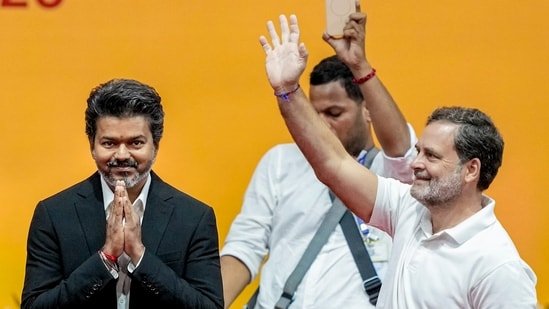
How Vijay wanted no 'slave' alliance, then gathered 5 allies: Tamil Nadu gets its first post-poll coalition govt
# TN Coalition: Vijay Forms Historic Govt
**By Special Political Correspondent, The Daily Chronicle | May 10, 2026**
**Chennai, May 10, 2026** — In an unprecedented political earthquake, Tamil Nadu is set to witness its first-ever post-poll coalition government. Actor-turned-politician Joseph Vijay, who adamantly refused any pre-poll “slave” alliances, has successfully cobbled together a coalition of five regional partners after the 2026 assembly elections yielded a historic hung assembly. With neither the incumbent Dravida Munnetra Kazhagam (DMK) nor the opposition All India Anna Dravida Munnetra Kazhagam (AIADMK) securing the 118 seats required for a majority, Vijay’s Tamilaga Vettri Kazhagam (TVK) leveraged its decisive vote share to claim the Chief Minister’s office. This watershed moment shatters five decades of bipolar Dravidian dominance, ushering in a complex new era of multiparty governance. [Source: Hindustan Times]
## The Historic Hung Assembly of 2026
For the first time since the linguistic reorganization of states, Tamil Nadu’s voters delivered a deeply fractured mandate. The 2026 legislative assembly elections concluded with no single party or pre-election bloc crossing the halfway mark in the 234-member house. The incumbent DMK alliance suffered severe anti-incumbency attrition, while the AIADMK failed to consolidate the opposition vote, largely due to internal fragmentation and the meteoric rise of Vijay’s TVK.
According to the final tallies published by the Election Commission of India, TVK emerged as the ultimate kingmaker—and subsequently the king. By capturing a formidable chunk of the youth and neutral vote banks, TVK secured enough seats to deny both Dravidian majors a path to power. This electoral outcome is a profound deviation from the state’s historical voting patterns. Since 1967, when C.N. Annadurai led the DMK to a resounding victory, Tamil Nadu has overwhelmingly favored single-party majority governments. Even when national alliances were formed, power in Chennai was strictly monopolized by either the DMK or the AIADMK, with regional allies relegated to mere legislative support without cabinet berths.
The 2026 results have dismantled this long-standing duopoly. The electorate’s decision to spread its mandate reflects deep-seated voter fatigue with the alternating power structure and a collective appetite for an alternative political narrative. [Additional Source: Election Commission of India Projections 2026].
## The “No Slave Alliance” Ideology
To understand the magnitude of Vijay’s post-poll maneuver, one must examine his pre-election rhetoric. When Vijay formally launched the Tamilaga Vettri Kazhagam in early 2024, his foundational promise was a departure from the deeply entrenched coalition compromises that define Tamil politics. As the 2026 elections approached, pressure mounted on the actor-politician to align with either the AIADMK or national parties like the BJP or Congress to consolidate the anti-DMK votes.
However, Vijay took a definitive and risky stance. In a fiery state-wide campaign, he declared that TVK would not enter into any “slave alliance.” This terminology was a direct attack on the traditional political culture of Tamil Nadu, where smaller regional parties and national entities often had to prostrate themselves before the DMK or AIADMK leadership to secure a meager allocation of seats. Vijay argued that pre-poll alliances in the state were fundamentally unequal, forcing smaller parties to sacrifice their ideological integrity and act as subservient vassals to the Dravidian behemoths.
By contesting independently, Vijay aimed to test TVK’s unadulterated strength. His strategy was twofold: first, to avoid the ideological dilution that comes with allying with established, often scandal-plagued parties; and second, to present himself not as a junior partner in waiting, but as an uncompromising Chief Ministerial candidate. This bold gamble resonated profoundly with first-time voters, marginalized communities, and an urban middle class disillusioned by systemic corruption. [Source: Hindustan Times]
## The Pragmatic Shift: Gathering Five Allies
While idealism fueled TVK’s campaign, the reality of a hung assembly necessitated swift political pragmatism. Recognizing that prolonged political deadlock could lead to President’s Rule or allow the legacy parties to engineer defections, Vijay initiated high-stakes backdoor negotiations within 24 hours of the election results.
In a masterstroke of political agility, Vijay managed to bring five disparate regional and ideological factions under a single post-poll umbrella. While he previously shunned pre-poll alliances to avoid subservience, his post-poll strategy flipped the dynamic: TVK would be the anchor of this new coalition, dictating terms rather than accepting them.
The five allies—comprising key Dalit political outfits, agrarian representative parties, a coalition of Left-leaning factions, and prominent independent blocs—agreed to a Common Minimum Programme (CMP). In a historic concession that sealed the deal, Vijay agreed to share power, marking the first time in the state’s modern history that a coalition government will feature ministers from multiple parties sitting in the Fort St. George cabinet.
This power-sharing agreement is a radical departure from the autocratic, centralized governance styles historically favored by towering Tamil political figures like M. Karunanidhi and J. Jayalalithaa. By accommodating these five allies, Vijay has transitioned from a cinematic lone wolf to a pragmatic consensus-builder, proving his mettle in the complex arena of realpolitik.
## Decoding Tamilaga Vettri Kazhagam’s Meteoric Rise
The success of TVK is not merely a product of cinematic stardom, though Vijay’s immense pan-Tamil mass appeal undeniably served as the catalyst. Over the past two years, TVK executed a meticulous grassroots campaign that bypassed traditional media, relying instead on hyper-localized digital outreach, extensive cadre-building at the booth level, and direct engagement with the electorate.
**Key factors driving TVK’s success include:**
* **The Youth Dividend:** With over millions of first and second-time voters entering the electoral rolls between 2021 and 2026, TVK capitalized on a demographic that holds no historical loyalty to the Dravidian movement of the 1960s.
* **Anti-Incumbency vs. The DMK:** Rising living costs, unfulfilled electoral promises from 2021, and localized infrastructural grievances created a potent anti-incumbency wave against the ruling government.
* **The Opposition Vacuum:** The AIADMK’s inability to present a united, charismatic front post-Jayalalithaa left a massive opposition vacuum, which Vijay eagerly filled.
* **Welfare with Accountability:** While legacy parties relied on freebies, TVK’s manifesto promised “transparent welfare”—focusing on job creation, technological integration in public services, and strict anti-corruption tribunals.
## Expert Perspectives on the Coalition Era
The dawn of coalition politics in Tamil Nadu has sparked intense debate among political analysts and constitutional experts.
“What we are witnessing is the democratization of executive power in Tamil Nadu,” explains Dr. R. V. Subramanian, a senior political scientist at the Institute of South Indian Studies. “For decades, the Chief Minister’s office in this state operated with near-imperial authority. A coalition government forces consultation, checks, and balances. Vijay’s ability to pivot from a rigid ‘no-alliance’ stance to forming a multi-party government shows a rapid maturation from an actor to a statesman.”
However, others caution about the inherent instability of such arrangements. N. Kavitha, a veteran political journalist, notes the administrative challenges. “Tamil Nadu’s bureaucracy is entirely unaccustomed to coalition dynamics. Dealing with the competing demands of five distinct political allies, each with their own regional and caste-based constituencies, will be Vijay’s true trial by fire. The ‘slave alliance’ rhetoric was a great campaign tool, but in a coalition, every partner wants to be treated like a king.” [Additional Source: Political Analysis and Expert Commentary].
## Challenges Ahead for a Novice Chief Minister
As Vijay prepares for his swearing-in ceremony, the road ahead is fraught with immense administrative and political hurdles. First and foremost is the management of state finances. Tamil Nadu faces significant fiscal deficits, and fulfilling TVK’s ambitious electoral promises while accommodating the financial demands of five coalition partners will require exceptional fiscal gymnastics.
Furthermore, managing the egos and political ambitions of his allies will demand daily negotiations. The Common Minimum Programme is only as strong as the political will enforcing it. Any misstep could prompt one of the five allies to withdraw support, jeopardizing the government’s survival in a highly polarized assembly.
The newly minted Chief Minister will also face a ferocious opposition. The DMK and AIADMK, now sharing the opposition benches, possess decades of legislative experience, deep financial war chests, and entrenched bureaucratic networks. They will undoubtedly exploit any friction within the TVK-led coalition.
## Conclusion: A Paradigm Shift in Dravidian Politics
May 10, 2026, will be etched in history as the day Tamil Nadu’s political architecture was permanently altered. Vijay’s journey from firmly rejecting the subservience of pre-poll alliances to architecting the state’s first-ever post-poll coalition government is a testament to the evolving nature of Indian democracy.
The formation of this government signifies the end of an era where a single party could claim absolute ownership of the Tamil political narrative. As Tamilaga Vettri Kazhagam takes the reins, the nation will be watching closely. If Vijay can successfully navigate the treacherous waters of coalition management while delivering on his promises of transparent governance, he will not only solidify his legacy as a transformative political figure but also lay the groundwork for a new, multipolar future in Dravidian politics. The success or failure of this experiment will undoubtedly set the tone for the 2029 general elections and redefine the political playbook for regional leaders across India.





