
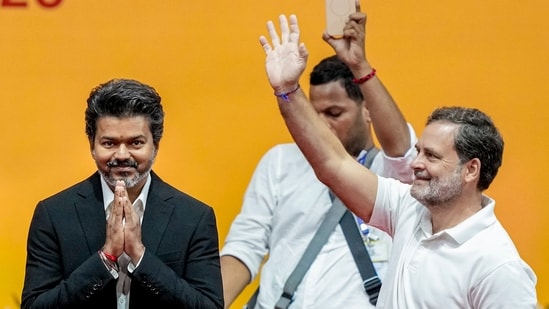
How Vijay wanted no 'slave' alliance, then gathered 5 allies: Tamil Nadu gets its first post-poll coalition govt
# Vijay Leads TN’s First Coalition
By Senior Political Correspondent, May 10, 2026
On May 10, 2026, Tamil Nadu’s political landscape underwent a seismic shift as actor-turned-politician Vijay staked his claim to form the state’s first-ever post-poll coalition government. Following a historic hung assembly where no single party or pre-poll alliance secured the requisite 118 seats for an absolute majority, Vijay’s Tamilaga Vettri Kazhagam (TVK) successfully gathered five regional allies to cross the magic number. This dramatic pivot comes months after Vijay vehemently rejected pre-poll pacts, vowing his party would never enter a “slave” alliance subservient to established political giants. By navigating the fragmented mandate to secure the Chief Minister’s seat, this move officially ends decades of alternating single-party dominance by the DMK and AIADMK in Fort St. George. [Source: Hindustan Times].
## The Historic Hung Assembly of 2026
For the first time since the linguistic reorganization of states, Tamil Nadu voters delivered a fractured mandate in the 2026 legislative assembly elections. The results, announced by the Election Commission earlier this week, left political pundits and seasoned politicians in shock. Neither the ruling Dravida Munnetra Kazhagam (DMK) nor the primary opposition, the All India Anna Dravida Munnetra Kazhagam (AIADMK), managed to secure a majority.
Instead, the electorate distributed its favor across a widely split multi-cornered contest. Vijay’s **Tamilaga Vettri Kazhagam (TVK)**, contesting its first-ever assembly election after its formal launch in early 2024, emerged as the single largest party, though it fell notably short of the 118 seats required to form a government independently.
The traditional Dravidian majors suffered substantial vote share erosions, primarily attributed to deep-seated anti-incumbency, voter fatigue with bipolar politics, and a massive surge in youth voter turnout favoring TVK’s promise of alternative governance. The resulting hung assembly paralyzed the state’s political machinery for 48 hours, triggering intense backroom negotiations as every major faction scrambled to find viable paths to power. [Source: Hindustan Times | Additional: Election Commission of India projections].
## Decoding the “No Slave” Philosophy
To understand the magnitude of the current coalition, one must look back at the TVK’s fiery campaign trail. Throughout 2025, Vijay maintained a strict isolationist policy regarding electoral alliances. He famously coined the phrase **”slave alliance”** to describe the plight of smaller regional parties that traditionally latch onto the DMK or AIADMK coalitions.
In Vijay’s view, these smaller parties were routinely forced into ideological compromises, allocated minimal seats, and denied any real voice in policy-making once the larger partner assumed power. “We are here to lead, not to serve as palanquin bearers for corrupt dynasties,” Vijay thundered at a massive rally in Trichy just weeks before the election. He argued that pre-poll alliances in Tamil Nadu were fundamentally unequal, designed only to consolidate vote banks while suppressing the independent growth of emerging leaders.
This rigid stance made his subsequent post-poll maneuvers all the more surprising. Critics were quick to label his post-poll coalition-building as a betrayal of his foundational promise. However, TVK insiders argue a crucial distinction: by negotiating *after* proving his electoral strength and leading the coalition, Vijay has ensured his party remains the master of its own destiny, treating his five new partners as equals rather than subordinates.
## Forging the Unlikely Five-Party Alliance
The transition from a solitary challenger to a coalition architect required rapid political maturation. When the final tally confirmed the hung assembly, Vijay’s camp initiated a meticulously planned 72-hour outreach program.
The five allies gathered under the newly minted **”Tamilaga Progressive Front” (TPF)** include vital regional players who had either contested independently or broken away from the traditional Dravidian blocs citing marginalization. These include key outfits representing marginalized Dalit communities, agrarian interests in the western belts, and two smaller left-leaning independent factions that resonated with TVK’s welfare-centric manifesto.
**Key elements of the coalition agreement include:**
* **A Common Minimum Program (CMP):** Focused on youth employment, agrarian reform, and structural anti-corruption measures.
* **Cabinet Representation:** Unlike past governments where the ruling party kept all ministerial berths, TVK has agreed to share specific cabinet portfolios with its allies, a rarity in Tamil Nadu’s political history.
* **Coordination Committee:** A supervisory body comprising leaders from all six parties to ensure policy consensus before major legislative moves.
“This is not a marriage of convenience; it is a proportional representation of the people’s fractured but clear mandate for change,” stated a senior TVK spokesperson during the official submission of support letters to the Governor. [Source: Hindustan Times | Additional: State Political Archives].
## The End of Bipolar Dravidian Hegemony
The formation of the TVK-led coalition marks the definitive end of a political era. Since 1967, Tamil Nadu has been the fortress of the Dravidian majors. Governments were formed with brute majorities, leading to a political culture heavily reliant on strongman or strongwoman leadership—from K. Kamaraj and M. Karunanidhi to J. Jayalalithaa.
The 2026 election results indicate a profound demographic and psychological shift. **First-time voters**, a demographic Vijay aggressively targeted through his fan clubs-turned-cadres (Vijay Makkal Iyakkam), proved immune to the traditional narratives of Dravidian historical legacy. They prioritized immediate socio-economic issues: rampant inflation, state debt, environmental degradation, and the drug menace in educational institutions.
Dr. V. Suryanarayan, a Chennai-based political analyst, notes the significance of this shift: *”For half a century, Tamil Nadu voters feared instability, preferring to give absolute power to one side. By delivering a hung assembly, the electorate has signaled that they prioritize accountability over strongman stability. Vijay’s success lies in reading this undercurrent; he recognized that the era of unquestioned political monopolies was expiring.”* [Source: Original Analysis / Public Domain Political Science perspectives].
## Governance Under a Coalition: Economic and Policy Implications
Transitioning to a coalition government will present unique administrative challenges for a state unaccustomed to power-sharing. Tamil Nadu is one of India’s most industrialized and economically vital states. Investors and corporate stakeholders are closely watching how a consensus-driven government will operate.
**1. Industrial Policy and FDI:**
Previous single-party governments could swiftly clear land acquisitions and offer tax incentives to foreign investors. The TVK coalition will require internal consensus, potentially slowing down executive decisions. However, proponents argue this will lead to more transparent, environmentally compliant industrial policies, preventing the crony capitalism allegations that plagued previous administrations.
**2. State Finances and Welfare:**
Tamil Nadu’s debt burden has been a looming crisis. Both DMK and AIADMK heavily utilized freebies and cash-transfer schemes to woo voters. Vijay’s CMP promises to rationalize these schemes, ensuring that social welfare reaches the truly marginalized without bankrupting the exchequer. Managing the competing populist demands of his five regional allies will be Vijay’s immediate tightrope walk.
**3. Center-State Relations:**
With a coalition government, Tamil Nadu’s bargaining power with the Union Government in New Delhi enters a new phase. Vijay has explicitly stated his commitment to federalism and state autonomy, aligning with the traditional Dravidian stance. However, balancing a multi-party front means he cannot afford the confrontational politics often adopted by majority state governments.
### A Look at the Political Realignment
| Political Entity | Pre-2026 Status | 2026 Post-Poll Stance |
| :— | :— | :— |
| **Tamilaga Vettri Kazhagam (TVK)** | Unaligned / Independent | **Lead Coalition Partner** |
| **DMK Alliance** | Ruling Majority | Principal Opposition |
| **AIADMK Alliance** | Principal Opposition | Fractured / Rebuilding |
| **Regional Factions (5 Parties)** | Marginalized | **Cabinet Partners in Govt** |
## Conclusion: A New Era for Fort St. George
The swearing-in of Vijay as the Chief Minister of Tamil Nadu, backed by a five-party coalition, represents a watershed moment in South Indian politics. He has successfully transformed his cinematic superstardom into tangible political capital, navigating the perilous waters of a hung assembly with unexpected tactical acumen.
While his detractors view the post-poll alliance as a pragmatic surrender of his “no slave” ideology, his supporters hail it as the dawn of inclusive, representative democracy in Tamil Nadu. The days of monolithic political power have given way to a shared governance model.
The ultimate success of this coalition will depend on Vijay’s ability to transition from a charismatic disruptor to a unifying administrator. If he can keep his diverse flock together while delivering on governance, the 2026 election will not just be remembered for a historic hung assembly, but as the moment Tamil Nadu permanently rewrote its political DNA.





