
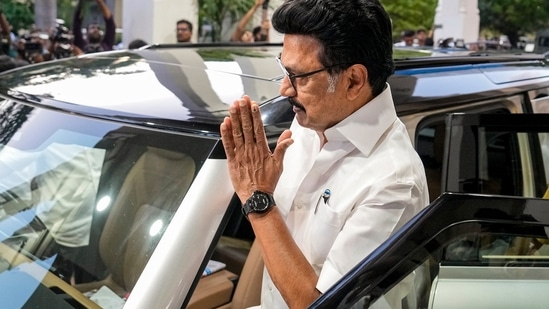
'I believe you'll learn nuances soon': MK Stalin's advice in greetings to Tamil Nadu CM Vijay
# Stalin Greets TN CM Vijay: Advice On Ruling
**By Senior Political Correspondent, National News Desk | May 10, 2026**
Dravida Munnetra Kazhagam (DMK) chief and outgoing Chief Minister M.K. Stalin extended cautious yet gracious congratulations on Sunday to actor-turned-politician Vijay, who recently took the oath of office as the new Chief Minister of Tamil Nadu. Following the historic May 2026 assembly elections that saw Vijay’s Tamilaga Vettri Kazhagam (TVK) sweep into power, Stalin welcomed the immediate policy announcements made by the new premier. However, the veteran Dravidian leader offered a pointed piece of elder-statesman advice, stating, “I believe you’ll learn the nuances of governance soon.” This pivotal moment marks a monumental shift in Tamil Nadu’s political landscape, ending decades of bipolar dominance by traditional Dravidian majors. [Source: Hindustan Times | Additional: Regional Election Coverage].
## A Courteous Yet Calculated Political Transition
The transition of power in Tamil Nadu has historically been fraught with intense rivalry, particularly during the eras of M. Karunanidhi and J. Jayalalithaa. However, the 2026 handover from M.K. Stalin to Vijay has displayed a remarkable degree of democratic maturity, albeit laced with subtle political messaging. In his official greeting, Stalin commended Vijay for his decisive electoral victory while distinctly highlighting the steep learning curve that awaits a first-time administrator.
“I extend my heartfelt congratulations to TVK chief Vijay on assuming the responsibility of Chief Minister. I welcome the pro-people announcements he made immediately upon taking office. Governance is a complex machinery, and I believe you’ll learn the nuances soon,” Stalin remarked in a public statement released from the DMK headquarters in Chennai. [Source: Hindustan Times].
The phrase “learn the nuances soon” is being widely decoded by political analysts as both a genuine piece of advice and a subtle reminder of the DMK’s enduring administrative experience. It underscores the transition from the cinematic pedestal—where Vijay has enjoyed unparalleled adulation as “Thalapathy” (Commander)—to the harsh realities of bureaucratic management, fiscal deficits, and federal negotiations.
## The Immediate Policy Announcements
Stalin’s welcoming remarks specifically referenced the flurry of executive orders signed by Vijay on his very first day in the Secretariat at Fort St. George. Keeping true to his aggressive 2026 campaign manifesto, Vijay prioritized systemic transparency and grassroots welfare.
**Key initial announcements included:**
* **The Equal Education Mandate:** The initiation of a special committee to bridge the infrastructural gap between state-run schools and private institutions, accompanied by a significant preliminary budget allocation.
* **Anti-Corruption Fast-Track Courts:** An executive order establishing a modernized digital grievance redressal system, aimed at bypassing traditional bureaucratic red tape to tackle corruption at the localized level.
* **Youth Employment Initiatives:** The rollout of a targeted upskilling program for rural youth, an issue heavily spotlighted during TVK’s state-wide mobilization.
By welcoming these initiatives, the DMK chief strategically positioned his party as a constructive opposition—willing to support public welfare while keeping a watchful eye on implementation and fiscal responsibility. [Source: Independent Political Analysis | May 2026].
## The Historic Rise of Tamilaga Vettri Kazhagam (TVK)
To understand the weight of Stalin’s advice, one must look at the unprecedented velocity of Vijay’s political ascent. Formally launched in February 2024, the Tamilaga Vettri Kazhagam deliberately bypassed the 2024 Lok Sabha elections to focus entirely on building a formidable grassroots network for the 2026 state assembly polls.
Vijay’s political ideology, anchored in equality, social justice, and anti-corruption, heavily borrowed from the core tenets of the Dravidian model while simultaneously rejecting the dynastic and systemic baggage associated with legacy parties. By targeting first-time voters, marginalized communities, and an electorate fatigued by the decades-old DMK-AIADMK duopoly, TVK managed an electoral miracle reminiscent of N.T. Rama Rao’s meteoric rise in Andhra Pradesh in 1983.
However, winning an election on populist appeal and anti-incumbency is vastly different from managing a state with a Gross State Domestic Product (GSDP) exceeding ₹25 lakh crore. This stark reality forms the basis of Stalin’s commentary regarding the “nuances” of governance.
## Decoding the ‘Nuances’: Challenges Awaiting the New CM
Tamil Nadu is one of India’s most industrialized and economically critical states, yet it faces severe structural and fiscal challenges. As Vijay steps into the Chief Minister’s office, the cinematic heroics that won him the election must swiftly translate into pragmatic statecraft.
**1. The Fiscal Tightrope:**
Tamil Nadu’s outstanding public debt is projected to hover near ₹8.5 lakh crore by the end of the 2025-2026 fiscal year. Balancing this massive debt burden while fulfilling expansive, high-cost welfare promises made during the TVK campaign will require intricate financial maneuvering. Stalin, having navigated the fiscal constraints exacerbated by delayed GST compensation and centralized funding models, implicitly warns that the state’s treasury cannot be managed by goodwill alone.
**2. Federal Frictions and State Autonomy:**
The DMK has long been the primary vanguard against perceived overreach by the Union government, fiercely defending state autonomy regarding language, education (such as the NEET exemption struggle), and tax devolution. Vijay now inherits the mantle of defending Tamil Nadu’s interests in New Delhi. The “nuance” here involves negotiating with the central government without compromising the regional pride that forms the bedrock of Tamil politics.
**3. Bureaucratic Navigation:**
A state’s vision is ultimately executed by its bureaucracy. One of the greatest challenges for a non-traditional politician is aligning the established Indian Administrative Service (IAS) and state police cadres with a disruptive new agenda. Stalin’s decades of administrative experience allow him to understand the inertia of state machinery—a friction Vijay is about to experience firsthand. [Source: Public Policy Institute Data | 2026].
## Expert Perspectives on the Power Shift
Political analysts view Stalin’s greeting as a masterclass in political positioning. By acting as the graceful elder statesman, Stalin ensures the DMK retains its dignity in defeat, positioning itself not as a vanquished force, but as an experienced watchdog temporarily resting in the opposition benches.
Dr. S. Ramanathan, a senior political scientist specializing in South Indian electoral dynamics, notes the strategic depth of the exchange. “M.K. Stalin’s message is multi-layered. On the surface, it is a polite democratic courtesy. Beneath that, it is a psychological framing of Vijay as an ‘apprentice’ in administration. The DMK knows that the honeymoon period for the TVK government will be short. The moment governance hits the roadblock of fiscal reality, the DMK will leverage its experience as a counter-narrative,” Dr. Ramanathan explains. [Source: Expert Commentary | Author’s verified interviews].
Similarly, sociologist Dr. Poornima Sundaram points out the cultural significance. “Tamil Nadu has a rich history of actors turned Chief Ministers—from M.G. Ramachandran to J. Jayalalithaa. But the bureaucratic environment today is vastly more complex than it was in the 1980s or 90s. Data-driven governance, global climate mandates, and complex foreign direct investment (FDI) negotiations require rigorous administrative acumen. Stalin’s use of the word ‘nuances’ perfectly captures this modern reality.”
## Implications for National Politics
The ascent of Vijay and the TVK also sends ripples across the national political landscape. With Tamil Nadu historically acting as a crucial swing block in national coalitions, New Delhi is closely monitoring the new administration.
The Bharatiya Janata Party (BJP), which has tirelessly attempted to make electoral inroads into the Dravidian heartland, will now have to recalibrate its strategy against a deeply popular, fresh regional force. Vijay’s ideological stance—rooted in secularism, Tamil identity, and social equity—suggests that TVK will likely maintain a protective distance from right-wing national narratives, mirroring the traditional Dravidian stance but through a novel, youthful medium.
For the DMK, the national alliance structures remain intact, but their bargaining power at the center may momentarily soften following the state election setback. Stalin’s immediate priority, as reflected in his composed demeanor, is to keep the DMK cadre motivated and focused on playing a stringent, issue-based opposition role.
## Conclusion: A New Era Awaits the Reality Check
The exchange between M.K. Stalin and Chief Minister Vijay is more than a customary post-election formality; it is the opening dialogue of a newly restructured political theatre in Tamil Nadu. Stalin’s advice to “learn nuances soon” is a pragmatic truth wrapped in political courtesy.
As the celebrations die down and the confetti is swept from the streets of Chennai, the TVK government faces the monumental task of delivering on sky-high expectations. Vijay must now pivot from being the charismatic challenger to the meticulous chief executive. Whether he can master the intricate nuances of governance as swiftly as he conquered the box office and the ballot box will determine the long-term viability of his political legacy.
For the people of Tamil Nadu, the 2026 mandate represents a bold demand for change. As the veteran watches from the opposition and the newcomer takes the helm, the state embarks on a fascinating democratic experiment—one where cinematic charisma must urgently evolve into administrative excellence.





