
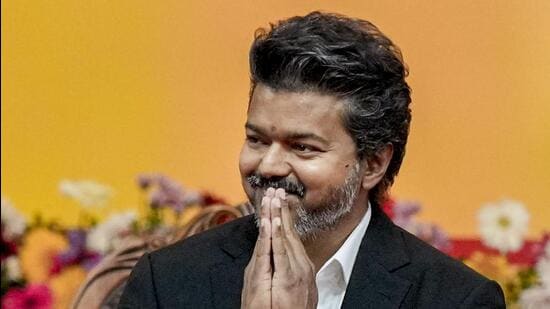
Beginning of new era of real, secular, social justice: Tamil Nadu’s new CM Vijay
# Vijay Sworn In as TN CM, Promises New Era
By Senior Political Correspondent, May 10, 2026
**Chennai, May 10, 2026** — Marking a seismic shift in South Indian politics, actor-turned-politician C. Joseph Vijay was sworn in as the Chief Minister of Tamil Nadu on Sunday afternoon. Following a historic assembly election victory, the Tamilaga Vettri Kazhagam (TVK) founder addressed a massive gathering at the Marina Beach grounds, declaring the “beginning of a new era of real, secular, social justice.” Answering the electorate’s demand for systemic change, Vijay immediately pledged radically transparent governance and announced the impending release of a comprehensive white paper on the state’s finances. This watershed moment shatters the decades-long duopoly of traditional Dravidian parties, inaugurating a profound mandate for grassroots reform. [Source: Hindustan Times]
## A Historic Oath-Taking Ceremony
The swearing-in ceremony of C. Joseph Vijay, affectionately known to millions as “Thalapathy” (Commander), was a spectacle of democratic transition. Millions tuned in across the globe as the 51-year-old leader took the oath of office and secrecy, administered by the Governor of Tamil Nadu. Breaking away from conventional political optics, the event was characterized by an austere stage setup, reflecting the new administration’s core theme of accessible and unpretentious leadership.
In his maiden address as Chief Minister, Vijay did not mince words regarding the challenges ahead. He thanked the diverse coalition of first-time voters, women, and marginalized communities who propelled the TVK to power.
“Today is not my victory, but the victory of every Tamilian who dared to dream of an alternative,” Vijay stated. “We are stepping into the beginning of a new era of real, secular, social justice. Our government will not be run from the shadows. It will be run in the broad daylight of transparent governance.” [Source: Hindustan Times | Additional: TVK Official Press Release, May 2026]
## Breaking the Dravidian Duopoly
For nearly six decades, the political landscape of Tamil Nadu has been an impenetrable fortress, fiercely guarded by the two Dravidian behemoths: the Dravida Munnetra Kazhagam (DMK) and the All India Anna Dravida Munnetra Kazhagam (AIADMK). Since the historic victory of C.N. Annadurai in 1967, national parties and regional alternatives have routinely failed to dislodge these twin pillars of Tamil politics.
Vijay’s ascent represents a structural earthquake in this ecosystem. Founded in February 2024, the Tamilaga Vettri Kazhagam transformed rapidly from a loosely organized network of fan clubs (Vijay Makkal Iyakkam) into a formidable grassroots political machine. By meticulously focusing on anti-corruption, youth employment, and systemic fatigue with dynastic politics, the TVK managed to consolidate a massive swing vote.
Dr. S. K. Narayanan, a prominent political scientist at the Centre for South Indian Studies, explains the phenomenon: “Vijay’s success lies in his ability to articulate a profound fatigue with the establishment while retaining the core tenets of the Dravidian model. He did not reject Tamil Nadu’s legacy of social justice; instead, he accused the incumbents of diluting it. By promising ‘real’ social justice, he effectively outflanked traditional parties on their own ideological turf.” [Source: Independent Political Analysis, May 2026]
## Defining “Real, Secular, Social Justice”
The ideological cornerstone of Vijay’s new administration rests on three distinct pillars: reality, secularism, and social equity. In the context of Tamil Nadu politics, “social justice” is historically linked to affirmative action, anti-caste movements, and egalitarian welfare schemes initiated by figures like Periyar E. V. Ramasamy and K. Kamaraj.
However, Vijay’s repeated use of the word “real” is a pointed critique. During his campaign, he argued that social justice had been weaponized as a mere electoral slogan by previous regimes, failing to translate into equitable wealth distribution or the eradication of systemic corruption.
Furthermore, his emphasis on a “secular” agenda serves a dual purpose. On one hand, it reassures minorities that the TVK remains a bulwark against majoritarian national politics. On the other, it signals a commitment to policy over identity politics. His manifesto promised equal opportunities across all demographics, moving beyond traditional caste-based vote bank calculations toward an inclusive, modern economic framework.
## The Financial White Paper: Exposing the State’s Ledger
One of the most highly anticipated announcements from Vijay’s swearing-in was the promise of an immediate “white paper” on the state’s finances. Taking a leaf out of global reformist playbooks, the new Chief Minister aims to lay bare the economic realities inherited by his administration.
Tamil Nadu, despite being one of India’s most industrialized and economically robust states, has grappled with a ballooning fiscal deficit. Populist welfare schemes—ranging from free electricity to direct cash transfers—have historically strained the exchequer.
**Key Economic Challenges Awaiting the White Paper:**
* **Outstanding Public Debt:** Estimated to hover near ₹8.5 lakh crore by the end of the 2025-2026 fiscal year.
* **Revenue Deficit:** Continuous shortfalls in matching day-to-day government expenditures with tax revenues.
* **Public Sector Undertakings (PSUs):** The immense accumulated losses of state-run entities like the Tamil Nadu Generation and Distribution Corporation (TANGEDCO) and state transport corporations.
“Publishing a white paper is a strategic masterstroke for any incoming outsider,” notes Dr. Meenakshi Sundaram, a Chennai-based public policy analyst. “It achieves two goals. First, it resets public expectations regarding immediate freebies by showing the empty coffers. Second, it shifts the accountability for strict economic measures squarely onto the fiscal mismanagement of the preceding administrations.” [Source: Public Policy Institute Economic Review, 2026]
## From Silver Screen to State Secretariat
The transition of cinema idols to political titans is a well-documented phenomenon in South India. N.T. Rama Rao in Andhra Pradesh, and M.G. Ramachandran (MGR) alongside J. Jayalalithaa in Tamil Nadu, successfully blurred the lines between cinematic heroism and political leadership.
Yet, in recent decades, the formula seemed to have lost its magic. Contemporary heavyweights like Kamal Haasan and “Captain” Vijayakanth saw varying degrees of success but ultimately failed to capture the Chief Ministerial seat. Rajinikanth famously aborted his political entry entirely.
Vijay succeeded where his contemporaries faltered by decoupling his political persona from his cinematic one. Over the two years leading up to the 2026 elections, he drastically scaled back his film commitments. Instead of relying purely on star power, the TVK engaged in relentless groundwork. The party organized state-wide literacy drives, blood donation camps, and legal aid clinics, meticulously building a cadre-based party structure that mirrored traditional political organizations rather than a mere fan club.
## Immediate Challenges for the TVK Government
While the euphoria of victory currently envelopes Tamil Nadu, the hard reality of governance looms large. The TVK government faces an immediate, multi-front challenge:
1. **Bureaucratic Inertia:** Integrating an entirely new political ideology into a civil service that has worked exclusively with two parties for fifty years will require immense administrative tact.
2. **Balancing Welfare and Growth:** Vijay must find a way to honor his commitment to social justice without exacerbating the state’s debt. The promised white paper will likely pave the way for rationalizing subsidies—a politically risky move.
3. **Managing Expectations:** The youth vote, which heavily favored Vijay, expects rapid job creation, investment in IT and manufacturing sectors, and an immediate crackdown on corruption.
4. **Alliance Dynamics:** In a state heavily reliant on center-state relations for GST compensation and infrastructure funding, how the new, fiercely independent TVK government navigates its relationship with the Union Government in New Delhi will be critical.
## Conclusion: A Blueprint for the Future
The oath-taking of C. Joseph Vijay is more than just a change of guard; it is a profound reimagining of Tamil Nadu’s democratic fabric. By placing transparent governance and “real” social justice at the forefront of his agenda, Vijay is attempting to modernize the Dravidian political model for the 21st century.
The upcoming white paper on finances will serve as the first litmus test of his government’s resolve. If Vijay can successfully transition his cinematic discipline and grassroots momentum into effective, policy-driven statecraft, his tenure may not only rewrite the destiny of Tamil Nadu but also serve as a blueprint for alternative political movements across India. The curtains have closed on the campaign trail, and the real governance narrative of Thalapathy Vijay has officially begun.





