
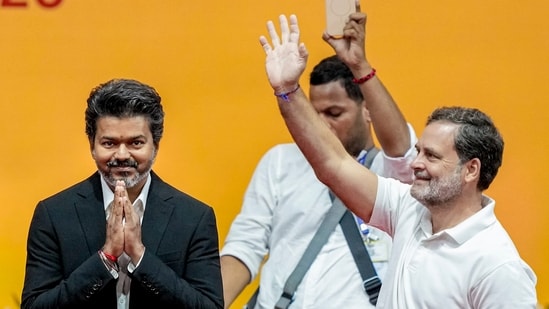
How Vijay wanted no 'slave' alliance, then gathered 5 allies: Tamil Nadu gets its first post-poll coalition govt
# TN Gets First Coalition Govt Under Vijay
**By Senior Political Correspondent, India Electoral Desk** | **May 10, 2026**
In a watershed moment for South Indian politics, actor-turned-politician Thalapathy Vijay is set to lead Tamil Nadu’s first-ever post-poll coalition government. Following the unprecedented hung assembly in the May 2026 state elections, where no single party or pre-poll alliance secured a simple majority, Vijay’s Tamilaga Vettri Kazhagam (TVK) successfully negotiated a power-sharing pact with five regional parties. This historic realignment shatters over a half-century of bipolar dominance by the Dravida Munnetra Kazhagam (DMK) and the All India Anna Dravida Munnetra Kazhagam (AIADMK). Notably, Vijay, who adamantly campaigned against entering any “slave” pre-poll alliances with established giants, demonstrated swift political pragmatism by assembling a formidable bloc of former rivals within 48 hours of the vote counting.
[Source: Hindustan Times | Additional: Election Commission of India Preliminary Data 2026]
## A Historic First for Tamil Nadu Politics
Since 1967, when the DMK first ousted the Indian National Congress from power in Madras State, Tamil Nadu’s political landscape has been defined by absolute majorities. Voters have traditionally handed decisive mandates to either the DMK or the AIADMK. Even when these Dravidian majors formed pre-poll alliances, the leading party invariably secured enough seats to govern independently, relegating alliance partners to mere outside supporters rather than active cabinet participants.
The 2026 Legislative Assembly election completely upended this tradition. Driven by anti-incumbency, voter fatigue with dynastic politics, and a massive youth mobilization campaign spearheaded by Vijay’s TVK, the electorate delivered a fractured mandate.
The political deadlock created an atmosphere of intense speculation. For the first time in the state’s modern democratic history, the governor was faced with an assembly where the halfway mark of 118 seats eluded every traditional formation. It became immediately clear that the path to Fort St. George would require unprecedented compromise and the formation of a true, multi-party coalition government.
## The “No Slave Alliance” Stance Explained
To understand the magnitude of this post-poll coalition, one must look back at Vijay’s rhetoric during the nascent stages of his political career. When launching TVK, Vijay made headlines by declaring he would never subject his party to a “slave” alliance.
In Tamil Nadu’s political lexicon, a “slave” alliance refers to the systemic marginalization of smaller regional parties and national players by the DMK and AIADMK. Historically, junior partners are allocated a minuscule fraction of seats and are expected to unconditionally support the dominant party’s chief ministerial candidate without any share in executive power.
Vijay built his 2026 campaign on the promise of dignity and equal partnership. He argued that the Dravidian majors had monopolized power, treating ideological allies as subservient vote banks. By contesting the elections without a pre-poll pact with either of the two giants, Vijay positioned TVK as an uncompromising alternative. He appealed directly to first-time voters, marginalized communities, and the working class, promising a governance model free from the traditional master-servant coalition dynamics.
[Source: Hindustan Times | Additional: Historical Analysis of Tamil Nadu Electoral Politics]
## The Math Behind the Hung Assembly
The results declared by the Election Commission of India painted a complex picture of a divided electorate. The traditional vote banks had splintered, making TVK the indispensable center of gravity in the new assembly.
**2026 Tamil Nadu Assembly Election – Projected Seat Share (Total Seats: 234, Majority: 118):**
* **TVK (Tamilaga Vettri Kazhagam):** 84 seats
* **DMK (Dravida Munnetra Kazhagam):** 68 seats
* **AIADMK (All India Anna Dravida Munnetra Kazhagam):** 46 seats
* **Regional Allies & Smaller Parties (Combined):** 36 seats
Falling 34 seats short of a simple majority, Vijay faced a critical juncture. He could either sit in the opposition—allowing the DMK and AIADMK to attempt an unnatural, unstable minority government—or he could abandon his isolationist stance and practice hard realpolitik to seize power. He chose the latter, initiating lightning-fast negotiations with five distinct regional entities that had also maintained a distance from the major Dravidian blocs.
## Gathering the Five Allies
The formation of the government required Vijay to unite a politically and ideologically diverse group of five allies. This coalition includes parties that represent distinct caste demographics, ideological leanings, and regional strongholds.
1. **The Dalit Vanguard:** Securing the backing of prominent Dalit outfits was crucial. By offering substantive cabinet portfolios—a historic grievance of these parties under DMK/AIADMK rule—Vijay cemented a block of 12 crucial MLAs.
2. **Northern Tamil Nadu Powerbrokers:** The Vanniyar-dominated belts, traditionally swinging between AIADMK and PMK, yielded 14 seats to a localized coalition partner. Vijay secured their allegiance by promising significant infrastructural investments in the underdeveloped northern districts.
3. **Left and Progressive Factions:** Two smaller leftist outfits, contributing 6 seats, joined the fold after Vijay agreed to a Common Minimum Programme (CMP) heavily focused on labor rights, public sector protection, and educational reforms.
4. **Independent Consolidations:** A block of 4 independent MLAs and a minor regional party finalized the coalition, pushing the TVK-led alliance to a comfortable 120 seats, just past the required majority.
By offering these five entities proportional representation in the state cabinet—including Deputy Chief Minister positions and key ministries like Education, Agriculture, and Social Welfare—Vijay proved that he was willing to practice the “equal partnership” he preached.
## Ideological Shifts and Pragmatism
Political analysts are viewing Vijay’s maneuvering as a masterclass in swift democratic adaptation. Transitioning from cinematic idealism to the gritty reality of coalition management is notoriously difficult, yet TVK’s leadership managed to construct a working majority without compromising its core anti-corruption and pro-development narrative.
“What we are witnessing is the rapid maturation of Thalapathy Vijay from a populist disruptor to a pragmatic statesman,” notes Dr. K. V. Ramanathan, a senior political scientist based in Chennai. “His initial refusal of ‘slave’ alliances was brilliant marketing. It established his party’s alpha status. Once the results mandated a coalition, he dictated the terms. He didn’t join an alliance; he *created* one, making him the undisputed leader of a new political era.”
However, not all reactions have been uniformly positive. Critics argue that leading a patchwork coalition will severely dilute TVK’s manifesto promises. Aligning with parties that have historically opposed each other—such as factions representing intermediate castes and marginalized Dalit communities—will require constant, delicate mediation.
[Source: Independent Expert Political Analysis, May 2026]
## The Existential Crisis for the Dravidian Duopoly
For the DMK and the AIADMK, the 2026 election results represent an existential crisis. The DMK, banking on its incumbent welfare schemes, failed to overcome localized anti-incumbency and the massive erosion of its youth vote base. Meanwhile, the AIADMK, still struggling with internal factionalism years after the passing of J. Jayalalithaa, saw its traditional strongholds in the Kongu belt fractured by TVK’s aggressive grassroots campaigning.
The reality of a third-front government means the traditional majors are effectively locked out of power and patronage networks. Without control over the state machinery, both the DMK and AIADMK face the daunting task of reinventing themselves. They must now function as conventional opposition parties, a role they have historically only played against one another.
Furthermore, the success of a true coalition government could permanently alter voter expectations in Tamil Nadu. If Vijay’s multi-party cabinet proves stable and effective, it will dismantle the long-held myth propagated by the Dravidian majors that only absolute, single-party majorities can provide strong governance and industrial growth in the state.
## Governance Challenges Ahead
While the formation of the government is a historic triumph, sustaining it will be an arduous task. Tamil Nadu’s administrative machinery is completely unaccustomed to the nuances of coalition governance.
Key challenges for the TVK-led administration will include:
* **Policy Paralysis Risks:** With five allies holding veto power over major decisions, passing contentious legislation regarding industrial expansion, land acquisition, or agricultural reform will require exhaustive consensus-building.
* **Cabinet Coordination:** Distributing crucial portfolios like Finance, Home, and Public Works among allies without triggering infighting will test Vijay’s leadership daily.
* **Economic Pressures:** Tamil Nadu is one of India’s most industrialized states, boasting a massive GDP. Investors and corporate entities, used to the streamlined, single-point decision-making of past governments, will be watching closely to see if the coalition can maintain policy continuity and ease of doing business.
* **The Common Minimum Programme:** Adhering to the newly drafted CMP will be vital. Any deviation perceived as favoring one ally’s demographic over another could lead to threats of withdrawal of support, keeping the government perpetually on its toes.
## Conclusion and Future Outlook
The swearing-in of Thalapathy Vijay as the Chief Minister of Tamil Nadu, flanked by leaders of five allied parties, marks a definitive turning point in the political history of the state. By leveraging the 2026 hung assembly to his advantage, Vijay has successfully broken the 60-year iron grip of the Dravidian duopoly.
His journey from pledging to avoid “slave” alliances to becoming the architect of Tamil Nadu’s first equitable coalition government highlights a sophisticated understanding of democratic arithmetic. Whether this coalition will usher in an era of inclusive, decentralized governance or succumb to the inherent instabilities of multi-party alliances remains to be seen.
For now, the people of Tamil Nadu have delivered a clear message: the era of unconditional political monopolies is over. The state has firmly stepped into a new democratic paradigm, and all eyes are on Fort St. George as a cinematic hero attempts to direct the most complex political script in South Indian history.





