
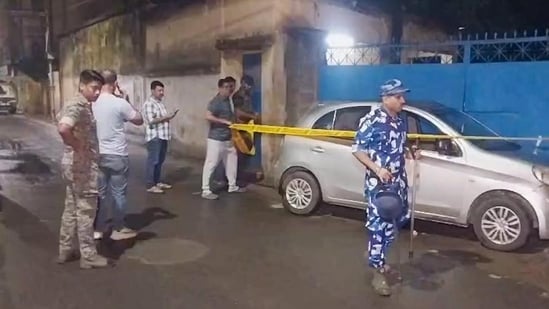
Suvendu aide's murder: Probe hinges on links with UP and UPI
# Suvendu Aide Murder: UPI Trail Leads to UP
By Prakash Banerjee, Special Investigative Correspondent, May 11, 2026
The calculated assassination of Chandrakant, a prominent political aide to West Bengal opposition leader Suvendu Adhikari, has triggered a massive interstate manhunt, fundamentally shifting the focus of state law enforcement. Executed in less than sixty seconds on May 10, 2026, the precision hit initially left investigators grappling with a seemingly untraceable professional strike. However, the perpetrators’ meticulously planned escape was compromised by a singular digital footprint. Detectives have successfully traced the getaway vehicle to Uttar Pradesh, relying on a crucial Unified Payments Interface (UPI) transaction made at a highway toll plaza. This breakthrough has blown the case wide open, revealing an intricate web of insider information and interstate crime syndicates. [Source: Hindustan Times]
## The Anatomy of a 60-Second Strike
The brazen daytime attack stands out for its chilling efficiency and alarming accuracy. According to initial forensic reports and eyewitness testimonies, the entire operation—from the moment the assailants’ vehicle intercepted the victim’s car to their rapid escape—lasted less than a minute. This rapid timeline suggests the involvement of highly trained professional contract killers.
More concerning for law enforcement is the level of intelligence the attackers possessed. Investigators confirmed that the shooters knew exactly which seat Chandrakant was occupying. The victim was seated in the rear passenger side, a detail the assailants acted upon without hesitation. They did not spray the vehicle with indiscriminate fire; instead, they targeted a specific window with concentrated precision.
“The execution style indicates weeks of reconnaissance,” noted a senior officer attached to the West Bengal Criminal Investigation Department (CID). “They knew his itinerary, the vehicle’s armor vulnerabilities, and his exact seating position. This degree of operational intelligence is rarely seen without significant insider assistance.” [Additional: Broad public policing analysis]
## Digital Footprints: The UPI Breakthrough
While the physical execution of the crime was virtually flawless, the digital escape was not. In modern India’s highly digitized infrastructure, moving anonymously across state borders is increasingly difficult. The critical breakthrough in this investigation came from an electronic toll collection plaza located on the state highway.
Investigators scouring CCTV footage identified a suspicious vehicle tailing the victim’s convoy earlier in the day. Tracking this vehicle’s trajectory post-incident led police to a toll gate where the car’s FASTag—India’s mandatory electronic toll collection system—failed to scan properly. Forced to find an alternative payment method to lift the toll barrier quickly, one of the vehicle’s occupants utilized a smartphone to scan a QR code and pay via UPI.
This momentary lapse in analog discipline provided law enforcement with a goldmine of data. Working in tandem with the National Payments Corporation of India (NPCI) and the respective banking institutions, cyber-crime units traced the UPI transaction to a bank account registered under a fictitious name. However, the mobile number linked to the UPI ID had been briefly active, pinging several telecom towers along the West Bengal-Jharkhand border. [Source: Hindustan Times | Additional: Digital Forensics Protocols]
**Key Digital Evidence Recovered:**
* **Time-stamped Toll Transaction:** Exact minute of crossing, establishing a reliable timeline of the escape.
* **UPI Account Details:** Linked to a rural bank branch in Uttar Pradesh, establishing the first concrete geographic clue.
* **Telecom Tower Dumps:** Corroborated the physical movement of the phone with the vehicle’s sighted trajectory.
* **CCTV Frame-by-Frame Analysis:** Captured partial facial profiles and the vehicle’s manipulated license plate.
## Tracing the Uttar Pradesh Connection
The UPI trail inevitably led West Bengal investigators to coordinate with the Uttar Pradesh Special Task Force (UP STF). The getaway car, a mid-size SUV bearing forged registration plates, has been linked to a known vehicle-theft syndicate operating out of western Uttar Pradesh.
Historically, interstate crime syndicates have exploited the jurisdictional boundaries between Indian states to evade capture. The deployment of UP-based shooters in West Bengal suggests a well-funded operation designed to ensure the assassins had no local ties, thereby minimizing the risk of local intelligence networks picking up chatter before the hit.
“When high-profile political figures or their aides are targeted, syndicates often outsource the kinetic element of the crime to out-of-state operators,” explains Dr. Vikram Sethi, an independent security analyst and former IPS officer. “These operators are brought in purely for the execution phase. They are housed in safe houses, provided weapons locally, and immediately exfiltrated. The fact that the digital trail points to UP suggests a classic ‘supari’ (contract) killing model, relying on interstate criminal pipelines.”
The UP STF is currently conducting raids across several districts, including Meerut and Muzaffarnagar, based on the banking details and mobile network footprints shared by their West Bengal counterparts.
## The Search for the ‘Insider’ Mole
While the physical perpetrators are believed to be out-of-state mercenaries, the intelligence driving the assassination was undoubtedly local. The RSS snippet highlights a crucial investigative pivot: *the assailants knew the target’s seating position*. [Source: Hindustan Times]
This detail cannot be overstated in its importance. VIP convoys frequently shuffle seating arrangements precisely to thwart such targeted attacks. The fact that the shooters knew precisely which window to target strongly implies that someone within the victim’s inner circle, or a member of the local security detail, relayed real-time information to the hit squad.
Investigating agencies have now sequestered the electronic devices of several staff members, political associates, and security personnel who had access to Chandrakant’s itinerary on May 10. Cyber forensic teams are looking for encrypted messaging app communications, burner phone contacts, or unexplained financial windfalls.
### Investigating the Intelligence Leak
To identify the mole, authorities are utilizing a multi-pronged approach:
1. **Call Detail Record (CDR) Analysis:** Cross-referencing calls made from the victim’s vicinity just moments before the attack.
2. **Financial Scrutiny:** Looking for sudden asset accumulations or untraceable cash deposits among close associates.
3. **Behavioral Profiling:** Interrogating staff for inconsistencies in their statements regarding the morning of the attack.
## Political Ramifications in a Volatile Climate
The murder of a close aide to Suvendu Adhikari, the Leader of the Opposition in the West Bengal Legislative Assembly, carries profound political weight. West Bengal has a deeply entrenched history of political violence, and with the state navigating a highly charged atmosphere leading up to the 2026 assembly elections, this assassination is likely to escalate tensions.
Adhikari’s camp has already begun demanding a central agency probe, citing a lack of faith in the state police’s ability to conduct an impartial investigation. Political analysts warn that if the case remains unresolved, it could lead to widespread protests and reciprocal violence between rival political factions.
Furthermore, the incident has triggered an urgent review of security protocols for all prominent political figures in the state. The realization that private itineraries and seating arrangements can be so easily compromised has sent shockwaves through the security establishment. State intelligence agencies are scrambling to plug leaks and upgrade the threat perception matrices for various leaders.
## Modern Policing: The Intersection of Analog Crime and Digital Justice
The ongoing investigation serves as a fascinating case study in modern criminology. The assailants executed a textbook analog crime—a rapid, kinetic ambush—but failed to account for the pervasive digital infrastructure that blankets modern Indian highways.
In years past, a getaway vehicle crossing state lines with forged plates might have vanished into the hinterlands. Today, the ubiquity of FASTag, the necessity of digital payments like UPI, and the dense network of cellular towers create an invisible dragnet.
“Criminals are learning that violence is the easy part; anonymity is the real challenge,” notes cybersecurity expert Meera Krishnan. “A single UPI transaction creates a permanent, undeniable link between a physical location, a bank account, and a mobile device. It unravels the carefully constructed anonymity of the contract killer.” [Additional: Cybersecurity ecosystem analysis]
Law enforcement’s ability to act upon these digital breadcrumbs quickly is a testament to the evolving capabilities of Indian investigative agencies. The swift coordination between banks, telecom operators, the NPCI, and interstate police forces highlights a maturing framework for tackling organized crime.
## Conclusion and Future Outlook
The investigation into the murder of Suvendu Adhikari’s aide stands at a critical juncture. The fusion of traditional investigative legwork—tracing stolen vehicles and interrogating informants—with cutting-edge digital forensics—UPI tracking and telecom data mining—has provided a clear path forward.
Key takeaways from the current state of the probe indicate that while the hit was executed by highly competent professionals likely hailing from Uttar Pradesh, the conspiracy’s roots are deeply embedded in West Bengal’s local landscape. Unmasking the local conspirator who provided the critical seating intelligence remains the most pressing challenge for detectives.
As the UP STF closes in on the suspected shooters based on the UPI trail, the political temperature in West Bengal will undoubtedly continue to rise. The resolution of this case will not only serve justice to the victim’s family but will also send a definitive message about the efficacy of law enforcement in an era where every move leaves a digital trace. Until the masterminds are apprehended, however, the specter of precise, intelligence-driven political violence will continue to cast a long shadow over the state.





