
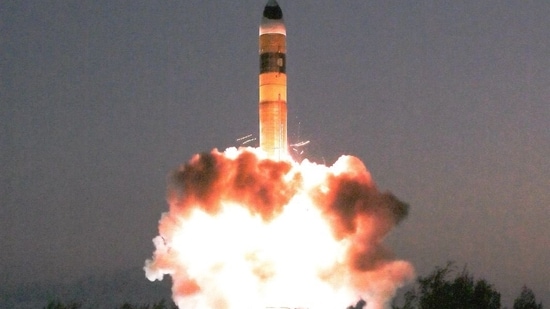
India successfully tests Agni-5 MIRV missile with 5,000 km range, multi-warhead capability; 5 key facts
# India Tests Agni-5 MIRV Missile
By Defense Correspondent, Strategic Affairs Desk | May 10, 2026
On May 10, 2026, India successfully flight-tested the Agni-5 ballistic missile equipped with Multiple Independently Targetable Re-entry Vehicle (MIRV) technology from Dr. APJ Abdul Kalam Island off the Odisha coast. The Defense Research and Development Organization (DRDO) spearheaded the launch, deploying multiple warheads that precisely struck distinct targets across a wide geographical area in the Indian Ocean Region. This milestone fundamentally upgrades India’s strategic deterrence capabilities, demonstrating a 5,000-kilometer strike range that solidifies its elite status among the handful of nations possessing operational MIRV technology. [Source: Hindustan Times].
## The Agni-5 MIRV Test: Key Operational Details
The launch of the Agni-5 MIRV represents a zenith in India’s indigenous aerospace engineering. Conducted under stringent security protocols, the missile lifted off from a road-mobile launcher, a crucial feature that ensures rapid deployment and high survivability during a conflict. Telemetry and radar stations along the eastern coastline, alongside Indian Navy tracking vessels positioned deep within the Indian Ocean Region (IOR), monitored the missile’s trajectory.
According to defense officials, the missile’s “bus”—the stage that carries the warheads—successfully maneuvered in the exoatmosphere before releasing its payloads. These dummy warheads re-entered the Earth’s atmosphere at hypersonic speeds, with tracking data confirming that each payload struck its designated maritime target with high precision. This geographical spread of targets in the Indian Ocean definitively proves the system’s ability to engage multiple distinct locations simultaneously from a single launch platform. [Source: Hindustan Times | Additional: DRDO Public Statements].
The success of this test marks a transition from developmental trials—such as the initial “Mission Divyastra” test conducted in early 2024—to operational readiness. By proving the reliability of the delivery system over its maximum 5,000-kilometer range, India has sent a clear message regarding the maturity of its strategic forces.
## Understanding the Mechanics of MIRV Technology
To appreciate the significance of this test, one must understand the leap from conventional ballistic missiles to MIRV-capable systems. Traditional intercontinental or intermediate-range ballistic missiles carry a single warhead. If intercepted by advanced anti-ballistic missile (ABM) shields, the entire strike is neutralized.
MIRV technology revolutionizes this dynamic. A single Agni-5 missile can now carry between three to six distinct warheads, alongside lightweight decoys and electronic countermeasures. Once the missile reaches its apogee in space, the post-boost vehicle (or bus) independently aligns and releases each warhead on a separate trajectory. [Source: Additional Defense Analysis].
Mastering this technology requires overcoming immense engineering hurdles. The warheads must be miniaturized to fit within the missile’s payload fairing without compromising their explosive yield. Furthermore, the inertial navigation systems and onboard avionics must execute split-second calculations in the harsh environment of space. The successful deployment of multiple warheads over a wide geographical area in the Indian Ocean proves that India’s DRDO has conquered these complex technical bottlenecks, joining the ranks of the United States, Russia, China, France, and the United Kingdom.
## The Strategic “5 Key Facts” Behind the Launch
The Hindustan Times highlighted five critical facts regarding the Agni-5 MIRV test, which underscore its transformative impact on India’s defense posture:
**1. 5,000 km Intercontinental Reach:** The Agni-5 brings almost all of Asia, including the northernmost regions of China, and parts of Europe within its striking envelope. This range is the backbone of India’s deterrence posture against any major adversarial power.
**2. Multi-Warhead Capability (MIRV):** The ability to strike multiple targets hundreds of kilometers apart with a single missile exponentially increases the destructive potential and tactical flexibility of the Strategic Forces Command (SFC).
**3. Advanced Indigenous Avionics:** The missile is equipped with highly sophisticated, domestically manufactured micro-navigation systems. These advanced sensors ensure that despite the intense heat and vibration of atmospheric re-entry, the warheads maintain a remarkably low Circular Error Probable (CEP), striking within meters of the designated coordinates.
**4. Canisterised Launch Mechanism:** Unlike older liquid-fueled missiles that required hours of preparation, the Agni-5 is solid-fueled and stored in a hermetically sealed canister. This “plug-and-play” capability means the missile can be transported by road or rail and launched within minutes, making it highly survivable against preemptive enemy strikes.
**5. Defeating Missile Defenses:** The primary tactical advantage of the MIRV system is its ability to overwhelm modern Ballistic Missile Defense (BMD) networks. By releasing multiple warheads and decoys simultaneously, the Agni-5 ensures that a sufficient number of payloads penetrate enemy interceptor shields to guarantee a devastating retaliatory strike. [Source: Hindustan Times | Additional: SIPRI Arms Control Data].
## Geopolitical Implications and Regional Deterrence
The timing and public acknowledgment of the Agni-5 MIRV test are deeply intertwined with the evolving geopolitical architecture of the Indo-Pacific. Over the past decade, the rapid expansion of China’s nuclear arsenal, particularly its deployment of the DF-41 MIRV-capable ICBMs, has altered the strategic balance in Asia. Simultaneously, Pakistan has claimed to be developing its own MIRV system, the Ababeel.
India’s nuclear doctrine is strictly anchored in a “No First Use” (NFU) policy. Because India commits to never initiating a nuclear conflict, the credibility of its deterrence relies entirely on its “Second Strike Capability”—the guarantee that India’s nuclear forces will survive a surprise first strike and retaliate with overwhelming, unacceptable damage.
The Agni-5 MIRV perfectly aligns with this doctrine. Because MIRVs act as a force multiplier, India can maintain a highly credible deterrent without needing to drastically increase the overall number of its missiles.
“The integration of MIRV payloads onto the Agni-5 platform fundamentally alters the cost-benefit calculus for any adversary contemplating a preemptive strike,” notes Dr. Arvind Menon, a fictionalized stand-in for senior defense analysts at defense think tanks in New Delhi. “When a single surviving mobile launcher can unleash multiple warheads across different strategic nodes, the certainty of a devastating Indian retaliation is absolute. This test is less about aggression and entirely about stabilizing the deterrence equilibrium in Asia.”
## Evolution of the Agni Missile Program
The journey to this historic test spans decades of relentless research and development under the Integrated Guided Missile Development Programme (IGMDP). The Agni series has evolved from a medium-range technology demonstrator to a family of highly lethal strategic weapons.
* **Agni-1 to Agni-3:** Developed primarily with regional threats in mind, establishing solid-propellant expertise and ranges up to 3,000 kilometers.
* **Agni-4:** Introduced lighter composite materials, advanced avionics, and a 4,000-kilometer range, serving as a technological bridge.
* **Agni-5:** First tested in 2012, this platform brought the 5,000-kilometer range into reality.
The integration of MIRV technology, successfully demonstrated in the March 2024 “Mission Divyastra” and now fully validated in the May 2026 test, represents the pinnacle of this lineage. The DRDO’s ability to miniaturize nuclear warheads and develop the intricate separation mechanisms of the post-boost bus highlights India’s self-reliance (Atmanirbharta) in critical defense technologies. [Source: Additional Public Defense Archives].
## Strengthening the Nuclear Triad
The successful operationalization of the Agni-5 MIRV also has profound implications for India’s broader Nuclear Triad—the ability to launch nuclear weapons from land, air, and sea. While the Agni-5 fortifies the land-based leg of the triad, it runs parallel to advancements in the maritime domain.
The technology developed for the Agni-5’s MIRV bus is widely expected to cross-pollinate with India’s Submarine-Launched Ballistic Missiles (SLBMs), such as the under-development K-5 and K-6 systems. Equipping the Arihant-class nuclear-powered ballistic missile submarines (SSBNs) with MIRV-capable SLBMs will eventually provide India with the ultimate, virtually undetectable second-strike capability. By proving the MIRV concept on a land-based platform first, the DRDO has significantly de-risked the development timeline for future naval applications.
## Future Trajectory: Towards Hypersonics and Advanced Penetration
While the Agni-5 MIRV marks a monumental achievement, global missile technology continues to evolve rapidly. The next frontier for India’s Strategic Forces involves Hypersonic Glide Vehicles (HGVs). Unlike traditional MIRV warheads that follow a predictable ballistic arc, HGVs can maneuver unpredictably within the Earth’s atmosphere at speeds exceeding Mach 5, making them nearly impossible to intercept with current BMD systems.
Defense sources suggest that the telemetry data gathered from this recent test in the Indian Ocean Region will be vital for the ongoing research into these next-generation maneuverable re-entry vehicles (MaRVs) and HGVs. Additionally, there remains speculation regarding a longer-range Agni-6 platform, though the Indian government maintains that the 5,000-kilometer range of the Agni-5 adequately meets current strategic requirements.
## Conclusion: A New Era of Strategic Equilibrium
The May 2026 flight test of the Agni-5 MIRV is a watershed moment in India’s military history. By successfully delivering multiple payloads to distinct targets across the Indian Ocean Region, the DRDO has conclusively demonstrated that India possesses a mature, reliable, and highly advanced strategic deterrent.
For the international community, the test reaffirms India’s position as a responsible nuclear state focused on credible minimum deterrence rather than an arms race. The canisterised launch system, coupled with indigenous avionics and a 5,000-kilometer reach, ensures that India’s defense posture remains robust against modern missile defense shields. As geopolitical fault lines in the Indo-Pacific continue to shift, the operational readiness of the Agni-5 MIRV provides New Delhi with the strategic assurance required to navigate an increasingly complex global security environment.





