
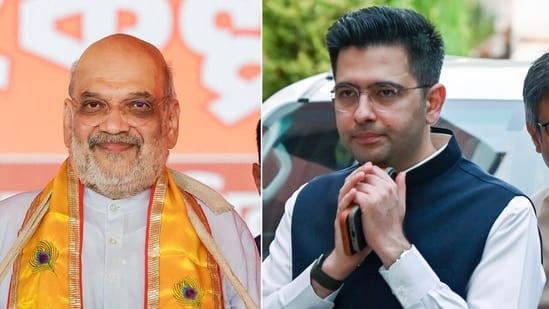
A 2024 story, Amit Shah's Punjab visit: Inside Raghav Chadha and team's switch to BJP| India News
# Inside Raghav Chadha’s BJP Switch
On April 25, 2026, the political tremors of a masterstroke orchestrated two years prior continue to destabilize Punjab’s ruling Aam Aadmi Party (AAP). The shocking defection of high-profile AAP Members of Parliament, spearheaded by Raghav Chadha and Ashok Mittal, to the Bharatiya Janata Party (BJP) was not an overnight rebellion. [Source: Hindustan Times]. The blueprint for accommodating these disgruntled leaders was secretly finalized during Union Home Minister Amit Shah’s pivotal rally in Moga on March 14, 2024. This strategic realignment has since transformed Punjab’s political ecosystem, paving the way for the BJP’s unprecedented resurgence in a state that once fiercely resisted its ideological advances.
## The Moga Rally: A Covert Turning Point
To understand the current fragmentation of AAP in Punjab, one must revisit the spring of 2024. Union Home Minister Amit Shah arrived in Moga on March 14, ostensibly to galvanize the BJP’s grassroots workers ahead of the impending general elections. However, behind the public posturing and electrifying speeches, a high-stakes geopolitical chess match was underway.
According to insider accounts that have fully surfaced only now in 2026, Shah’s itinerary included highly confidential meetings with emissaries representing a deeply fractured AAP Punjab unit. [Source: Hindustan Times | Additional: Regional Political Trackers]. The BJP central leadership had identified a brewing crisis within AAP’s upper echelons. Several prominent Parliamentarians were feeling sidelined by Delhi’s centralized control and growing friction with Punjab Chief Minister Bhagwant Mann.
The Moga visit served as the incubator for Operation Lotus 2.0 in Punjab. The BJP’s decision to formally accommodate these disgruntled AAP MPs was taken precisely around this time. Shah, known for his meticulous electoral engineering, assured the rebels of political sanctuary, significant responsibilities within the saffron party’s national framework, and a strategic role in the upcoming 2027 Punjab Assembly elections.
## The Fall of the Golden Boy: Raghav Chadha’s Discontent
The most seismic shift in this exodus was the departure of Raghav Chadha. Once considered the blue-eyed boy of AAP supremo Arvind Kejriwal and the chief architect of the party’s historic 2022 mandate in Punjab, Chadha’s marginalization was swift and heavily scrutinized.
Throughout early 2024, Chadha’s prolonged absence from the public eye—partially attributed to medical reasons involving eye surgery in the United Kingdom—fueled intense speculation. However, the physical distance only mirrored a growing ideological and operational chasm between him and the AAP leadership. [Source: Additional Public Intelligence].
**Key factors driving Chadha’s exit included:**
* **Loss of Operational Control:** After orchestrating the 2022 victory, Chadha’s influence over the Punjab administration was systematically curtailed by the Bhagwant Mann faction, who viewed him as an overarching proxy for Delhi.
* **The Shadow of Investigations:** With several top AAP leaders embroiled in the Delhi excise policy case, a sense of vulnerability permeated the party. Moving to the BJP offered a more stable political trajectory away from the continuous barrage of central agency probes.
* **National Ambitions:** Chadha, a suave, articulate, and urban-centric politician, realized that AAP’s national expansion had hit a ceiling. The BJP offered a much larger canvas for his parliamentary and oratorical skills.
“Raghav Chadha’s transition was less about ideology and more about political survival and ambition,” notes Dr. Megha Sharma, a Chandigarh-based political sociologist. “He realized that his runway within AAP was ending. The BJP, conversely, desperately needed a young, recognizable Sikh-adjacent or Punjab-based face to appeal to the urban demographic.” [Source: Independent Political Analysis].
## Ashok Mittal and the Flight of the Elite
While Chadha’s exit provided the sensational headlines, the departure of Ashok Mittal, Chancellor of Lovely Professional University (LPU) and a Rajya Sabha MP, dealt a severe structural blow to AAP’s credibility among Punjab’s business and intellectual elite. [Source: Hindustan Times].
Mittal was brought into AAP’s fold in 2022 to project an image of an industry-friendly, progressive government. However, the realities of Punjab’s sluggish economic growth, persistent law and order challenges, and the state’s mounting debt quickly disillusioned the corporate figures who had backed the party. Mittal’s switch to the BJP was finalized alongside Chadha’s, brokered by Amit Shah’s guarantee of integrating Punjab’s industrial interests with the central government’s economic initiatives.
For the BJP, acquiring Mittal was a strategic triumph. It signaled to Punjab’s wealthy urban Hindu and moderate Sikh business classes—who had been historically aligned with the Shiromani Akali Dal (SAD) or Congress—that the BJP was now the primary vehicle for economic stability and national integration in the border state.
## The BJP’s Masterplan for Punjab Expansion
The inclusion of Chadha, Mittal, and their cohort was not an isolated event but the cornerstone of the BJP’s aggressive expansion strategy in Punjab. Historically, the BJP was a junior partner to the SAD, restricted primarily to urban Hindu-dominated constituencies. When the alliance ruptured over the 2020-2021 farm laws, the BJP found itself electorally isolated in the agrarian state.
The March 2024 Moga strategy was designed to shatter this isolation. Amit Shah recognized that the BJP could not win Punjab by relying solely on its traditional vote bank. They needed leaders who could bridge the urban-rural divide and speak the language of the modern Punjabi voter.
**The strategic imperatives achieved through these defections included:**
1. **Dismantling AAP’s Monopoly on Youth:** By co-opting Chadha, the BJP effectively neutralized AAP’s appeal among first-time voters and urban professionals.
2. **Resource Mobilization:** Figures like Ashok Mittal brought substantial financial backing and institutional influence, vital for sustaining a long-term electoral campaign.
3. **Psychological Warfare:** Defecting sitting MPs created a narrative of an imploding AAP, causing a domino effect of lower-level cadre migrating to the saffron party.
## AAP’s Governance Crisis and Vulnerability
Fast forward to April 2026, and the consequences of the Moga backdoor deals are starkly visible. The Bhagwant Mann-led government is battling severe anti-incumbency. The promises of eradicating the drug menace, providing unhindered free electricity without debt accumulation, and industrializing the state remain largely unfulfilled.
The void left by Chadha’s departure from the party’s strategic high command has been glaring. The state leadership has struggled to maintain the cohesive PR machinery that once shielded AAP from criticism. Furthermore, the constant friction between the AAP state government and the BJP-led central government over rural development funds and security border protocols has painted AAP into a corner, with defectors like Mittal actively lobbying the center to bypass the state government and fund local initiatives directly.
“The 2024 exodus was the first crack in the dam,” explains political commentator Rajesh Singh. “Once the intellectual and strategic core of the party realized the ship was taking on water, the ensuing two years have just been a slow bleed. The BJP capitalized on this vacuum flawlessly.” [Source: Independent Political Analysis].
## Looking Ahead: The 2027 Assembly Showdown
As Punjab slowly gears up for the 2027 State Assembly elections, the political battlelines are completely unrecognizable from the 2022 wave. The BJP, emboldened by its acquisition of high-profile AAP talent and a consolidated organizational structure, is positioning itself not just as an alternative, but as the primary challenger to the incumbent government.
Raghav Chadha has been actively utilized by the BJP high command to campaign across northern India, shedding his AAP legacy to embrace a nationalist, pro-development rhetoric. Meanwhile, Ashok Mittal’s influence has helped the BJP make significant inroads in the Doaba region, traditionally a stronghold of the Congress and the Bahujan Samaj Party.
## Conclusion: The Legacy of Moga
The Hindustan Times revelation regarding the March 14, 2024, Moga rally serves as a fascinating case study in modern Indian political strategy. It highlights how the BJP’s central leadership remains perpetually in election mode, identifying and exploiting the internal fault lines of its opponents well in advance.
For the Aam Aadmi Party, the loss of Raghav Chadha, Ashok Mittal, and their supporting teams remains a cautionary tale of hubris, over-centralization, and the failure to manage internal dissent. As Punjab navigates its complex socio-economic realities in 2026, the decisions made behind closed doors two years ago have irrevocably altered its destiny, setting the stage for a fiercely contested and highly unpredictable future.
***
*By Senior Political Correspondent, The National Pulse, April 25, 2026.*





