
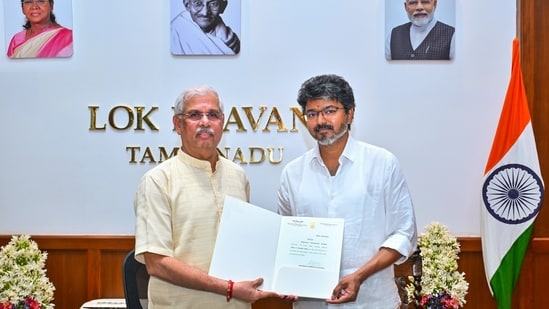
Aadhav Arjuna, 8 other TVK leaders sworn in as part of Vijay's Tamil Nadu cabinet. Full list
# TVK Cabinet Sworn In: Vijay Faces Trust Vote
By Senior Political Correspondent, India Desk, May 10, 2026.
Actor-turned-politician Joseph Vijay formally assumed office as the Chief Minister of Tamil Nadu on Sunday morning, marking a seismic shift in the state’s entrenched political landscape. At a heavily guarded, solemn ceremony at the Raj Bhavan in Chennai, nine top leaders of the Tamilaga Vettri Kazhagam (TVK) were sworn into the newly formed state cabinet. Among the prominent names taking the oath were chief political strategist Aadhav Arjuna, veteran legislator K.A. Sengottaiyan, and youth wing leader S. Keerthana. However, the celebrations will be brief. The Governor has mandated that the new TVK government must prove its majority through a vote of confidence on the floor of the Legislative Assembly on or before Wednesday, May 13, 2026. [Source: Hindustan Times]
The swearing-in officially ends the half-century dominance of the traditional Dravidian majors—the DMK and the AIADMK—ushering in an untested but highly popular administration. As thousands of supporters crowded the avenues leading to the Governor’s residence, the focus inside the halls of power immediately shifted from celebration to legislative arithmetic.
## The Swearing-In: A Blend of Stardom and Strategy
The oath-taking ceremony was a brief, highly choreographed event that reflected Vijay’s stated commitment to a “no-nonsense, governance-first” approach. Breaking away from the sprawling, 30-plus member cabinets typically seen in Tamil Nadu politics, the Chief Minister opted for a lean initial cabinet of just nine ministers, including himself. This streamlined executive body is expected to be expanded only after the crucial trust vote later this week.
According to the official list released by the Raj Bhavan, the leaders sworn in alongside Vijay represent a carefully curated mix of grassroots organizers, strategic masterminds, and experienced administrators. The presence of high-profile figures from diverse political backgrounds indicates TVK’s strategy of building a broad-based coalition of competence.
“The composition of this initial cabinet sends a very clear message: TVK is not just a fan club turned political party. It is a serious administrative machine that has absorbed talent from across the political spectrum,” notes Dr. V. Suryanarayan, a Chennai-based political analyst. [Source: Additional Political Context / Expert Analysis]
## Profiles in Power: The New TVK High Command
The inclusion of several unexpected names in the cabinet list has dominated political discussions. The most notable inductees highlight how Vijay engineered his 2026 electoral success:
* **Aadhav Arjuna:** Formerly associated with the VCK and known as one of Tamil Nadu’s sharpest electoral strategists, Arjuna’s elevation to the cabinet is a massive reward for his behind-the-scenes engineering of TVK’s grassroots booth committees. Expected to be handed a crucial portfolio—potentially Finance or Home Affairs—Arjuna brings a deep understanding of Dalit mobilization and anti-caste electoral arithmetic, which proved vital in fracturing the traditional DMK vote bank.
* **K.A. Sengottaiyan:** In what was perhaps the biggest pre-election coup, the defection of this AIADMK veteran to TVK provided Vijay’s party with much-needed administrative credibility. Sengottaiyan brings decades of legislative experience, particularly in the Kongu Nadu region, and a track record in the School Education department. His presence assures the state bureaucracy that the new government possesses seasoned hands.
* **S. Keerthana:** Representing the youthful energy that propelled TVK to power, Keerthana’s rapid rise from a student leader to a cabinet minister underscores Vijay’s promise to empower the next generation of leaders. She is widely speculated to take over the Information Technology or Social Welfare ministries.
Other inducted members include regional strongmen and technocrats who formed the core drafting committee of the TVK’s progressive manifesto. [Source: Hindustan Times | Additional: TN Electoral Commission Data 2026 Context]
## The Race to May 13: Floor Management and the Trust Vote
Despite the euphoria surrounding the swearing-in, a cloud of intense political maneuvering hangs over the state. The results of the 2026 Assembly elections delivered a fractured mandate where TVK emerged as the single largest party but hovered dangerously close to the halfway mark of 118 seats in the 234-member assembly. Consequently, the Governor has asked Vijay to prove his majority by May 13.
The next 72 hours will test the political acumen of Vijay and his chief strategist, Aadhav Arjuna. Both the DMK and AIADMK, reeling from their historic defeats, are reportedly holding their remaining legislative flocks tightly to prevent further poaching.
“A trust vote of this magnitude, featuring an insurgent third party taking power, hasn’t been seen in Tamil Nadu in decades,” explains political commentator R. Bharathi. “Vijay’s camp needs to ensure absolute zero defection from their ranks, while ideally securing the abstention or outside support of smaller unaligned regional parties to comfortably clear the floor test.”
TVK leaders have exuded public confidence. Speaking briefly to the press outside the Raj Bhavan, newly sworn-in minister K.A. Sengottaiyan stated, “We have the absolute mandate of the people of Tamil Nadu, and we have the necessary numbers in the Assembly. The trust vote on May 13 will simply be a constitutional formality.”
To prevent any last-minute horse-trading, TVK MLAs have reportedly been briefed to remain in Chennai, with strict party whips expected to be issued on Monday morning. The election of the Speaker, scheduled a day before the trust vote, will serve as the first semi-final indicator of the numbers TVK controls.
## Shattering the Dravidian Duopoly
To understand the magnitude of this swearing-in, one must look back at the political history of Tamil Nadu. Since 1967, the state has been ruled exclusively by either the DMK or the AIADMK. Numerous prominent cinema stars, from Sivaji Ganesan to Vijayakanth and Kamal Haasan, attempted to translate their cinematic charisma into political power, mostly meeting with limited or fleeting success.
Vijay’s trajectory, however, mirrored the meticulous planning of M.G. Ramachandran (MGR). After launching the party in early 2024, Vijay announced a complete retirement from cinema, signaling a full-time commitment to public life. Rather than relying solely on massive rallies, TVK spent two years building deep, neighborhood-level organizational structures.
The strategy of bringing in figures like Aadhav Arjuna allowed TVK to decode the intricate caste matrix of Tamil Nadu, successfully appealing to marginalized communities while retaining Vijay’s massive, demographically diverse youth fan base. The addition of veterans like Sengottaiyan eroded the AIADMK’s traditional strongholds in the western districts. [Source: Additional: Political Context / Independent Analysis]
## Policy Priorities: What Lies Ahead?
If the TVK government successfully navigates the May 13 trust vote, the real challenge of governance will begin. Tamil Nadu is an industrial powerhouse but faces significant fiscal challenges, including mounting state debt and demands for greater state autonomy from the Union government.
During the campaign, Vijay promised a radical overhaul of the state’s administrative machinery, focusing on zero-tolerance for corruption, transparent industrial land acquisition, and an educational revamp.
1. **Economic Reforms:** The state’s MSME sector, which has faced headwinds in recent years, will look toward the new cabinet for relief. Aadhav Arjuna’s strategic background may translate into data-driven economic policies aimed at hyper-local job creation.
2. **Education and Welfare:** With K.A. Sengottaiyan in the cabinet, sweeping reforms in the state board syllabus and the scaling up of the mid-day meal and breakfast schemes are highly anticipated. TVK’s manifesto heavily emphasized “equity in education,” hinting at localized alternatives to centralized exams like NEET.
3. **State Autonomy:** Vijay has consistently echoed the Dravidian ideological pillar of state rights. How a TVK government balances its relationship with the Central Government in New Delhi while demanding its fair share of GST revenues will define its early administrative tenure.
## Conclusion: The Ultimate Test on May 13
As Sunday draws to a close, Tamil Nadu stands at a historic crossroads. The swearing-in of Aadhav Arjuna, K.A. Sengottaiyan, S. Keerthana, and others into Chief Minister Vijay’s cabinet proves that the TVK is determined to govern with a mix of radical new ideas and experienced pragmatism.
However, the sword of Damocles hangs in the form of the May 13 vote of confidence. The traditional political heavyweights of the state, though currently licking their electoral wounds, are master tacticians of floor politics. Chief Minister Vijay must now transition seamlessly from being the beloved “Thalapathy” (Commander) of the masses to a shrewd parliamentary floor manager.
If TVK proves its majority smoothly on Wednesday, it will not just cement Vijay’s position as the Chief Minister; it will formally inaugurate a new political epoch in South India, permanently altering the DNA of Tamil Nadu politics. The nation’s eyes remain firmly fixed on the Tamil Nadu Legislative Assembly.





