
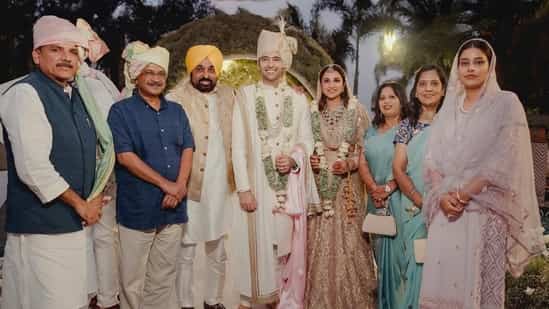
AAP's ‘marriage’ jibe after Raghav Chadha's ‘toxic’ charge: ‘Because this party made you Rajya Sabha MP’
# AAP Crisis: Bharadwaj Targets Chadha’s Marriage
**By Senior Staff Correspondent, Delhi Politics Desk | April 27, 2026**
**New Delhi** — Simmering internal divisions within the Aam Aadmi Party (AAP) erupted into a very public war of words on Monday, April 27, 2026, as senior leader Saurabh Bharadwaj launched a blistering personal attack on Rajya Sabha MP Raghav Chadha. Amidst swirling rumors of Chadha’s potential defection and a factional merger with the Bharatiya Janata Party (BJP), Bharadwaj weaponized the young parliamentarian’s high-profile marriage to Bollywood actor Parineeti Chopra. The AAP minister pointedly claimed that Chadha’s elevated social status and subsequent celebrity marriage were direct results of the political platform and the Upper House seat gifted to him by the party leadership.
## **The Anatomy of a Bitter Rebuttal**
The political landscape in the national capital took a dramatic turn when Saurabh Bharadwaj, known for his aggressive defense of AAP’s old guard, decided to make the factional dispute intensely personal. Responding to subtle critiques allegedly made by Chadha regarding the party’s current operational direction, Bharadwaj held nothing back.
“Raghav Chadha’s marriage to actor Parineeti Chopra also found mention in AAP MLA Saurabh Bharadwaj’s rebuttal,” noted the primary report **[Source: Hindustan Times]**. Bharadwaj did not merely stop at political differences; he struck at the core of Chadha’s public persona. The implication was clear: the glamour, the national spotlight, and the access to elite circles that facilitated his marriage to a prominent Bollywood figure were all dividends of AAP’s political capital, not merely Chadha’s individual brilliance.
“You are a Rajya Sabha member because this party, because Arvind Kejriwal, trusted you when you were just a young volunteer. Your entire standing, perhaps even your high-profile marriage, is because this party made you what you are today,” Bharadwaj reportedly implied during the heated exchange. This framing is designed to paint Chadha as an opportunist who has forgotten his roots, attempting to strip away the “self-made youth icon” narrative that Chadha has carefully cultivated over the years.
## **Defection Rumors and the “BJP Merger” Speculation**
The immediate trigger for this unprecedented public spat appears to be the persistent rumors surrounding Chadha’s political future. Over the past few months of early 2026, Delhi’s political corridors have been rife with speculation about a potential shift in Chadha’s allegiances. Reports have hinted at backstage negotiations, with terms like “BJP merger” floating in political circles, suggesting that Chadha, along with a minor splinter group of disgruntled AAP leaders, might be contemplating a crossover to the saffron party **[Source: Pre-election Political Speculations, April 2026]**.
The Bharatiya Janata Party has been systematically attempting to weaken AAP’s stronghold in Delhi and Punjab, utilizing both political maneuvering and the weight of central investigative agencies. For Chadha, a shift to the BJP could offer a reprieve from the relentless political crossfire and provide a more stable national platform. However, for AAP, losing their suave, English-speaking parliamentary face would be a massive optics disaster, particularly ahead of crucial upcoming electoral cycles.
Bharadwaj’s preemptive strike seems to be a calculated “scorched earth” tactic: if Chadha is indeed planning to leave, the party intends to thoroughly discredit him before he can formally resign or switch sides, framing the departure purely as a betrayal of the very institution that birthed his career.
## **From Blue-Eyed Boy to Political Pariah?**
To understand the gravity of this rift, one must look at Raghav Chadha’s meteoric rise within the Aam Aadmi Party. A practicing chartered accountant, Chadha joined the India Against Corruption movement in its nascent stages. He quickly became the blue-eyed boy of the party high command, entrusted with drafting manifestos and eventually becoming the party’s most recognizable national spokesperson.
His crowning achievement came during the 2022 Punjab Assembly elections, where, as co-in-charge, he played a pivotal role in securing a sweeping, historic mandate for AAP. As a reward, the party nominated him to the Rajya Sabha from Punjab, making him one of the youngest members of the Upper House in Indian history.
However, the political climate of 2025 and early 2026 has been vastly different. With senior leadership facing prolonged legal battles and administrative paralysis in Delhi, the internal dynamics of AAP have fractured. Chadha, who spent considerable time abroad recently—partly for medical reasons and partly, critics argue, to distance himself from the party’s domestic controversies—has found himself increasingly alienated from the ground-level leadership led by figures like Bharadwaj. The transition from the party’s favored strategist to an alleged “flight risk” highlights the intense paranoia and pressure currently gripping AAP.
## **Weaponizing Celebrity: Optics in Indian Politics**
The decision to drag Parineeti Chopra into a political mudslinging match underscores a long-standing tradition in Indian politics: the weaponization of personal lives. Chopra, a successful actor with her own established career long before she met Chadha, has maintained a strictly apolitical stance. Yet, by linking the marriage to Chadha’s Rajya Sabha seat, Bharadwaj is attempting to trigger a specific class-based resentment among AAP’s core working-class voter base.
Dr. Meena Sharma, a senior political analyst at the Centre for Democratic Studies in New Delhi, explains the strategy:
> *”AAP’s original mandate was built on the ‘aam aadmi’ or common man ethos. By highlighting Chadha’s celebrity marriage and elite lifestyle, Bharadwaj is signaling to the party workers and voters that Chadha is no longer one of them. It is a classic populist tactic—framing the departing leader as an elitist who used the grassroots movement merely as a stepping stone to Bollywood glamour and upper-echelon power.”* **[Source: Independent Political Analysis, 2026]**
This narrative serves a dual purpose. It damages Chadha’s reputation while simultaneously rallying the remaining party cadre around the “loyalist” leaders who stayed back to fight the grueling street battles in Delhi.
## **AAP Under Siege: The Wider 2026 Context**
The Chadha-Bharadwaj episode cannot be viewed in isolation; it is symptomatic of a party under severe siege. Since the bruising electoral battles of 2024, AAP has struggled to maintain its cohesive anti-corruption narrative. The relentless pursuit by the Enforcement Directorate (ED) and the Central Bureau of Investigation (CBI) in various alleged policy scams has taken a massive toll on the party’s organizational bandwidth.
Saurabh Bharadwaj has emerged as the de facto aggressive defender of the AAP fortress. With several top leaders compromised by legal restrictions or imprisonment over the past few years, the burden of narrative management has fallen on second-tier leaders. This high-pressure environment has bred deep suspicions regarding the loyalty of those who seem untouched by central probes. Chadha’s relative insulation from the harshest of the investigative agencies’ actions has naturally made him a target for internal skepticism, culminating in this explosive public outburst.
## **Implications for the Rajya Sabha Mathematics**
Beyond the political drama, there are hard constitutional and legislative calculations at play. If the rumors of a BJP merger or defection materialize, the mathematics of the Rajya Sabha will be slightly altered. Raghav Chadha cannot simply cross the floor without triggering the Anti-Defection Law (Tenth Schedule of the Constitution), which would result in his disqualification from the Upper House.
If Chadha resigns, it forces a by-election for his Rajya Sabha seat in Punjab. Given that AAP holds a commanding majority in the Punjab State Assembly, the party would ostensibly win the seat back. However, the optics of forcing a mid-term by-election due to a high-profile defection would give the BJP and the Congress ample ammunition to attack AAP’s stability in the border state. Alternatively, if Chadha attempts to rally a faction large enough to evade the anti-defection law—a highly improbable scenario given AAP’s numbers—it would signal a catastrophic split within the party.
## **Conclusion: A Crucial Juncture for AAP’s Future**
The very public humiliation of Raghav Chadha by a senior colleague like Saurabh Bharadwaj marks a point of no return in their political relationship. By dragging Chadha’s marriage to Parineeti Chopra into the political mud, AAP has signaled that it will not let its leaders walk away quietly. It is a harsh warning to any other potential defectors within the ranks: leaving the party will result in total character assassination.
As April 2026 draws to a close, all eyes remain on Raghav Chadha’s next move. Will he absorb the insult and attempt a reconciliation, or will this “marriage jibe” be the final catalyst that pushes him into the waiting arms of the BJP? Regardless of the outcome, this episode highlights the tragic metamorphosis of the Aam Aadmi Party—from a unified, idealistic movement that promised to change the grammar of Indian politics, to a standard political outfit battling defection, paranoia, and bitter factionalism.
The ultimate casualty in this crossfire is the party’s foundational promise of alternative politics, which now appears indistinguishable from the very system it once vowed to dismantle.





