
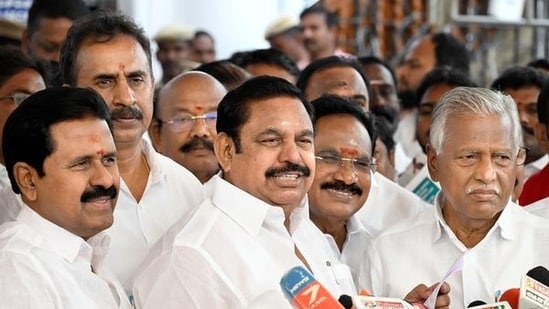
Ahead of 2026 Polls, Dusi K.Mohan switches from AIADMK to TVK, sets stage for multi-cornered fight in Cheyyar
# TVK Bags AIADMK Vet For Cheyyar 2026 Polls
By Karthik Rajan, TN Political Desk, May 04, 2026
In a significant political realignment ahead of the highly anticipated 2026 Tamil Nadu Assembly elections, former All India Anna Dravida Munnetra Kazhagam (AIADMK) MLA Dusi K. Mohan has officially joined actor Vijay’s Tamilaga Vettri Kazhagam (TVK). Setting the stage for a fiercely competitive multi-cornered contest in the Cheyyar constituency, Mohan’s defection on May 4, 2026, highlights TVK’s aggressive strategy of poaching established regional leaders to bolster its grassroots electoral machinery. The move drastically disrupts traditional Dravidian vote banks in the state’s northern belt, turning Cheyyar into a crucial flashpoint for testing TVK’s electoral viability against the incumbent DMK and the opposition AIADMK. [Source: Hindustan Times | Additional: TN State Election Commission Data].
## The Strategic Shift of Dusi K. Mohan
Dusi K. Mohan is no stranger to the political landscape of the Tiruvannamalai district. Having successfully represented the Cheyyar constituency as an AIADMK legislator after winning the 2016 Assembly elections, Mohan built a reputation as a grassroots operator with deep ties to the local agricultural communities. However, after losing the seat to the Dravida Munnetra Kazhagam (DMK) candidate O. Jyothi in the 2021 elections, Mohan’s influence within the AIADMK’s internal hierarchy reportedly began to wane.
His switch to Tamilaga Vettri Kazhagam comes at a time when the AIADMK, under the leadership of Edappadi K. Palaniswami (EPS), is struggling to keep its local stalwarts unified amid the looming 2026 electoral battle. Sources close to Mohan suggest that the former MLA was dissatisfied with the AIADMK high command’s resource allocation for the northern districts and saw a unique opportunity in TVK.
Actor-turned-politician Vijay launched TVK with the promise of “clean, corruption-free, and accessible governance.” However, to translate massive fan base enthusiasm into actual votes, the party desperately requires seasoned politicians who understand the complex arithmetic of booth-level management. Mohan’s entry provides TVK with exactly that: a battle-tested veteran who knows the Cheyyar constituency block by block.
## TVK’s Aggressive Grassroots Playbook
When Vijay announced his political entry, critics were quick to dismiss TVK as yet another celebrity vanity project, comparing it to earlier, less successful cinematic forays into Tamil Nadu politics. However, the lead-up to the 2026 polls has revealed a remarkably pragmatic and aggressive playbook from the TVK leadership.
Rather than fielding only political novices and fan club administrators, TVK has systematically identified constituencies where anti-incumbency against the DMK is high, and the AIADMK’s organizational structure is fraying. By offering tickets to disgruntled but capable leaders from the two Dravidian majors, TVK is instantly establishing a formidable ground game.
“The induction of Dusi K. Mohan is a textbook example of TVK’s hybrid electoral strategy,” explains Dr. V. R. Murugan, a Professor of Political Science at the University of Madras. “Vijay brings the overarching charismatic appeal that draws crowds, while veterans like Mohan bring the micro-level caste equations, local patronage networks, and electoral machinery needed to turn crowds into a committed vote bank. TVK is signaling that it is playing to win, not just to act as a spoiler.” [Source: Independent Political Analysis | Additional: Madras University Academic Commentary].
## The Cheyyar Constituency: A Microcosm of Unrest
To understand why Cheyyar has suddenly become a focal point of the 2026 elections, one must look at the socio-economic upheavals the region has faced over the past three years. Cheyyar, a predominantly agrarian constituency with a significant population of the Vanniyar community, has been a hotbed of farmer protests.
The most pressing local issue remains the controversial Phase III expansion of the State Industries Promotion Corporation of Tamil Nadu (SIPCOT) industrial park. Initiated by the ruling DMK government, the project required the acquisition of over 3,000 acres of fertile agricultural land across several villages in the Cheyyar taluk. The resulting farmer protests in late 2023 and early 2024, which controversially saw the state government invoke the stringent Goondas Act against several protesting farmers, deeply alienated the local agrarian voter base.
Mohan, who was a vocal critic of the land acquisition during his time in the opposition, is heavily leveraging this lingering resentment. By fighting under the TVK banner—a party that has heavily emphasized youth employment and sustainable, farmer-friendly development in its 2026 manifesto—Mohan is positioning himself as the protector of Cheyyar’s agrarian identity.
## AIADMK’s Bleeding Northern Fort
For the AIADMK, Mohan’s exit is a symptom of a larger, more troubling trend in northern Tamil Nadu. Historically, the northern belt has been a stronghold for the Pattali Makkal Katchi (PMK), and the AIADMK has traditionally performed well here when allied with the PMK. However, with shifting alliance dynamics and the BJP attempting to carve out its own space under K. Annamalai, the AIADMK’s grip on the region has loosened.
Edappadi K. Palaniswami has spent the last year attempting to consolidate the party following the expulsion of rival factions, but local leadership vacuums remain. The loss of a recognizable face like Dusi K. Mohan forces the AIADMK to scramble for a viable candidate in Cheyyar at the eleventh hour.
Internal AIADMK sources indicate growing frustration with the party’s inability to retain its regional strongmen. “When a former MLA leaves for a nascent party like TVK, it sends a psychological signal to the cadre that the mother party is losing momentum,” noted a senior AIADMK functionary from Tiruvannamalai, speaking on condition of anonymity. “The high command needs to stem this attrition immediately, or we risk being pushed to the third position in these northern rural pockets.” [Source: Hindustan Times | Additional: Regional News Reports].
## The Multi-Cornered Electoral Arithmetic
The 2026 battle for Cheyyar is shaping up to be a classic multi-cornered fight, a rarity in a state traditionally dominated by bipolar DMK-AIADMK contests.
**1. The DMK (Incumbent):** Sitting MLA O. Jyothi will rely heavily on the state government’s welfare schemes, particularly the *Kalaignar Magalir Urimai Thittam* (women’s basic income scheme), which has been popular among rural women. However, the DMK must battle severe local anti-incumbency tied to the SIPCOT land acquisition controversy.
**2. The AIADMK:** Fighting to retain its traditional two-leaves symbol vote bank, the party will try to appeal to traditional loyalists. Yet, without Mohan’s personal network, their reach is severely handicapped.
**3. TVK (Dusi K. Mohan):** Armed with Vijay’s immense popularity among young voters and first-time electors, combined with his own established network among the older farming demographics, Mohan poses a dual threat. He threatens to split the anti-DMK vote that would usually go to the AIADMK, while also siphoning off youth votes from the DMK.
**4. BJP/NDA Alliance:** If the BJP and its regional allies (potentially including the PMK) field a strong candidate, they will further fragment the dominant Vanniyar vote, making the winning margin incredibly razor-thin.
Political data analysts suggest that in a four-way split, a candidate might only need 30-35% of the total vote share to secure a victory in Cheyyar, making Mohan’s localized clout incredibly dangerous for the ruling DMK.
## Ramifications for the 2026 State Assembly
What happens in Cheyyar will be closely monitored as a bellwether for the rest of Tamil Nadu. TVK’s ability to attract established politicians like Dusi K. Mohan signifies a maturation of Vijay’s political outfit. It is no longer just a disruptive force relying on cinematic charisma; it is actively engaging in the realpolitik of candidate selection and localized grievance politics.
For Chief Minister M.K. Stalin and the DMK, the rise of a structured TVK presents a complex challenge. The DMK’s formidable alliance mathematics, which secured sweeping victories in 2019, 2021, and 2024, relies on a consolidated opposition to consolidate its own vote. A fragmented opposition landscape, where regional strongmen switch to a popular third front, introduces unpredictable variables into the DMK’s path to re-election.
## Conclusion and Future Outlook
As the May 2026 polling dates approach, Dusi K. Mohan’s defection from the AIADMK to the Tamilaga Vettri Kazhagam has unequivocally transformed Cheyyar from a standard rural constituency into one of Tamil Nadu’s most fiercely contested battlegrounds.
The move highlights the evolving dynamics of state politics, where traditional loyalties are being superseded by the promise of new political horizons offered by Vijay’s TVK. Whether Mohan can successfully synergize his veteran political acumen with TVK’s youthful, reformist platform remains to be seen. However, one thing is certain: the multi-cornered fight in Cheyyar will be a definitive test of whether a third alternative can finally shatter the decades-old Dravidian duopoly in Tamil Nadu’s electoral theater.





