
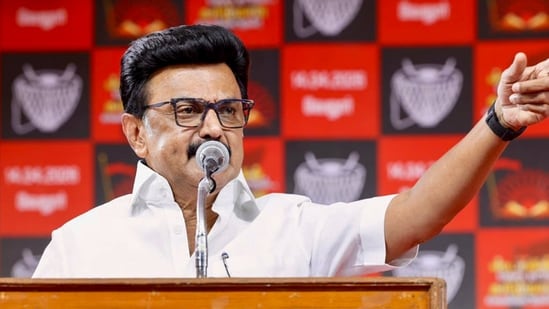
'As a self-respecting Tamil...': Stalin announces black flags protest against delimitation, chairs emergency meet| India News
# Delimitation Row: Stalin Warns of Consequences
On Wednesday, April 15, 2026, Tamil Nadu Chief Minister M.K. Stalin chaired an emergency high-level meeting in Chennai to announce statewide black flag protests against the impending nationwide parliamentary delimitation exercise. Invoking his identity as “a self-respecting Tamil” and the leader of the ruling Dravida Munnetra Kazhagam (DMK), Stalin warned the Union government of severe political “consequences” if the redrawing of electoral boundaries disadvantages southern states. The mobilization aims to push back against proposed population-based seat redistributions that threaten to diminish the parliamentary representation of states that successfully implemented national family planning initiatives over the past fifty years. [Source: Hindustan Times]
## Emergency DMK Meet Sparks Statewide Mobilization
The atmosphere at the Anna Arivalayam, the DMK’s headquarters in Chennai, was tense as senior party leaders, state ministers, and Members of Parliament gathered for the unscheduled emergency session. The core agenda was the looming 2026 delimitation deadline, a constitutional mandate that dictates the redrawing of Lok Sabha constituencies based on the latest census data.
Addressing the gathering, Chief Minister Stalin did not mince words. According to party sources and press briefings, he unequivocally stated that the current framework for delimitation was an existential threat to Tamil Nadu’s political voice in New Delhi. By framing his opposition through the lens of being “a self-respecting Tamil,” Stalin strategically elevated the administrative dispute into a deeply emotional and cultural battle.
He announced that the DMK and its allied partners would soon launch a massive, coordinated black flag protest across all districts of Tamil Nadu. The black flags, a traditional symbol of dissent and mourning in Dravidian politics, are intended to signal absolute non-cooperation with any federal attempt to reduce the state’s proportional representation in the lower house of India’s Parliament.
## The Roots of the Delimitation Dilemma
To understand the gravity of Stalin’s warning, one must look back at the historical constitutional arrangements regarding Indian elections. Under Article 82 of the Indian Constitution, Parliament is supposed to enact a Delimitation Act after every census to adjust the allocation of seats in the Lok Sabha to states, ensuring roughly equal populations per constituency.
However, during the Emergency in 1976, the 42nd Amendment froze the state-wise allocation of Lok Sabha seats based on the 1971 Census. This freeze was implemented specifically to ensure that states effectively managing their population growth through family planning programs were not penalized with reduced political power. In 2001, the 84th Amendment further extended this freeze until the first census taken after the year 2026.
With the 2026 deadline now arriving, the constitutional moratorium is theoretically lifted. The Union government’s recent unveiling of the new Parliament building, which features a Lok Sabha chamber capable of seating 888 members—up from the current 543—has intensified anxieties in the South that a massive expansion based strictly on population is imminent. [Additional: Constitutional Records on Delimitation]
## Punished for Progress? The Demographic Divide
At the heart of the standoff is a stark demographic divergence between North and South India. Over the last five decades, southern states like Tamil Nadu, Kerala, Andhra Pradesh, and Karnataka have heavily invested in education, healthcare, and women’s empowerment, leading to total fertility rates (TFR) dropping well below the replacement level of 2.1.
Conversely, densely populated northern states, particularly Uttar Pradesh and Bihar, have experienced much higher population growth rates over the same period. If delimitation is carried out strictly on current population figures, the political center of gravity will shift dramatically northward.
**Projected Shift in Political Power:**
* **Uttar Pradesh:** Currently holds 80 Lok Sabha seats. Demographic projections suggest this could jump past 120 seats if proportional representation is strictly applied.
* **Tamil Nadu:** Currently holds 39 Lok Sabha seats. Under a pure population-based reallocation, its relative percentage of total seats would shrink significantly, diluting its legislative influence.
“We are essentially being threatened with punishment for succeeding in the Union government’s own national development goals,” Stalin noted during the meeting, echoing a long-standing grievance among southern leaders. [Source: Hindustan Times | Additional: Demographic Data Projections]
## Federalism vs. Proportional Representation
The delimitation debate presents a genuine constitutional paradox, pitting two fundamental democratic principles against one another: federal equity and the doctrine of “one person, one vote.”
Proponents of proceeding with population-based delimitation argue that the current setup is fundamentally undemocratic. A voter in a highly populated northern constituency currently holds less electoral weight than a voter in a sparsely populated southern constituency. They contend that in a representative democracy, parliamentarians must represent roughly equal numbers of citizens to ensure fairness.
However, champions of federalism argue that India is a union of states with distinct linguistic and cultural identities. Diluting the political voice of the southern states could lead to deep regional alienation.
Dr. Aravind Swaminathan, a constitutional scholar and federalism expert based in New Delhi, explains the complexity: *”The impending delimitation exercise represents the most profound stress test to Indian federalism since the linguistic reorganization of states in 1956. While the principle of ‘one person, one vote’ is undeniable, applying it blindly in a diverse union like India risks permanently subjugating the political will of the South to the demographic bulk of the North. A compromise formula is urgently needed.”* [Additional: Expert Analysis]
## The Rhetoric of Respect: Tamil Identity Politics
By identifying himself first as “a self-respecting Tamil” in this context, MK Stalin is actively channeling the legacy of the Dravidian movement. The phrase harks back to the “Self-Respect Movement” founded by Periyar E. V. Ramasamy in the early 20th century, which sought to establish a society with equal human rights while fiercely protecting Tamil language and identity from perceived northern imposition.
For decades, Dravidian parties have positioned themselves as the ultimate defenders of state autonomy against an overreaching center. Whether it is opposition to the imposition of Hindi, battles over the devolution of tax revenues through the Finance Commission, or now, parliamentary delimitation, the underlying narrative remains consistent: protecting Tamil Nadu’s rights from systemic erosion.
The announcement of black flag protests is designed to resonate deeply with the state’s populace, framing the delimitation issue not merely as a dispute over parliamentary arithmetic, but as an affront to Tamil pride and autonomy.
## Financial Parallels and Escalating Tensions
The anger over political delimitation is closely intertwined with ongoing disputes regarding fiscal federalism. Tamil Nadu has long argued that it receives significantly less in central tax devolutions than it contributes, essentially subsidizing the development of the northern states.
Prof. Meera Menon, a political economist focusing on regional development, notes the compounding nature of these grievances. *”Southern states have already absorbed the financial hit of demographic divergence through successive Finance Commission formulas, which heavily weight population in tax distribution. Now, they are being asked to absorb a political hit as well. When a state loses both its financial autonomy and its parliamentary leverage, the federal contract begins to fray,”* she observes. [Additional: Economic Policy Review]
Stalin’s warning of “consequences” is viewed by analysts as a veiled threat that pushing through a unilateral delimitation without achieving a consensus could spark a severe constitutional crisis, potentially leading to legislative boycotts or legal challenges in the Supreme Court.
## Potential Alliances and National Implications
The DMK’s aggressive stance is likely to catalyze a broader “Southern Bloc” response. Political leaders across party lines in Kerala, Karnataka, Andhra Pradesh, and Telangana share similar existential dread regarding delimitation. Even national parties operating in the south, such as the Congress in Karnataka and Telangana, have historically supported maintaining the freeze or finding an alternative formula to protect southern seats.
If Stalin succeeds in uniting southern Chief Ministers, the Union government will face a formidable, geographically consolidated opposition. Several alternative solutions have been floated in policy circles over the past few years to avert this crisis. These include:
1. **Further extending the freeze:** Delaying delimitation until population growth stabilizes uniformly across the country (projected around 2050).
2. **Decoupling the Lok Sabha and Rajya Sabha:** Expanding the Lok Sabha by population but altering the structure of the Rajya Sabha (Upper House) to give equal representation to all states, similar to the US Senate.
3. **Adjusting internal boundaries only:** Conducting delimitation *within* states to ensure equal constituency sizes locally, without altering the total number of seats allocated to each state.
As of now, the Union government has not finalized the methodology for the post-2026 delimitation, leaving room for negotiation. However, the lack of clarity has only bred suspicion.
## Conclusion and Future Outlook
Chief Minister MK Stalin’s declaration of statewide black flag protests marks a significant escalation in the brewing national conflict over delimitation. By framing the issue as an assault on Tamil self-respect, he has ensured that the debate will command the emotional and political attention of the southern electorate.
As the 2026 deadline looms, the Union government finds itself walking a constitutional tightrope. It must navigate the legitimate democratic demands of the highly populated North without alienating the economically vital and culturally distinct South. The success or failure of Stalin’s planned protests over the coming weeks will serve as a crucial barometer for the political temperature of southern India, potentially setting the stage for one of the most defining federal clashes in modern Indian history.
***
By Special Correspondent, India News Desk | April 15, 2026





