
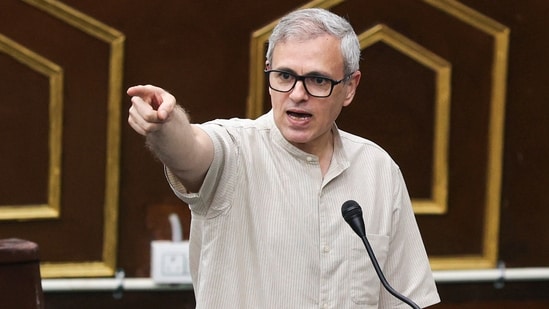
‘INDIA bloc will jointly decide response’: J&K CM Omar Abdullah on women’s quota bill and delimitation concerns| India News
# INDIA Bloc to Fight Delimitation & Quota Bias
**By Senior Political Correspondent** | **April 15, 2026**
**Srinagar** — Jammu and Kashmir Chief Minister Omar Abdullah announced on Wednesday that the opposition INDIA bloc will mount a unified and strategic response to the impending national delimitation exercise and the implementation of the Women’s Reservation Bill. Speaking at a press briefing, Abdullah raised severe concerns regarding the redrawing of electoral boundaries, explicitly alleging that previous constituency adjustments were systematically gerrymandered to benefit the ruling Bharatiya Janata Party (BJP). His remarks underscore mounting anxiety among opposition-ruled states regarding the post-2026 delimitation process, setting the stage for a massive parliamentary showdown over federal representation, regional equity, and gender parity. [Source: Hindustan Times].
## The Core Grievance: Gerrymandering Allegations
At the heart of Chief Minister Abdullah’s address was a profound skepticism regarding the neutrality of the Election Commission and boundary-drawing authorities. Abdullah did not mince words, pointing directly to the precedent set in Jammu and Kashmir as a cautionary tale for the rest of the nation. **He alleged that constituency boundaries had previously been drawn specifically to benefit a particular political party, effectively diluting the electoral power of regional demographics.** [Source: Hindustan Times].
Delimitation—the process of fixing limits or boundaries of territorial constituencies in a country or a province having a legislative body—is fundamentally designed to ensure population parity across electoral districts. However, the opposition argues that the process has been weaponized. In a sharply polarized political landscape, the art of “packing” (concentrating opposing voters in a few districts) and “cracking” (spreading them out to dilute their voting power) has become a primary concern for the INDIA coalition.
Abdullah’s stark warning serves as a rallying cry for opposition parties who fear that the national delimitation exercise, constitutionally slated to occur after the publication of the first census post-2026, will be manipulated to permanently alter the electoral math of the Lok Sabha. By leveraging demographic shifts, the opposition fears the ruling party aims to consolidate power in the Hindi heartland at the direct expense of border states and the southern peninsula.
## Women’s Quota Bill: A Double-Edged Sword?
The intersection of the delimitation exercise with the Women’s Reservation Bill (formally the Nari Shakti Vandan Adhiniyam) forms the second crucial pillar of the INDIA bloc’s current grievance. Passed with near-unanimous parliamentary support in 2023, the landmark legislation mandates a 33% reservation for women in the Lok Sabha and state legislative assemblies. However, its implementation was controversially explicitly tied to the completion of the next census and the subsequent delimitation exercise.
For Abdullah and the broader INDIA coalition, this conditional clause represents a legislative sleight of hand. **The opposition maintains that the linking of women’s quotas to an indefinite and politically sensitive boundary-drawing process is a stalling tactic.** They argue that the quota could and should have been implemented within the existing parliamentary framework.
“The fundamental rights of women to fair political representation are being held hostage by a deeply flawed and potentially biased redistricting agenda,” Abdullah noted during his interaction. The INDIA bloc argues that by marrying the universally popular concept of women’s empowerment to the highly contentious issue of delimitation, the ruling government has created a political shield to push through demographic gerrymandering without facing adequate scrutiny. [Additional Source: Public Legislative Records].
## The INDIA Bloc’s Joint Strategic Response
Recognizing the existential threat posed by a potentially biased national delimitation, Chief Minister Abdullah confirmed that the Jammu and Kashmir National Conference (JKNC) will not fight this battle in isolation. **”The INDIA bloc will jointly decide the response,”** he stated, signaling a coordinated opposition strategy that will span both parliamentary corridors and the judicial system. [Source: Hindustan Times].
The coalition’s strategic blueprint is expected to encompass several key initiatives:
* **Supreme Court Petitions:** The bloc is reportedly preparing extensive legal challenges demanding supreme judicial oversight of the upcoming Delimitation Commission to ensure absolute transparency and adherence to constitutional norms.
* **Parliamentary Disruption:** Opposition MPs are strategizing to leverage the upcoming Monsoon Session to demand a de-linking of the Women’s Reservation Bill from the delimitation process, pushing for immediate implementation of the 33% quota.
* **Cross-Regional Alliances:** Leaders from Southern states—who face the steepest loss in parliamentary representation due to their successful population control measures—are aligning with Northern opposition leaders like Abdullah to present a united front against the central administration.
* **Public Awareness Campaigns:** A nationwide outreach program is being drafted to explain the complex mechanics of gerrymandering to the electorate, highlighting how boundary manipulation directly impacts local governance and resource allocation.
By elevating a regional grievance to a national platform, Abdullah is helping to cement the ideological glue of the INDIA bloc, pivoting from reactive politics to a proactive, constitutional defense.
## Historical Context of J&K’s Electoral Boundaries
To fully grasp the weight of Abdullah’s accusations, one must examine the contentious history of delimitation in Jammu and Kashmir. Following the abrogation of Article 370 in 2019, a dedicated Delimitation Commission, headed by retired Supreme Court Justice Ranjana Prakash Desai, was tasked with redrawing the Union Territory’s electoral map.
Finalized in May 2022, the commission’s report increased the total number of assembly seats from 83 to 90. However, the distribution was heavily criticized by regional parties. **Jammu’s representation was increased by six seats (totaling 43), while the Kashmir Valley, despite having a significantly larger population, was granted only one additional seat (totaling 47).** [Additional Source: Historical Electoral Data].
For the National Conference and the People’s Democratic Party (PDP), this exercise was a textbook example of demographic disenfranchisement. They argued that the commission ignored the cardinal rule of population parity, instead using obscure geographical and logistical parameters to artificially inflate the electoral weight of the Hindu-majority Jammu region—a traditional stronghold for the BJP. Abdullah’s current rhetoric draws heavily on this 2022 experience, warning southern and eastern states that the “J&K model of delimitation” could soon be exported nationwide.
## Expert Perspectives on Electoral Redrawing
Political scientists and constitutional experts suggest that the upcoming national delimitation will be the most consequential administrative exercise in modern Indian history.
Dr. Meenakshi Sundaram, a senior fellow in constitutional law at the Center for Democratic Studies, notes the gravity of the situation: *”If delimitation proceeds purely on current demographic data without robust safeguards, we are looking at a fundamental rewiring of Indian federalism. States that implemented progressive family planning policies in the 1980s and 90s will essentially be politically penalized. Omar Abdullah’s concerns regarding gerrymandering are valid, as boundary drawing is rarely a purely mathematical exercise; it is inherently political.”*
Furthermore, electoral geographer Dr. Rajesh Kothari highlights the vulnerability of the system. *”The micro-adjustment of boundaries at the district level, as seen previously in J&K and Assam, can swing election results by 5 to 7 percent without a single voter changing their preference. When you tie an essential progressive reform like the Women’s Quota to such a volatile process, you inevitably invite allegations of systemic manipulation.”*
These expert analyses validate the INDIA bloc’s anxieties. The fear is not just about the macro-level shift of seats between states, but the micro-level redrawing of constituencies within states to fracture opposition vote banks—specifically minority and marginalized communities.
## Implications for the Federal Structure
Abdullah’s statements from Srinagar resonate violently in Chennai, Thiruvananthapuram, and Hyderabad. The lifting of the constitutional freeze on the allocation of Lok Sabha seats (mandated by the 84th Amendment to last until the first census after 2026) threatens to tear the fabric of India’s federal structure.
If seats are reapportioned strictly by population, Northern states like Uttar Pradesh, Bihar, and Rajasthan will see a massive influx of parliamentary power. Conversely, Southern states could lose significant influence over national policy and financial resource distribution.
The INDIA bloc is attempting to frame this not as a regional dispute, but as an assault on the cooperative federalism that binds the nation. **By intertwining the federalism debate with the Women’s Reservation Bill and allegations of gerrymandering, the opposition is crafting a multi-faceted narrative.** They are appealing to regional pride, feminist advocates, and democratic purists simultaneously, hoping to build a coalition broad enough to force the central government into a compromise.
The demand for a transparent, multi-partisan, and judicially overseen Delimitation Commission is expected to become the primary prerequisite set by the opposition before allowing the legislative process to proceed smoothly.
## Conclusion: A High-Stakes Political Chess Match
Chief Minister Omar Abdullah’s declaration that the INDIA bloc will collectively combat the intricacies of the upcoming delimitation and the delayed women’s quota signals a maturing, unified opposition strategy. The allegations of constituency manipulation are no longer isolated regional complaints; they have been elevated to national constitutional crises.
**Key Takeaways:**
* **Unified Front:** The INDIA coalition is pooling its regional grievances to form a centralized legal and political strategy against the 2026 delimitation process.
* **Weaponization of Quotas:** The opposition continues to view the linking of the Women’s Reservation Bill to delimitation as a strategic delay tactic by the central government.
* **Federal Tensions:** Abdullah’s warnings highlight a looming crisis between the demographic realities of Northern India and the economic/progressive achievements of Southern and border states.
As India moves closer to the unfreezing of electoral boundaries, the battle lines are clearly drawn. The coming months will determine whether the redrawing of the world’s largest democracy will be a triumph of representative equality, or, as Abdullah warns, a masterclass in demographic gerrymandering. The INDIA bloc’s ability to sustain this joint response will be the ultimate test of its political viability.





