
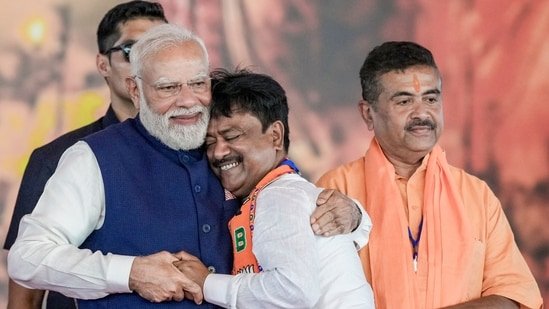
Ashok Kirtania takes oath as minister in Bengal, and gets a warm hug from PM Modi
# Bengal Cabinet: Kirtania Sworn In, Hugs PM
**KOLKATA** — Marking a watershed moment in West Bengal’s political landscape, Ashok Kirtania was officially sworn in as a cabinet minister on Saturday, May 9, 2026. The oath-taking ceremony, held under tight security and high spirits at Raj Bhavan, captured national attention when Prime Minister Narendra Modi broke standard protocol to share a warm, congratulatory hug with the newly appointed minister. Kirtania secured his prominent position in the new government after dealing a crushing electoral defeat to the Trinamool Congress (TMC) candidate Biswajit Das by a staggering margin of 40,670 votes. The election results, declared on May 4, have dramatically reshaped the state’s legislative assembly, paving the way for a new administrative era.
[Source: Hindustan Times | Additional: Public Election Data]
## A Historic Swearing-In Ceremony
The atmosphere at the Raj Bhavan in Kolkata was electric on Saturday afternoon as the state witnessed the installation of its new government. Dignitaries, senior bureaucrats, and top political brass from New Delhi gathered to witness the transition of power. When Ashok Kirtania’s name was called by the Chief Secretary, a loud cheer erupted from the assembled supporters and party workers.
Taking his oath in Bengali, Kirtania pledged allegiance to the Constitution, promising to serve the people of West Bengal with transparency and dedication. However, it was the moment immediately following the oath that dominated television screens and social media feeds. As Kirtania walked down the dais, Prime Minister Narendra Modi, seated in the front row, stood up and embraced the new minister in a warm hug.
Political analysts were quick to note the significance of the gesture. The Prime Minister’s embrace was not merely a personal congratulation; it was a highly symbolic validation of Kirtania’s grassroots struggle and a public acknowledgment of the crucial demographic he represents. The visual of the Prime Minister hugging a state cabinet minister instantly became the defining image of the 2026 West Bengal cabinet formation, symbolizing a cohesive bond between the Central government and the newly formed state administration.
## The Electoral Triumph: Dismantling a TMC Bastion
Ashok Kirtania’s elevation to the cabinet is firmly rooted in his spectacular performance in the 2026 assembly elections. Competing in a highly polarized and fiercely contested constituency, Kirtania managed to consolidate a massive mandate. When the Election Commission of India declared the results on May 4, Kirtania emerged victorious with a formidable margin of 40,670 votes against the TMC heavyweight, Biswajit Das.
Biswajit Das is no stranger to the region’s volatile politics, having previously switched political allegiances. His candidacy for the Trinamool Congress was seen as a strategic move by the former ruling party to retain its grip over the critical border constituencies of North 24 Parganas. However, Kirtania’s relentless door-to-door campaigning, focus on local infrastructure deficits, and resonant messaging regarding national security and citizenship rights entirely dismantled the TMC’s local machinery.
“The margin of over 40,000 votes in a state assembly election is not just a victory; it is a mandate of absolute trust,” noted a senior political commentator during the election coverage. This landslide victory was characterized by a massive voter turnout, where rural and semi-urban voters alike rallied behind Kirtania, expressing their frustration with alleged local-level corruption and a desire for systemic change.
[Source: Hindustan Times | Additional: Election Commission of India 2026 Data]
## The Matua Factor and Sociopolitical Dynamics
To understand the meteoric rise of Ashok Kirtania, one must look closely at the sociopolitical fabric of the North 24 Parganas district, particularly the Matua community. The Matuas, a close-knit Namasudra community with roots in East Bengal (now Bangladesh), have historically played a kingmaker role in West Bengal elections. Numbering in the millions, their voting patterns can sway the results of over 30 assembly constituencies.
Kirtania has long been associated with the socio-religious aspirations of the Matua Mahasangha. Over the past few years, his continuous engagement with the community leaders and his advocacy for the swift implementation of the Citizenship Amendment Act (CAA) resonated deeply with the populace. The CAA, which aims to provide a fast-tracked route to Indian citizenship for persecuted minorities from neighboring countries, has been the central emotional and political demand of the Matua community.
By defeating the TMC, a party that vehemently opposed the CAA, Kirtania proved that the implementation of the citizenship rules successfully galvanized the Matua vote bank. The Prime Minister’s hug at Raj Bhavan was, by extension, an embrace of the entire Matua community—a gesture reinforcing the Central government’s commitment to their welfare and integration.
## Formation of the Suvendu Adhikari Cabinet
Ashok Kirtania’s swearing-in is a key component of the broader political earthquake that has struck West Bengal: the formation of the Suvendu Adhikari-led cabinet. Following a fiercely fought electoral battle throughout April and May 2026, the Bharatiya Janata Party (BJP) successfully unseated the Trinamool Congress, ending Mamata Banerjee’s 15-year tenure as Chief Minister.
Suvendu Adhikari, who spearheaded the opposition’s charge, has meticulously crafted his new cabinet to reflect both regional representation and administrative efficiency. The inclusion of Kirtania as a prominent minister underscores Adhikari’s strategy to reward grassroots leaders who delivered in high-stakes constituencies.
“The Adhikari cabinet is designed to hit the ground running,” states an internal party memo leaked to the press. “By elevating leaders like Ashok Kirtania, the government is signaling a departure from centralized, Kolkata-centric governance to a model that empowers the border districts and historically marginalized communities.”
[Source: Hindustan Times | Additional: Regional Political Analysis]
## Expert Analysis: A Shift in Grassroots Power
Political scientists view the 2026 Bengal election results and the subsequent cabinet formation as a masterclass in grassroots mobilization. Dr. Ananya Sen, a Kolkata-based political analyst, explains the shift:
> **”What we are witnessing with Ashok Kirtania’s victory is the maturation of a localized political strategy. The TMC relied heavily on state welfare schemes, but Kirtania tapped into deeper, identity-based aspirations and an anti-incumbency wave driven by local grievances. The 40,670 vote margin is a definitive rejection of the politics of defection, heavily penalizing candidates like Biswajit Das who lacked ideological consistency.”**
Rajat Roy, a senior election observer, echoed similar sentiments regarding the optics of the swearing-in. “In Indian politics, optics are as vital as policy. PM Modi’s hug is a clear message to the party cadres that hard work in the toughest terrains of Bengal will be recognized at the very highest levels of leadership. It bridges the gap between Delhi and rural Bengal.”
## Economic and Social Implications for the Border Regions
As a minister, Kirtania inherits a complex portfolio of challenges and opportunities. His constituency and the surrounding regions of North 24 Parganas are primarily agrarian but heavily dependent on border trade with Bangladesh. The local economy has suffered from infrastructural bottlenecks, cross-border smuggling issues, and inadequate industrial investment.
Kirtania’s immediate priorities are expected to include:
* **Infrastructure Development:** Upgrading arterial roads connecting rural belts to the state highways to facilitate better agricultural trade.
* **Border Security and Economy:** Working in tandem with Central agencies to secure the border while promoting legitimate trade hubs (border haats).
* **Citizenship Drives:** Overseeing the smooth administrative processing of citizenship applications under the newly enacted rules, ensuring the Matua community faces no bureaucratic hurdles.
* **Youth Employment:** Initiating skill development centers tailored to the regional economy, moving beyond traditional agriculture.
The synergy between the State and Central governments—a dynamic absent during the previous TMC regime—is anticipated to unlock withheld central funds for regional development. Kirtania’s direct line to the Prime Minister’s office, visually confirmed by the warmth at Raj Bhavan, places him in an advantageous position to secure these benefits for his constituents.
## Conclusion: The Road Ahead
The oath-taking of Ashok Kirtania, framed by the affectionate endorsement from Prime Minister Narendra Modi, is more than a standard procedural event; it is a milestone in West Bengal’s shifting political narrative. Defeating a seasoned opponent by an overwhelming margin of 40,670 votes has cemented Kirtania’s reputation as a giant-slayer and a trusted leader of the masses.
As the Suvendu Adhikari cabinet takes charge of the state’s administration, the expectations are extraordinarily high. The new government must navigate the promises of rapid industrialization, social justice for communities like the Matuas, and the stabilization of a state heavily polarized by years of bitter political feuding.
For Ashok Kirtania, the real test begins now. Transitioning from a fiery grassroots campaigner to a functional state minister requires administrative acumen and diplomatic finesse. However, with a historic mandate behind him and the overt backing of the national leadership, Kirtania appears well-equipped to guide his constituency—and West Bengal—into a new chapter of development and integration.
***
**By Special Correspondent, India News Desk, May 9, 2026**





