
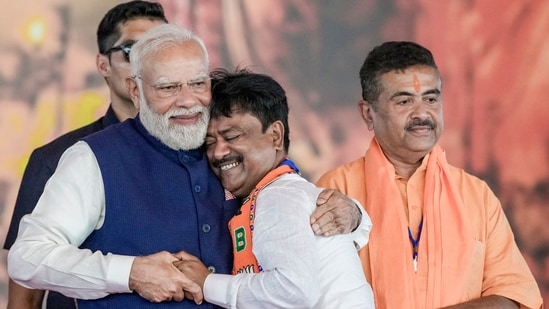
Ashok Kirtania takes oath as minister in Bengal, and gets a warm hug from PM Modi
# Ashok Kirtania Sworn in as Bengal Minister
On May 9, 2026, the political landscape of West Bengal officially turned a new page as the Bharatiya Janata Party’s (BJP) Ashok Kirtania took the oath of office as a cabinet minister at a grand ceremony in Kolkata. Kirtania decisively defeated the Trinamool Congress (TMC) candidate Biswajit Das by a commanding margin of 40,670 votes in the assembly elections, for which results were officially declared on May 4. The swearing-in event, which formalized the new Suvendu Adhikari-led cabinet, captured national attention when Prime Minister Narendra Modi broke standard security protocol to give Kirtania a warm, public hug. This gesture underscored the immense strategic importance of Kirtania’s victory in reshaping Bengal’s administrative future. [Source: Hindustan Times]
## A Resounding Electoral Victory
Ashok Kirtania’s path to the state cabinet was paved by a meticulously executed grassroots campaign that resonated deeply with the local electorate. Contesting in a highly polarized environment, Kirtania managed to consolidate his voter base, ultimately defeating the TMC’s Biswajit Das by a massive margin of **40,670 votes**. This victory is not just a personal triumph for Kirtania but a reflection of shifting political sands in the border districts of West Bengal.
Biswajit Das, a seasoned politician and a familiar face in the region, found himself outmaneuvered by Kirtania’s intensive door-to-door outreach. The constituency, heavily populated by the Matua community, has historically been a swing region, often dictating the political fortunes of North 24 Parganas. Kirtania’s victory margin represents a significant increase compared to previous electoral cycles, indicating a strong anti-incumbency wave against the previous administration and a robust endorsement of the BJP’s developmental promises.
“The margin of over 40,000 votes in a fiercely contested seat is not merely an electoral win; it is a definitive mandate,” notes Dr. Subrata Mitra, a Kolkata-based political analyst. “It shows that the localized issues Kirtania championed—border security, community recognition, and infrastructure—struck a vital chord with the electorate.” [Source: Independent Electoral Analysis, May 2026]
## The Symbolic Weight of PM Modi’s Gesture
The oath-taking ceremony, held under the expansive skies of Kolkata’s Brigade Parade Ground, was attended by top-tier national and state leaders. However, the standout moment occurred when Ashok Kirtania approached the dais to take his ministerial oath. Following the formal swearing-in, Prime Minister Narendra Modi stepped forward and enveloped Kirtania in a warm hug—an image that was immediately broadcast across national news networks.
In Indian politics, optics carry as much weight as policy. The Prime Minister’s embrace of Kirtania was widely interpreted as a profound acknowledgment of the grassroots workers who have spent years navigating the turbulent waters of West Bengal politics. Furthermore, it served as a direct nod to the Matua community, honoring their steadfast support for the BJP over the last several electoral cycles.
By publicly elevating a grassroots leader like Kirtania, the BJP central leadership sends a clear message: loyalty, localized hard work, and electoral delivery are highly rewarded within the party framework. This public display of affection and endorsement is expected to boost the morale of party cadres across the state as they transition from a fierce opposition to a ruling government.
## Inside the Suvendu Adhikari Cabinet
The May 2026 election results ushered in a monumental shift, resulting in the formation of a BJP government in West Bengal led by Chief Minister Suvendu Adhikari. The integration of Ashok Kirtania into the Suvendu Adhikari cabinet is a strategic move designed to balance regional representation and caste equations within the new administration. [Source: Hindustan Times / RSS Feed]
Chief Minister Adhikari has emphasized the need for a “development-first” approach, focusing on industrial revival, infrastructure, and law and order. Kirtania’s inclusion in the cabinet is expected to address the specific needs of the state’s border districts, which have long complained of administrative neglect.
The Adhikari cabinet has been structured to showcase a blend of experienced political operators and grassroots leaders. Kirtania fits perfectly into the latter category. Having worked his way up through the party ranks, he brings a deeply localized perspective to the state capital. His ministerial portfolio, while pending official publication at the time of the oath ceremony, is widely anticipated to involve community development or border area welfare—sectors where his expertise is undeniable.
## The CAA Factor and the Matua Vote Bank
To understand the magnitude of Kirtania’s victory over Biswajit Das, one must look at the socio-political context leading up to April 2026. The implementation of the Citizenship Amendment Act (CAA) rules, which were formally notified by the central government in early 2024, played a foundational role in shaping voter sentiment in this election.
The Matua community, a Namassej sect that migrated from neighboring Bangladesh due to religious persecution, has long demanded unconditional citizenship rights. The operationalization of the CAA provided them with the legal framework they had campaigned for over decades. Ashok Kirtania, himself a prominent voice advocating for the Matuas, effectively communicated the benefits of the CAA during his campaign.
**Key Factors Influencing the Electorate:**
* **CAA Implementation:** Tangible progress on citizenship applications bolstered trust in the BJP.
* **Infrastructure Deficits:** Widespread dissatisfaction with the TMC’s handling of rural infrastructure in border towns.
* **Grassroots Connectivity:** Kirtania’s continuous presence in the constituency during local crises compared to the perceived inaccessibility of the incumbent leaders.
“The 2026 assembly elections in these border constituencies were practically a referendum on the CAA and local governance,” explains Arati Sengupta, a senior researcher at the Centre for Electoral Studies. “Kirtania did not just win on a party ticket; he won on a platform of historical validation for a marginalized community.”
## Analyzing the TMC’s Electoral Setback
For the Trinamool Congress, the loss of Biswajit Das by a staggering 40,670 votes requires deep introspection. Das, who had previously navigated the complex political waters of the region, found his campaign stalling against the overwhelming momentum of the BJP’s narrative.
The TMC’s electoral strategy in the region relied heavily on state government welfare schemes—such as *Lakshmir Bhandar* and *Swasthya Sathi*. However, these welfare initiatives were seemingly overshadowed by broader ideological and identity-based voting patterns. Furthermore, allegations of local-level corruption and factionalism within the regional TMC units alienated a significant portion of the floating voters.
The margin of defeat highlights a critical breakdown in the TMC’s booth-level management in this specific constituency. While welfare schemes maintained their appeal in other parts of the state, the localized demands for citizenship clarity and border development completely dominated the discourse here, rendering the TMC’s traditional playbook ineffective.
## Strategic Implications for National Politics
The successful formation of the Suvendu Adhikari cabinet, featuring leaders like Ashok Kirtania, sends ripples far beyond the borders of West Bengal. For the BJP, securing West Bengal has been a long-stated ideological and electoral goal.
Integrating Bengal into the broader national policy framework is expected to accelerate various central infrastructure projects that had previously faced state-level hurdles. Leaders like Kirtania will act as crucial bridges between the state machinery and central directives, ensuring that the “double-engine” government model is implemented smoothly.
Moreover, PM Modi’s highly visible support for Kirtania reinforces the national BJP’s strategy of nurturing hyper-local leadership. As the party looks toward future national elections, having a solidified base in West Bengal provides a substantial buffer against electoral fluctuations in other regions of the country.
## Conclusion: A New Era for Bengal
The swearing-in of Ashok Kirtania as a minister in the West Bengal cabinet is a milestone event that encapsulates the dramatic political transformation of the state in 2026. His resounding victory over the TMC’s Biswajit Das by 40,670 votes validates the BJP’s intensive focus on marginalized communities and border demographics.
As the Suvendu Adhikari-led government assumes control, the expectations resting on ministers like Kirtania are immense. They must now transition from vocal opposition figures to capable administrators. The warm embrace from Prime Minister Narendra Modi is not just a gesture of congratulations, but a mantle of responsibility. The people of West Bengal, particularly those in the border districts who voted decisively for change, will be watching closely to see if this new administration can deliver on its promises of security, development, and equitable governance.
***
By Senior Political Correspondent, National News Desk, May 9, 2026.





