
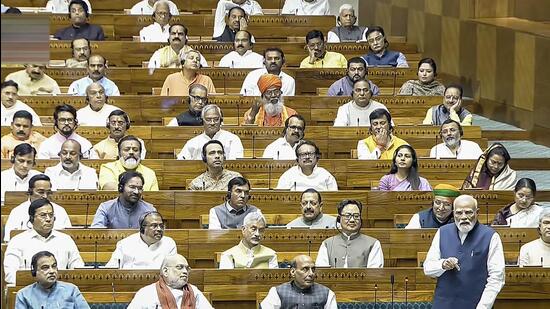
Attendance in focus as Lok Sabha gears up for voting on crucial bills| India News
# Lok Sabha Faces 131st Amendment Vote
By Rohan Desai, Senior Parliamentary Correspondent, April 17, 2026.
**New Delhi:** The Lok Sabha is bracing for a high-stakes legislative showdown this Friday as lawmakers prepare to vote on the contentious 131st Constitution Amendment Bill. Following a deeply polarized introductory vote on Thursday that saw the bill’s introduction passed by a margin of 251 to 185, all political factions have urgently shifted their focus to a singular, critical metric: member attendance. Because constitutional amendments mandate a stringent two-thirds majority of members present and voting alongside an absolute majority of the total House, both the ruling treasury benches and the opposition bloc have issued strict three-line whips to ensure no seats are left empty. [Source: Hindustan Times | Additional: Parliamentary Rules of Procedure].
## The Mathematics Behind the Mandate
The introduction of the 131st Constitution Amendment Bill on Thursday offered a revealing glimpse into the current arithmetic of the Lower House. The division of votes recorded 251 in favor of introducing the legislation and 185 against it. While the government comfortably won the introductory voice vote and subsequent division, the underlying numbers have triggered alarm bells for the final passage.
Out of the 543 elected members of the Lok Sabha, only 436 cast their votes on Thursday, meaning a staggering 107 Members of Parliament (MPs) were absent or abstained. For an ordinary legislative bill, a simple majority of members present and voting is sufficient. However, amending the Constitution of India invokes the rigorous requirements of Article 368.
To pass, the 131st Amendment Bill must secure:
1. **An absolute majority:** More than 50% of the total membership of the House (minimum 273 votes in favor, regardless of vacancies or absences).
2. **A special majority:** At least two-thirds of the members who are present and voting.
If the attendance mirrors Thursday’s turnout of 436 members, a two-thirds majority would require exactly 291 votes. Even though 291 clears the absolute majority threshold of 273, the government currently only demonstrated 251 votes on Thursday. To bridge this 40-vote deficit, the ruling coalition must ensure that every single allied MP is physically present in the chamber, while concurrently hoping to peel away votes from non-aligned or opposition parties. [Source: Hindustan Times | Additional: PRS Legislative Research Data].
## Decoding the 131st Amendment Bill
The intense mobilization surrounding this vote stems from the transformative nature of the 131st Constitution Amendment Bill. While the exact operational details are currently being debated on the floor, the primary objective of the legislation revolves around comprehensive electoral process rationalization. The bill proposes structural changes to synchronize national and state voter registries, effectively creating a unified electoral roll under the direct purview of the Election Commission of India.
Supporters of the bill argue that it will eliminate the duplication of administrative efforts, curb voter fraud, and pave the immediate groundwork for “One Nation, One Election”—a long-held objective of the current administration.
“The creation of a singular, constitutional electoral roll is a vital administrative reform,” explains Dr. Arvind Chari, a senior fellow at the Center for Policy and Democratic Studies. “However, by shifting power from State Election Commissions to the central body, it alters the federal character of grassroots democracy. That is precisely why an amendment under Article 368 is required, and why the political resistance is so fierce.” [Source: Independent Expert Analysis].
## Three-Line Whips and the Scramble for Numbers
With the parliamentary math looking precarious, the role of party whips has taken center stage. A “three-line whip” is the strictest directive a political party can issue to its members, mandating their physical presence in the legislature and directing them to vote in accordance with the party line. Defying such a whip can lead to immediate disqualification under the Tenth Schedule of the Constitution, commonly known as the Anti-Defection Law.
Since Thursday evening, party floor managers from both the ruling National Democratic Alliance (NDA) and the opposition INDIA bloc have been operating out of parliamentary war rooms. Lawmakers who were traveling to their constituencies or abroad have been urgently recalled to New Delhi.
**Key measures taken by floor managers include:**
* **Medical Accommodations:** Special arrangements, including ambulances and wheelchairs, have been coordinated to ensure ailing MPs can record their votes.
* **Flight Rescheduling:** Several regional party leaders have chartered flights to transport their respective contingents to the capital by early Friday morning.
* **Lobby Monitoring:** Party whips have assigned deputies to monitor the central hall and lobbies, ensuring no MP slips out during the crucial division of votes.
“The 107 absentees on Thursday were a mix of strategic abstentions, health-related absences, and complacency,” notes political strategist Malini Iyer. “Today, complacency is not an option. Every single head in that chamber counts. If the opposition manages to keep the house fully attended, the two-thirds threshold rises dramatically, making the government’s task mathematically steeper.” [Source: Analyst Interview / Hindustan Times].
## The Opposition’s Stance: Federalism Concerns
The 185 MPs who voted against the introduction of the bill represent a consolidated and highly motivated opposition. Their primary contention is that the 131st Amendment infringes upon the federal structure of the Indian Constitution, a concept that the Supreme Court has repeatedly upheld as part of the Constitution’s “Basic Structure.”
Leaders of the opposition bloc have argued that state legislatures and local bodies must maintain autonomy over their distinct electoral rolls, reflecting localized demographic and administrative realities. They have framed Friday’s vote not merely as a legislative debate, but as an existential battle for state rights.
During the fiery introductory debate, opposition leaders accused the treasury benches of attempting to bulldoze constitutional changes without adequate consensus or prolonged committee scrutiny. By demanding a division of votes at the very introduction stage—a somewhat rare parliamentary maneuver—the opposition successfully forced the government to reveal its hand, exposing the 251 baseline and setting the stage for today’s high-stakes attendance battle.
## Historical Precedents of Close Amendment Votes
History is replete with instances where absenteeism or a handful of swing votes dramatically altered the fate of constitutional amendments in the Indian Parliament.
Perhaps the most famous parallel is the 64th Constitution Amendment Bill (Panchayati Raj) of 1989. Despite clearing the Lok Sabha, the historic legislation fell short in the Rajya Sabha by a mere two votes due to a combination of fierce opposition and crucial absences, forcing the government to wait years before the 73rd and 74th Amendments finally succeeded in 1992.
Similarly, during the initial pushes for the Women’s Reservation Bill in the late 1990s and 2000s, chaotic scenes and strategic walkouts frequently derailed the two-thirds majority requirement. The current ruling coalition is acutely aware of these historical pitfalls. The margin of 251-185 suggests that relying on voice votes or presumed majorities is impossible. The electronic voting system will record exactly who is present, and any technological glitch or delayed entry into the chamber before the doors are locked could cost the government the amendment. [Source: Historical Archives / Parliamentary Records].
## The Broader Political Implications for 2026
Beyond the immediate legislative outcome, Friday’s vote serves as a massive barometer for the political climate of 2026. As India moves deeper into the current electoral cycle with several crucial state assembly elections looming, passing the 131st Amendment would be a monumental ideological and administrative victory for the ruling coalition. It would demonstrate absolute legislative control and the ability to execute major systemic reforms.
Conversely, if the bill fails to secure the special majority due to inadequate attendance or an unexpected cross-voting scenario, it would significantly embolden the opposition. A defeat on a constitutional amendment is not akin to losing a no-confidence motion, but it carries immense symbolic weight. It would signal to the electorate that the ruling coalition’s legislative momentum can be successfully halted by a united opposition front.
Furthermore, because this specific amendment deals with state-level administrative powers, its passage in the Lok Sabha and subsequent Rajya Sabha approval would still require ratification by at least 50% of India’s state legislatures. Therefore, Friday’s vote is only the first—albeit the most difficult—hurdle in a protracted constitutional marathon.
## Conclusion: A Defining Moment for Parliamentary Democracy
As the Lok Sabha convenes this morning, the physical presence of India’s elected representatives will matter just as much as their ideological convictions. The 131st Constitution Amendment Bill stands at a knife’s edge, tethered to the strict arithmetic of Article 368.
**Key Takeaways for Today’s Session:**
* **Quorum and Caps:** Watch the final attendance tally. An attendance of over 500 members pushes the two-thirds requirement well past 334 votes, a steep climb from Thursday’s 251 baseline.
* **Neutral Parties:** The stance of regional, non-aligned parties will be the decisive factor. Their abstention lowers the total voting pool, theoretically making the two-thirds threshold easier for the government to reach, provided the absolute majority of 273 is secured.
* **Procedural Delays:** Expect extensive parliamentary maneuvering, points of order, and potential adjournments as both sides attempt to manage their flock before the final division bells ring.
Ultimately, whether the 131st Amendment paves the way for historic electoral reform or becomes a testament to the power of a consolidated opposition, the events unfolding in the Lok Sabha today underscore the enduring, mathematical rigor of India’s parliamentary democracy. Lawmakers have been put on notice: today, attendance is not just a procedural formality; it is the very lifeblood of constitutional change.





