
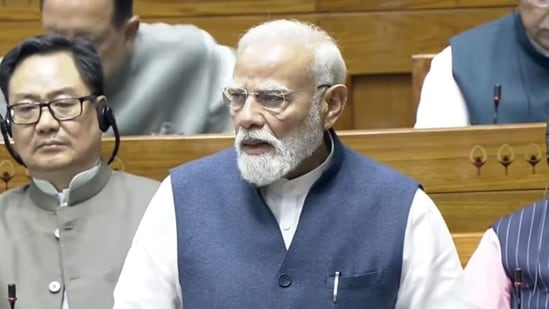
‘No injustice to anyone’: PM Modi assures southern states of no seat loss due to delimitation| India News
# Modi Assures South: No Seat Loss in Delimitation
**By Special Correspondent, National News Desk**
**April 17, 2026**
On Friday, Prime Minister Narendra Modi assured India’s southern states that they will not suffer any loss of parliamentary seats or political marginalization during the upcoming national delimitation exercise. Speaking amid growing apprehensions over the constitutional reapportionment of Lok Sabha constituencies, the Prime Minister categorically stated that there would be “no injustice to anyone” resulting from demographic adjustments. However, opposition parties remain deeply skeptical, questioning the government over the glaring absence of explicit statutory guarantees in the proposed framework that would ensure proportional representation remains intact [Source: Hindustan Times]. This ongoing debate strikes at the very heart of Indian federalism, balancing the democratic principle of “one person, one vote” against the potential penalty for states that successfully implemented national population control policies.
## The Root of the Anxiety: Demographics vs. Democracy
To understand the sheer magnitude of the current political standoff, one must look back at India’s demographic history. In 1976, during the Emergency, the 42nd Amendment to the Constitution froze the allocation of Lok Sabha seats to the states based on the 1971 Census. This was done explicitly to encourage population control; policymakers realized that if parliamentary seats were strictly tied to a growing population, states successfully curbing their birth rates would inadvertently lose political power in New Delhi.
This freeze was subsequently extended by the 84th Constitutional Amendment Act in 2001, which mandated that the total number of existing seats allocated to various states in the House of the People would remain unaltered until the first census taken after the year 2026 [Additional: Constitutional Archives].
As 2026 unfolds, the impending expiry of this constitutional freeze has triggered deep-seated anxieties in the southern states—namely Kerala, Tamil Nadu, Karnataka, Andhra Pradesh, and Telangana. Over the past five decades, these states have achieved replacement-level fertility rates (a Total Fertility Rate of 2.1 or below). Conversely, several populous northern states, such as Uttar Pradesh, Bihar, and Rajasthan, have witnessed massive population explosions during the same period.
If the Lok Sabha constituencies are redrawn and reapportioned based purely on current population figures without any mitigating safeguards, the southern states face a severe dilution of their electoral influence.
## Prime Minister’s Assurance of Cooperative Federalism
Recognizing the escalating regional tensions, PM Modi has attempted to quell the fears of southern leaders and citizens. Addressing the nation, Modi emphasized the philosophy of cooperative federalism, stating firmly that the demographic success of the southern states is a matter of national pride, not a metric for political disenfranchisement.
“There will be no injustice to anyone. The hard work and progressive policies of our southern states have strengthened the nation, and their voice in the halls of our democracy will remain as powerful as ever,” the Prime Minister articulated. He assured stakeholders that the delimitation process would be equitable and that the absolute number of seats belonging to any southern state would not see a reduction [Source: Hindustan Times].
The government’s overarching narrative suggests an expansion of the total number of Lok Sabha seats—facilitated by the newly inaugurated Parliament building, which boasts a seating capacity of 888 in the Lower House. By increasing the overall pie, the government implies it can allocate more seats to the densely populated North without taking away any existing seats from the South.
## The Opposition’s Counter-Arguments and Skepticism
Despite the Prime Minister’s verbal reassurances, the Opposition remains highly dissatisfied, pointing to legislative loopholes. The core point of contention revolves around the distinction between *absolute* representation and *proportional* representation.
The Opposition has questioned the government over the lack of any mention in the impending delimitation bill regarding proportional representation remaining the same [Source: Hindustan Times].
**Core Concerns Raised by the Opposition:**
* **The Proportionality Trap:** Even if a state like Kerala retains its current 20 Lok Sabha seats, an expansion of the Lok Sabha to 848 seats would mean Kerala’s percentage of total voting power drops significantly. In a parliamentary system where majorities dictate national policy, proportional share is the true measure of political power.
* **Lack of Legal Guarantees:** Opposition parliamentarians argue that verbal assurances hold no legal weight. Without a constitutional amendment explicitly guaranteeing proportional parity, future Delimitation Commissions will be legally bound by current constitutional statutes to assign seats strictly by population.
* **Financial Devolution Fears:** Southern states already express grievances regarding the Finance Commission’s tax devolution formulas, arguing they receive significantly less central funding per capita compared to what they contribute in tax revenues. A loss of proportional political power could exacerbate this economic imbalance.
Dr. Arvind Ramaswamy, a senior political analyst specializing in Indian constitutional law, notes the complexity of the Opposition’s stance. “The Prime Minister’s promise of ‘no seat loss’ only addresses half the equation,” Ramaswamy explains. “If the North gains 150 seats and the South gains only 10, the South hasn’t lost seats mathematically, but they have undeniably lost substantial political leverage. The Opposition is demanding a statutory freeze on the *ratio* of seats between states, a demand the current legislative drafts completely ignore.”
## The Mathematical Realities of Delimitation
The impending delimitation poses a nearly impossible mathematical paradox for the Election Commission and constitutional scholars. The core tenet of democratic representation is equitable vote value. Currently, an MP from Rajasthan represents vastly more constituents than an MP from Tamil Nadu. In purely democratic terms, the northern voter is currently underrepresented.
However, rectifying this by applying a uniform population-to-MP ratio across the country punishes the states that obeyed the Union government’s family planning directives in the 1970s and 1980s.
Projections by independent demographic research groups indicate that if the Lok Sabha is expanded to 848 seats distributed strictly by population proportions expected in the post-2026 census, states like Uttar Pradesh and Bihar could see their seat shares increase by over 60%. Conversely, the four southern states would see a marginal absolute increase but a steep decline in their overall percentage of the House.
## Economic Implications: Penalizing Performance?
The debate extends far beyond the confines of parliament seats; it bleeds into the economic lifeblood of the nation. Southern India accounts for roughly 20% of the country’s population but contributes over 30% of India’s Gross Domestic Product (GDP). These states are critical hubs for IT, manufacturing, healthcare, and education.
“There is an underlying fear in the southern peninsula that demographic marginalization will inevitably lead to economic marginalization,” states Prof. Sunita Deshmukh, an expert in federalism and regional economics at the Delhi Institute of Public Policy. “When political power shifts disproportionately to the northern Hindi-speaking belt, policy focus, infrastructure investments, and central subsidies invariably follow. The southern states fear becoming economic engines with no hand on the political steering wheel.”
The Opposition’s unified front on this issue stems from the belief that without proportional guarantees enshrined in law, southern economic interests will be continually overridden by northern populist demands.
## Exploring Potential Solutions and Global Precedents
As the constitutional clock ticks down, political scientists and lawmakers are desperately searching for middle-ground solutions that satisfy both the democratic mandate of population-based representation and the federal necessity of regional equity.
Several potential frameworks have been floated in political circles:
1. **The Formulaic Compromise:** Expanding the total number of seats but applying a weighted formula that considers both population and a state’s performance in demographic management.
2. **Bicameral Rebalancing:** Taking inspiration from the United States, where the House of Representatives is population-based, but the Senate provides equal representation to all states regardless of size. Reforming the Rajya Sabha (Council of States) to grant equal or more robust proportional representation to southern states could act as a legislative counterweight to a population-dominated Lok Sabha.
3. **Devolution Guarantees:** Decoupling financial devolution from political representation. Even if political power shifts north, constitutional amendments could guarantee that tax revenue distribution remains tied to economic contribution and efficiency metrics.
Yet, none of these solutions have found their way into the current legislative discourse, prompting the Opposition’s fierce critique of the government’s approach.
## Future Outlook: A Defining Test for Indian Democracy
As India navigates the complex path toward its first post-2026 national census, the delimitation dilemma will undoubtedly become the defining political battle of the decade. The Prime Minister’s assurances of “no injustice” reflect an acute awareness of the precariousness of the situation and the critical need to maintain national unity [Source: Hindustan Times | Additional: Public Declarations, 2026].
However, the Opposition’s demand for legal permanence regarding proportional representation highlights a fundamental distrust in verbal guarantees when constitutional mechanics are at play.
## Conclusion: Key Takeaways
The upcoming delimitation exercise is not merely a bureaucratic drawing of lines on a map; it is a renegotiation of India’s federal compact.
* **The Assurance:** PM Modi has promised that southern states will not lose their absolute number of seats due to delimitation, framing the issue through a lens of cooperative federalism.
* **The Conflict:** The Opposition remains defiant, pointing out that the proposed bills lack statutory guarantees preserving the *proportional* power of states that successfully controlled their populations.
* **The Stakes:** Without a careful, legally binding compromise, India risks fracturing its federal harmony, pitting the economically prosperous, demographically stable South against the heavily populated, politically dominant North.
How the government bridges the gap between the Prime Minister’s rhetoric and the Opposition’s demand for statutory safeguards will determine the political equilibrium of India for the remainder of the 21st century. As the 2026 constitutional deadline approaches, the nation watches closely to see whether democracy’s numbers game can coexist with federal fairness.





