
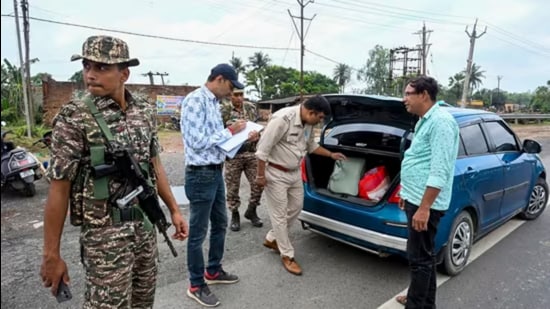
Bengal AIMIM leader held for violence during protests against voter deletions| India News
Chief Minister Mamata Banerjee Reveals Malda Conspiracy Involving AIMIM BJP
The political cauldron of West Bengal is once again simmering, this time centered on Malda district where recent protests over voter list deletions escalated into violence. Following the arrest of a leader from the All India Majlis-e-Ittehadul Muslimeen (AIMIM), Chief Minister Mamata Banerjee has publicly stated that the incident exposes a wider conspiracy. She alleges that both AIMIM and the Bharatiya Janata Party (BJP) are actively working to destabilize the state, a serious charge that has sent ripples through the political landscape. This development is particularly significant for Omni 360 News, as it reflects the intricate dynamics ahead of crucial elections.
The Unrest in Malda A Local Flashpoint
The core of the recent disturbances in Malda stems from protests against the deletion of names from the electoral roll. While seemingly a routine administrative exercise, voter list revisions can become highly contentious, especially in a politically charged environment like West Bengal. For many local residents, having their name removed from the list can mean losing their right to vote, a fundamental democratic right. On March 25, these simmering concerns boiled over into open protest near the Kaliachak block office.
Initially intended as a demonstration, the gathering quickly turned chaotic. Local reports indicated that protestors blocked National Highway 81, a vital artery, causing significant disruption. The situation further deteriorated as instances of vehicle vandalism, stone-pelting, and attempts to obstruct government work were reported. Police personnel, attempting to manage the escalating crowd, resorted to lathi-charge and deployed tear gas to disperse the agitators, painting a grim picture of civil unrest in the region.
The Arrest That Sparked Accusations
In the aftermath of the violence, law enforcement moved swiftly, leading to the arrest of Tariqul Islam, an AIMIM state secretary, from Kaliachak. Islam was apprehended based on an First Information Report (FIR) filed by Election Commission staff, which accused him and others of serious charges including arson, unlawful assembly, rioting, and obstructing official duties. This arrest provided a direct link between a recognized political entity and the on-ground disturbances.
It was this specific arrest that Chief Minister Mamata Banerjee seized upon, using it as evidence to support her broader claims. Speaking publicly, she asserted, “The arrest of an AIMIM leader from Malda has exposed the conspiracy behind the Malda violence. The AIMIM and BJP are trying to create disturbances in the state.” The Chief Minister further indicated that she had instructed police to investigate the source of funding for the alleged violence, suggesting a premeditated and financially backed effort to create instability.
Political Backlash and Counter-Allegations
As expected, Mamata Banerjee’s accusations drew swift and strong reactions from the implicated parties. Akhtar Hasan, the state president of AIMIM, vehemently denied any involvement in the violence. He labeled the case against Tariqul Islam as “false” and accused the Trinamool Congress (TMC) of being “panicked,” implying that the ruling party was fabricating charges due to fear of growing opposition influence. Hasan stressed that AIMIM advocates for peaceful democratic processes and would not instigate violence.
Similarly, the BJP leadership in Bengal dismissed the Chief Minister’s claims as politically motivated. BJP leader Samik Bhattacharya countered that the Trinamool Congress was attempting to communalize the issue, deflecting blame from its own governance and creating divisions for electoral gain. The BJP maintains that their party has no role in instigating violence and are, in fact, victims of TMC’s political machinations.
Understanding the Deletion of Voter Names
To grasp the full context of the Malda protests, it’s essential to understand the process of voter list deletions. The Election Commission of India regularly updates electoral rolls to ensure accuracy. This involves adding new eligible voters and removing names of those who have passed away, moved to a different constituency, or appear as duplicates. While a necessary administrative task, the process can sometimes lead to genuine errors or be perceived by sections of the public as an attempt to disenfranchise certain communities or political opponents.
Election Commission officials in Bengal clarified that approximately 1.5 million names were deleted for various reasons across the state, while 2.5 million new names were added, indicating a routine, albeit large-scale, revision. However, for those whose names are removed, especially without clear communication, it can lead to frustration and a feeling of being targeted, thus creating fertile ground for protests.
Bengal’s Volatile Political Climate
The Malda incident underscores the volatile political climate in West Bengal, a state historically prone to political violence. With the Lok Sabha elections on the horizon, every local incident is quickly amplified and interpreted through a political lens. The Chief Minister’s direct accusation against two opposition parties highlights the fierce electoral battle underway, where narratives of conspiracy and sabotage are frequently deployed.
The accusations by Mamata Banerjee serve multiple purposes. Firstly, they aim to discredit AIMIM and BJP by linking them to lawlessness. Secondly, they attempt to rally her own party’s supporters by portraying the TMC as a bulwark against external forces trying to destabilize Bengal. For Omni 360 News, observing these tactical maneuvers is crucial to understanding the deeper currents shaping the state’s political future.
Key Takeaways
- Protests in Malda over voter list deletions escalated into violence, leading to blockades and property damage.
- AIMIM state secretary Tariqul Islam was arrested in connection with the unrest, facing charges of arson and rioting.
- Chief Minister Mamata Banerjee accused AIMIM and BJP of conspiring to create disturbances in West Bengal, linking the arrest to this alleged plot.
- AIMIM leaders have denied involvement, calling the arrest a false case and accusing TMC of political opportunism.
- BJP leaders have also refuted the allegations, asserting that TMC is communalizing the issue for political gain.
- The incident highlights the sensitive nature of voter list revisions and the highly charged political atmosphere in West Bengal leading up to elections.
As investigations continue, the Malda violence and the subsequent political blame game will remain a significant talking point. The challenge for authorities will be to conduct an impartial inquiry that brings facts to light, while political parties grapple with shaping public perception ahead of the upcoming electoral contest. The incident serves as a stark reminder of how local grievances can quickly become national political flashpoints in India’s vibrant, often tumultuous, democracy.





