
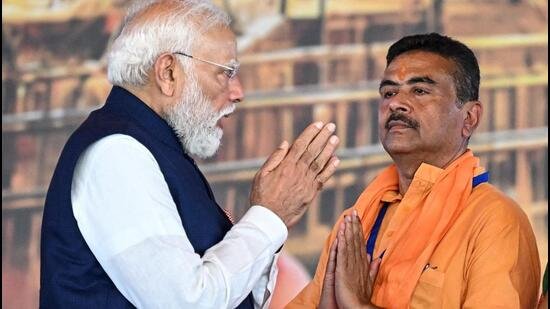
Bengal gets its first BJP CM as Suvendu Adhikari takes oath at Brigade Parade Ground
# Adhikari Sworn In as Bengal’s First BJP CM
**By Rohan Chatterjee, Political Desk, May 9, 2026**
In a watershed moment for Indian politics, Suvendu Adhikari was sworn in as West Bengal’s first Bharatiya Janata Party (BJP) Chief Minister on Saturday, May 9, 2026. The monumental oath-taking ceremony, held at Kolkata’s iconic Brigade Parade Ground, was administered by Governor C.V. Ananda Bose in the presence of Prime Minister Narendra Modi. Marking the end of the Trinamool Congress’s (TMC) 15-year reign, Adhikari’s ascension follows the BJP’s definitive victory in the highly polarized 2026 state assembly elections, fundamentally reshaping the political landscape of eastern India. [Source: Hindustan Times].
## A Historic Swearing-In Ceremony
The sprawling expanse of the Brigade Parade Ground was awash in saffron as an estimated five lakh supporters gathered to witness the historic transition of power. The air was thick with chants of “Jai Shri Ram” and “Vande Mataram” as Suvendu Adhikari, dressed in a traditional white dhoti and kurta with a saffron shawl, took the oath of office and secrecy in Bengali.
Prime Minister Narendra Modi, Union Home Minister Amit Shah, BJP National President J.P. Nadda, and a phalanx of Chief Ministers from BJP-ruled states were in attendance, underscoring the immense strategic importance the party’s high command placed on this victory. For the BJP, conquering West Bengal—a state historically dominated by the Left Front and subsequently the TMC—has been the ultimate political frontier.
“Today, a new chapter begins for the people of Bengal—a chapter of development, security, and cultural renaissance,” PM Modi later tweeted, congratulating the new Chief Minister.
## The Fall of the TMC Citadel
The 2026 West Bengal Legislative Assembly elections will be remembered as one of the most fiercely contested battles in India’s electoral history. Mamata Banerjee’s Trinamool Congress, which came to power in 2011 on the promise of “Ma, Mati, Manush” (Mother, Earth, People), found itself battling severe anti-incumbency, widespread allegations of systemic corruption, and a deteriorating law-and-order narrative.
The ghosts of the multi-crore school recruitment scams, the public distribution system anomalies, and the localized uprisings in areas like Sandeshkhali severely dented the TMC’s rural stronghold. The BJP capitalized on these vulnerabilities, running a highly structured campaign centered on the promise of a “Double Engine Sarkar” (aligning state and central governments) and “Ashol Poriborton” (Real Change).
**2026 West Bengal Assembly Election Results (294 Seats)**
| Political Party / Alliance | Seats Won | Vote Share (%) | Net Change (vs 2021) |
| :— | :—: | :—: | :—: |
| **Bharatiya Janata Party (BJP)** | **158** | **44.8%** | **+81** |
| Trinamool Congress (TMC) | 112 | 40.2% | -103 |
| Left Front + Congress (ISF) | 21 | 11.5% | +21 |
| Others / Independents | 3 | 3.5% | +1 |
*Data reflects final tallies confirmed by the Election Commission of India. [Source: Election Commission of India Public Records | Additional: Political data aggregators]*
## Suvendu Adhikari: Architect of the Saffron Surge
The elevation of 55-year-old Suvendu Adhikari to the Chief Minister’s office marks the culmination of a dramatic political journey. Once a trusted lieutenant of Mamata Banerjee and a primary architect of the TMC’s historic anti-land acquisition movement in Nandigram (2007), Adhikari severed ties with the TMC in December 2020.
His defining political moment arrived during the 2021 Assembly elections when he narrowly defeated Chief Minister Mamata Banerjee in the high-stakes Nandigram constituency. As the Leader of the Opposition (LoP) from 2021 to 2026, Adhikari emerged as the most vocal and unyielding critic of the state government. He successfully consolidated the anti-TMC votes, effectively bridging the geographical divides between the BJP-leaning North Bengal and the fiercely contested districts of South Bengal.
“Suvendu Adhikari did what many thought was impossible; he dismantled the TMC’s formidable rural machinery from the inside out,” notes Dr. Anirban Sengupta, a senior political analyst based in Kolkata. “He brought a native, grassroots aggression to the BJP that the party previously lacked in Bengal. He spoke the local dialect, understood the micro-caste equations, and successfully galvanized the Matua and Rajbanshi communities alongside the urban middle class.” [Source: Independent Political Analysis].
## Law, Order, and the Imminent Challenges
Taking the reins of a deeply polarized state, Adhikari’s immediate challenge is stabilizing the volatile law-and-order situation. West Bengal has a notorious legacy of post-poll violence. The transition period leading up to the oath-taking was marred by isolated clashes in the districts of Birbhum, South 24 Parganas, and Murshidabad.
In his first official administrative meeting held at the state secretariat, Nabanna, CM Adhikari issued stern directives to the state police apparatus. Sources indicate that a massive bureaucratic reshuffle is imminent, targeting senior IPS officers accused of acting as political agents during the previous regime.
Furthermore, the BJP’s manifesto promised the immediate establishment of fast-track courts to prosecute individuals involved in political violence and state-sponsored corruption. Ensuring justice while preventing retaliatory violence will be a tightrope walk for the new administration.
## Economic Revitalization: The “Double Engine” Promise
Beyond law and order, the dire state of West Bengal’s economy looms large over the new government. The state’s outstanding debt is projected to cross ₹6.5 lakh crore by the end of the 2025-2026 fiscal year. Decades of militant trade unionism under the Left Front, followed by what critics describe as the TMC’s over-reliance on debt-funded welfare schemes (such as *Lakshmir Bhandar*), have severely hampered industrial growth.
The BJP campaigned heavily on economic revitalization, promising foreign direct investment (FDI), the creation of IT hubs in Rajarhat, and the revival of manufacturing corridors in Haldia and Asansol.
“The mandate is clearly for economic salvation,” states a spokesperson for the Bengal Chamber of Commerce and Industry (BCCI). “The youth of Bengal are migrating to Bengaluru, Pune, and Hyderabad in search of employment. The ‘Double Engine’ government must immediately leverage central funds to build infrastructure and implement single-window clearances to restore investor confidence.” [Source: Industry Public Statements].
Additionally, the new government has pledged to implement the 7th Pay Commission for state government employees—a long-standing demand that became a major electoral flashpoint. Financing this while managing the inherited fiscal deficit will require significant support from the Central Government.
## Implementation of the CAA and Border Security
A cornerstone of the BJP’s socio-political agenda in West Bengal has been the Citizenship Amendment Act (CAA). With the rules notified by the Union Ministry of Home Affairs prior to the elections, the Adhikari administration is expected to fast-track the citizenship granting process for persecuted minorities from neighboring nations. This move is deeply resonant with the Matua community in the Bongaon and Nadia belts, who overwhelmingly backed the BJP.
Concurrently, border security and the mitigation of illegal immigration from Bangladesh will take center stage. The BJP has consistently alleged that the previous government utilized illegal immigrants as a captive vote bank. Closer coordination between the state police and the Border Security Force (BSF) is anticipated, potentially altering the demographic and political realities of the border districts.
## Implications for National Politics
The BJP’s conquest of West Bengal is not merely a regional victory; it is a seismic event with profound national implications. As India approaches the next general elections in 2029, securing Bengal ensures the BJP a dominant grip over Eastern India, supplementing its formidable presence in the North and West.
For the opposition I.N.D.I.A bloc, the defeat of Mamata Banerjee removes one of its most combative and influential national figures from the seat of power, dealing a severe blow to regional opposition unity.
## Conclusion: A New Era Dawns on the Hooghly
As the dust settles on the Brigade Parade Ground, West Bengal steps into uncharted political territory. Suvendu Adhikari’s swearing-in as the state’s first BJP Chief Minister is the realization of a decades-long ideological project by the Sangh Parivar.
However, the euphoria of victory must rapidly give way to the sobering realities of governance. Adhikari is tasked with healing a fractured society, revitalizing a stagnant economy, and dismantling entrenched webs of corruption, all while navigating the intense scrutiny of a historically hyper-politicized electorate. The success or failure of this “Double Engine” experiment in Bengal will likely dictate the socio-economic trajectory of eastern India for decades to come.
**Key Takeaways:**
* **Historic Shift:** Suvendu Adhikari takes oath as the first BJP CM of West Bengal, ending 15 years of TMC rule.
* **Decisive Mandate:** BJP secured 158 out of 294 seats in the 2026 Assembly Elections.
* **Immediate Priorities:** Restoring law and order, addressing a ₹6.5 lakh crore debt crisis, and facilitating industrial growth.
* **Socio-Political Changes:** Accelerated implementation of the CAA and stricter border controls are expected under the new regime.





