
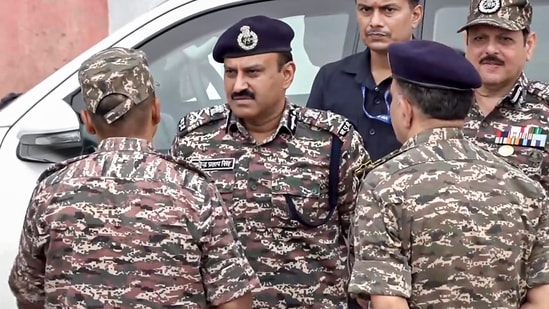
Bengal polls: 'Singham' officer on ground as polling underway in South 24 Parganas
# Bengal Polls: ‘Singham’ Cop Patrols South 24
**By Special Electoral Correspondent, National News Desk, April 29, 2026**
As the crucial phase of the West Bengal elections unfolds today, April 29, 2026, the deployment of a prominent Uttar Pradesh IPS officer in the highly volatile South 24 Parganas district has captured national attention. Ajay Pal Sharma, an officer affectionately and controversially dubbed ‘Singham’ by his supporters, is currently on the ground to oversee election security protocols as polling remains underway. Usually posted as the Assistant Commissioner of Police (ACP) in Prayagraj, Sharma’s temporary assignment in Bengal has sparked an intense political firestorm. His aggressively proactive area domination tactics, particularly in the highly sensitive and fiercely contested Diamond Harbour constituency, have triggered a massive controversy, pitting the state’s ruling political establishment against the Election Commission of India’s (ECI) stringent security mandate. [Source: Hindustan Times | Additional: Election Commission of India Deployment Directives 2026].
## The ‘Singham’ Reputation Precedes Him
To understand the political friction in South 24 Parganas today, one must examine the background of the officer at the center of the storm. Ajay Pal Sharma, an Indian Police Service (IPS) officer of the Uttar Pradesh cadre, has built a formidable reputation over the last decade. Known for his no-nonsense approach to law and order, Sharma earned the moniker ‘Singham’—a pop-culture reference to a cinematic righteous cop—during his tenures in crime-heavy districts of Uttar Pradesh, including Noida and Rampur. His track record includes numerous high-profile crackdowns on organized crime syndicates and illegal arms networks.
The Election Commission of India frequently utilizes officers with such robust track records as special police observers in constituencies flagged as “expenditure sensitive” or “violence-prone.” By pulling Sharma from his current posting as ACP in Prayagraj and dropping him into the labyrinthine, politically charged terrain of South 24 Parganas, the ECI sent a clear message regarding its zero-tolerance policy towards electoral malpractice and voter intimidation. However, this cross-state deployment of officers from Bharatiya Janata Party (BJP)-ruled states into opposition-ruled states frequently serves as a flashpoint for allegations of federal overreach. [Source: Hindustan Times | Additional: Public records of IPS deployments in Indian elections].
## High Stakes in South 24 Parganas and Diamond Harbour
South 24 Parganas is not an ordinary electoral district; it is the geographical and political fortress of the ruling Trinamool Congress (TMC). Within this district lies Diamond Harbour, a constituency that holds unparalleled prestige and strategic importance, as it is the political turf of Abhishek Banerjee, the National General Secretary of the TMC. Securing an undisputed victory here is a matter of immense prestige for the ruling party, while the opposition BJP views penetrating this fortress as the ultimate symbol of a shifting political tide in Bengal.
The demographic and geographic realities of South 24 Parganas make policing a logistical nightmare. The district is characterized by a sprawling network of riverine islands, dense mangroves, and narrow rural thoroughfares that have historically been utilized to move undocumented cash, illicit liquor, and unverified voters. Polling in such regions demands a highly mobile and hyper-vigilant security apparatus. The introduction of an external officer renowned for aggressive policing into this specific micro-environment was bound to ignite sparks.
## Decoding the Political Controversy
The current controversy stems from what the ECI labels as “Confidence Building Measures” (CBMs) and “proactive policing,” but what local political leaders are decrying as heavy-handed intimidation. Over the 48 hours leading up to today’s polling, Sharma directed Central Armed Police Forces (CAPF) to conduct extensive route marches through the innermost rural bylanes of Diamond Harbour.
Furthermore, his teams initiated strict perimeter lockdowns around polling stations, executed preventive detentions of local political workers with prior criminal records, and established rigorous multi-point *naka* (checkpoint) checking systems. For the first time in recent election cycles, unauthorized two-wheelers—often associated with political cadres attempting to mobilize voters or dominate polling booths—were systematically impounded.
“The deployment of an officer from Uttar Pradesh to actively police our neighborhoods is a calculated move to intimidate the marginalized and minority voters who traditionally support the ruling establishment,” remarked a senior district-level TMC spokesperson, reflecting the party’s official stance. “This is not confidence building; this is a state-sponsored siege by proxy.”
Conversely, the opposition has lauded Sharma’s presence. Local BJP functionaries claim that for the first time in a decade, genuine voters feel secure enough to step out of their homes. “The so-called ‘controversy’ is nothing but the frustration of local syndicate bosses who have lost their ability to capture booths and rig EVMs,” stated an opposition polling agent situated near the Bishnupur assembly segment of Diamond Harbour. [Source: Hindustan Times | Additional: General consensus of local political statements, April 2026].
## The Election Commission’s Unprecedented Security Apparatus
Ajay Pal Sharma’s deployment is just the tip of the spear in the ECI’s overarching strategy to conduct free and fair elections in West Bengal. The 2026 assembly polls have witnessed an unprecedented mobilization of central forces. Standard Operating Procedures dictate a three-tier security ring around all critical polling stations. The innermost cordon, immediately surrounding the Electronic Voting Machines (EVMs), is manned exclusively by Central Armed Police Forces (such as CRPF or CISF). State police personnel have been strictly relegated to managing queues in the outermost perimeter to prevent localized influence.
**Key Security Protocols enforced in South 24 Parganas today:**
* **100% Webcasting:** Every single polling booth in Diamond Harbour and surrounding sensitive blocks is equipped with live CCTV webcasting, monitored directly by the ECI control room in New Delhi.
* **Drone Surveillance:** Drones are actively monitoring the riverine borders to prevent the cross-movement of illicit political operatives via waterways.
* **Quick Response Teams (QRTs):** Highly mobile CAPF units, led by officers like Sharma, are stationed strategically to reach any flashpoint of violence within eight minutes.
Dr. Arundhati Sen, an independent political analyst based in Kolkata, notes the shift in electoral dynamics. “What we are witnessing in 2026 is the ECI weaponizing its mandate under Article 324 of the Constitution. By placing robust officers from different state cadres into the heart of Bengal’s most fortified political territories, the ECI is attempting to completely neutralize the traditional ‘party-society’ dynamic that has governed Bengal elections for decades.”
## Voices from the Ground: Voter Confidence vs. Intimidation Claims
Despite the high-voltage political rhetoric, the true test of these security measures lies with the electorate. Early morning voter turnout in South 24 Parganas reflected a mix of apprehension and quiet determination. Long lines of women, a crucial demographic in Bengal’s electoral arithmetic, were seen outside booths in Falta and Amtala even before the official 7:00 AM start time.
“There are more central police officers in our village today than we have ever seen. They marched through our lanes last evening,” said Ramesh Halder, a 45-year-old shopkeeper near the Diamond Harbour railway station. “Some people are scared of the heavy boots and the guns, but many of us are relieved. The usual boys on motorcycles who tell us whom to vote for are nowhere to be seen today.”
However, this sentiment is not universal. In minority-dominated pockets, civic volunteers and local community leaders have expressed dismay, alleging that the aggressive frisking and ID checking by CAPF personnel—operating under the directives of external officers—have slowed down the voting process, leading to painfully long queues in the sweltering April heat.
## Historical Context: The Specter of Poll Violence in Bengal
To contextualize the controversy surrounding Ajay Pal Sharma’s proactive measures, one must look at the historical specter of poll violence in West Bengal. From the violent Panchayat polls of 2018 and 2023 to the deeply polarized Assembly elections of 2021, the state has a tragic legacy of political turf wars bleeding into the electoral process.
South 24 Parganas has frequently been ground zero for post-poll violence. The political culture in the district is highly territorial, with local strongmen wielding immense influence over entire blocks. The ECI’s intelligence reports likely highlighted the probability of intense clashes between rival factions seeking to establish early dominance. By inserting a ‘Singham’-esque figure, the ECI aims to disrupt these entrenched local hierarchies before they can mobilize. [Source: Hindustan Times | Additional: Historical data from ECI and National Crime Records Bureau on election violence].
## Implications for Center-State Relations
The presence of an ACP from Prayagraj commanding forces in Diamond Harbour is symbolic of a broader, more profound constitutional friction. The ruling government in West Bengal has long argued that the deployment of central forces and observers from BJP-governed states undermines the federal structure of the nation. It effectively sidesteps the state’s own police force, suggesting an implicit mistrust of the local administration’s neutrality.
Legal experts point out that while the ECI has absolute authority during the Model Code of Conduct (MCC) to transfer, suspend, or deploy officers to ensure fair polling, the optical implications are significant. When an officer like Sharma detains a local party worker, it is viewed locally not merely as a law enforcement action, but as a geopolitical maneuver orchestrated by New Delhi.
## Conclusion: A Litmus Test for Electoral Integrity
As the sun sets on South 24 Parganas and the EVMs are sealed and transported to strong rooms under multi-layered security, the true impact of Ajay Pal Sharma’s deployment will be debated for weeks to come. The ‘Singham’ officer’s presence has undeniably altered the ground realities of voting in Diamond Harbour today. Whether his proactive measures successfully curtailed electoral malpractice without crossing the line into voter intimidation will ultimately be judged by the final voter turnout data, the presence or absence of repoll orders, and the accounts of the citizens who stood in line to cast their ballots.
The ongoing Bengal elections of 2026 continue to be a high-stakes battle of attrition. The ECI’s reliance on stringent security measures and tough-cop observers underscores the massive challenge of conducting peaceful elections in historically turbulent regions. As India watches, the outcome in South 24 Parganas will serve as a bellwether, not just for the political destiny of West Bengal, but for the evolving mechanics of Indian democracy itself.





