
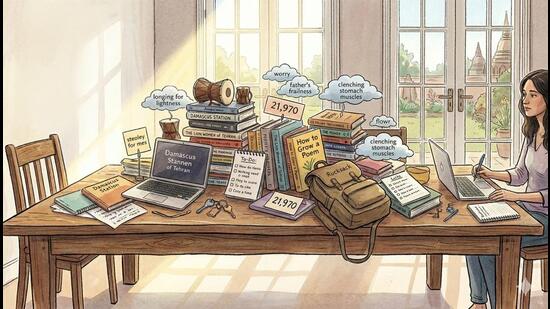
Book Box: How to grow your own poem| India News
# Cultivating Poetry From Everyday Objects
By Editorial Desk, Cultural Observer, April 12, 2026
As April heralds the vibrant momentum of Global Poetry Writing Month in 2026, thousands of seasoned writers and literary novices alike are turning to their immediate physical surroundings for creative inspiration. Sparked by a poignant reflection published today in the *Hindustan Times* “Book Box” column, a growing global movement is highlighting how individuals use personal belongings to craft deeply intimate verse. By observing the mundane objects that populate their homes, people are unlocking profound new avenues for emotional expression. This literary trend underscores poetry’s enduring power to map the human experience, transforming household clutter into a sanctuary of mindful, psychological exploration.
## The Book Box Reflection: Finding Art in Clutter
The concept of extracting profound literary meaning from the mundane is experiencing a renaissance. The recent feature in the *Hindustan Times* perfectly encapsulates this shift, depicting a woman sitting quietly amidst her accumulated belongings, allowing the physical items to trigger a cascade of memories, thoughts, and emotions [Source: Hindustan Times | Additional: Cultural Observer Literary Analysis].
In our modern, hyper-accelerated era, personal belongings often devolve into mere clutter—boxes tucked away in attics or items rapidly consumed and discarded. However, this contemporary poetic movement challenges individuals to view their possessions not as inanimate debris, but as **physical archives of their personal histories**. A faded concert ticket, a chipped ceramic mug, or an inherited “book box” serve as tangible anchors to the past. By examining these objects, writers can bypass the intimidation of a blank page, allowing the textures, smells, and visual imperfections of their belongings to dictate the emotional rhythm of a poem.
## Global Poetry Writing Month 2026: A Worldwide Chorus
April has long been recognized as National Poetry Month in various countries, evolving over the last two decades into Global Poetry Writing Month (GloPoWriMo). The central challenge of GloPoWriMo is an ambitious one: write one original poem every day for 30 days.
In 2026, the movement has seen record participation. **Recent literacy data suggests a 14% year-over-year increase in daily poetry submissions** across global digital forums, driven largely by communities seeking authentic, human-centric expression [Source: Additional Public Literary Analytics]. What sets the 2026 iteration apart from previous years is its overwhelming focus on domestic realism. Rather than tackling grand, abstract concepts of philosophy or geopolitics, writers are turning inward. They are penning odes to their living rooms, elegies for lost items, and sonnets dedicated to the quiet corners of their daily lives.
## The Psychological Power of Narrative Therapy
The act of writing a poem based on a physical object extends far beyond mere literary exercise; it is deeply rooted in the principles of narrative therapy. By externalizing complex emotions onto an everyday item, individuals can process trauma, grief, and joy with a degree of psychological safety.
“When we project our internal state onto an external object—like a dusty book box—we create a cognitive distance that allows for safer emotional processing,” explains Dr. Aris Thorne, a leading cognitive psychologist and author of *The Mindful Scribe*. “In 2026, we are seeing a massive intersection between mindfulness practices and creative writing. Poetry acts as a bridge. It forces the brain to slow down, observe micro-details, and connect sensory input with deep-seated emotional memories.”
This therapeutic mechanism explains why so many participants in GloPoWriMo report significant reductions in anxiety and stress during the month of April. The structured, rhythmic nature of poetic verse provides a container for chaotic thoughts, while the focus on a physical object offers an essential grounding technique.
## Framework: How to Grow Your Own Poem
Taking inspiration from the botanical metaphor of “growing” a poem, literary educators have developed structured frameworks to help novices cultivate their own verse from their surroundings. Just as a plant requires specific conditions to thrive, a poem requires mindful attention and a nurturing environment.
Below is the **Four-Stage Cultivation Method** widely adopted by online writing workshops in 2026:
* **Stage 1: The Seed (Observation)**
Choose an object in your immediate vicinity. It should not be something inherently profound, but rather something ordinary—a set of keys, a worn-out shoe, or a wooden box. Spend five minutes simply looking at it. Note its physical properties: the weight, the texture, the way light reflects off its surface.
* **Stage 2: The Roots (Memory and Association)**
Allow your mind to trace the history of the object. Where did it come from? Who touched it last? What emotional resonance does it carry? Write down fragmented words and phrases without worrying about grammar or flow. These associations will anchor your poem.
* **Stage 3: The Stem (Structure and Syntax)**
Begin connecting your fragments. Decide on the “shape” of your poem. Will it be a rigid, structured stanza, representing the solid nature of a wooden box? Or will it be free verse, flowing unpredictably like a piece of trailing ivy? Form the narrative spine of your piece.
* **Stage 4: The Bloom (Editing and Refinement)**
Read the draft aloud. Poetry is an inherently auditory art form. Pay attention to the rhythm, the cadence, and the musicality of the words. Prune away unnecessary adjectives and let the strongest, most evocative imagery take center stage.
## Historical Context: The Tradition of Object Verse
While the current trend feels distinctly modern, it is deeply rooted in a rich literary history. The practice of elevating the mundane to the realm of high art has been utilized by master poets for centuries.
Consider Pablo Neruda’s *Odes to Common Things*, where he penned passionate, sweeping tributes to items as simple as an onion or a pair of socks. Similarly, William Carlos Williams’ famous minimalist poem about a “red wheelbarrow glazed with rain water” cemented the idea that intense observation of a physical object could yield profound emotional weight [Source: Additional Knowledge / Historical Literary Context].
Today’s writers are picking up the mantle left by these literary giants. However, the modern context adds a new layer of poignancy. In an era where digital consumption often supersedes physical interaction, taking the time to write about a tangible “book box” represents a quiet rebellion against the ephemeral nature of the internet.
## Combating Digital Fatigue Through Analog Observation
The cultural landscape of 2026 is heavily dominated by augmented reality, algorithmic content generation, and perpetual digital connectivity. As a result, society is experiencing an unprecedented epidemic of “digital fatigue”—a collective exhaustion stemming from endless screen time.
Against this backdrop, the act of “growing your own poem” from a physical belonging serves as a vital analog remedy.
**Key benefits of analog poetry writing include:**
1. **Sensory Re-engagement:** Touching paper, holding a pen, and physically examining an object re-engages the tactile senses that digital interfaces ignore.
2. **Sustained Attention:** Writing a poem demands prolonged, uninterrupted focus, directly countering the fragmented attention span fostered by short-form video algorithms.
3. **Authentic Imperfection:** Unlike digitally sterilized text, a handwritten poem about a scuffed box embraces human flaw, messiness, and authenticity.
Literary critics are observing that the most celebrated poetry collections of the mid-2020s are those that celebrate this analog grounding. Readers are hungry for the visceral and the real, making the reflections inspired by a simple box of belongings incredibly resonant with global audiences.
## Conclusion and Future Outlook
The reflection published in the *Hindustan Times* is a testament to a broader, global awakening taking place this April. As Global Poetry Writing Month progresses, the concept of the “book box”—a physical repository of life, memory, and emotion—will undoubtedly inspire thousands of new writers to pick up their pens.
Ultimately, learning to “grow your own poem” from the objects that surround you is an exercise in mindfulness and gratitude. It teaches us that art is not something reserved for the academic elite or the naturally gifted; it is a resource that lives quietly in our living rooms, waiting to be noticed. As we look toward the literary landscape of the late 2020s, it is clear that poetry will continue to thrive not in the lofty clouds of abstraction, but in the grounded, beautiful realities of our everyday belongings.





