
‘Bridge struck like a storm’: Survivors recount horror, flag safety lapses in boat tragedy near Vrindavan| India News
# Vrindavan Boat Tragedy Exposes Safety Lapses
**By Vikram Sahay, National Affairs Correspondent | April 11, 2026**
**VRINDAVAN, UTTAR PRADESH** — A serene pilgrimage turned into an unthinkable nightmare on the Yamuna River early Saturday morning when a tourist boat violently collided with a bridge pillar, resulting in a devastating loss of life. The tragedy, which unfolded on April 11, 2026, was triggered by a mid-river mechanical failure that forced passengers to switch vessels in treacherous waters. Survivors are now coming forward to expose flagrant safety violations, including severe overcrowding and a complete absence of life jackets, prompting local authorities to launch a high-level investigation into the unregulated boating sector operating along the holy city’s ghats.
## A Mid-River Nightmare
For the Bahl family from Jagraon, Ludhiana, the journey to Vrindavan was meant to be a spiritual retreat. Instead, it ended in unspeakable tragedy. According to survivor accounts, the ordeal began shortly after the tourist boat departed from the ghat. Halfway across the river, the vessel’s outboard motor suffered a catastrophic mechanical failure, leaving the boat drifting helplessly in the current.
Vijay Bahl, who tragically lost his wife and son in the accident, recounted the terrifying sequence of events. He stated that the boat operator, rather than calling for an official rescue or towing the disabled vessel to the nearest bank, hailed another passing tourist boat. The passengers were then forced to execute a highly dangerous mid-river transfer between the two unstable vessels.
[Source: Hindustan Times | Additional: Regional Police Reports]
“We were told to step across the boats while they were bobbing in the water,” recalled another survivor currently recovering at a local district hospital. “There was panic, the second boat was already carrying people, and suddenly there were too many of us on one side.”
## “The Bridge Struck Like a Storm”
The transfer, executed under duress and without standard safety protocols, dangerously compromised the buoyancy and balance of the second boat. Burdened heavily beyond its prescribed passenger capacity, the second vessel’s engine struggled against the Yamuna’s undercurrents.
Survivors described the agonizing moments leading up to the capsize. As the overloaded boat drifted dangerously close to a concrete bridge abutment, the operator lost complete navigational control. One survivor described the sudden, violent impact by stating that the “bridge struck like a storm.”
The sheer force of the collision immediately fractured the wooden hull of the boat, causing it to take on water rapidly. Within seconds, the vessel overturned, plunging dozens of unsuspecting pilgrims—many of whom were elderly or young children—into the deep, murky waters of the Yamuna. Because the passengers were caught entirely off guard by the sudden jolt, few had the opportunity to brace themselves or grab onto floating debris.
## Glaring Safety Violations on the Yamuna
This tragedy has pulled back the curtain on the severe, systemic safety lapses that plague the informal boating industry in prominent Indian pilgrimage centers. Survivors and eyewitnesses have unanimously flagged several egregious violations of basic maritime safety.
**Key Safety Lapses Identified:**
* **Absence of Life Jackets:** Despite strict state guidelines mandating the provision of wearable personal flotation devices (PFDs) for every passenger, survivors noted that not a single life jacket was distributed prior to boarding.
* **Vessel Overcrowding:** The second boat, which ultimately capsized, was already operating near its maximum capacity before it took on the stranded passengers from the disabled vessel.
* **Poor Mechanical Maintenance:** The initial boat’s engine failure highlights a pervasive lack of routine mechanical audits. Many operators use repurposed diesel engines that are rarely serviced.
* **Lack of Emergency Protocols:** The operators demonstrated no knowledge of emergency evacuation procedures, opting for a reckless mid-river transfer instead of signaling the river police.
[Source: Hindustan Times | Additional: State Inland Waterways Authority Guidelines]
## Expert Analysis: The Cost of Unregulated Tourism
The rapid influx of tourists to Mathura and Vrindavan, particularly during peak spiritual seasons, has led to a boom in unregulated local tourism operators. While this micro-economy supports hundreds of local boatmen, it operates in a regulatory grey area.
Dr. Manish Chaturvedi, an inland waterways and maritime safety analyst, explains the structural failures leading to such disasters. “What we are witnessing in Vrindavan is a tragic culmination of administrative apathy and unregulated commercial pressure,” Dr. Chaturvedi noted. “The Inland Vessels Act clearly outlines safety parameters, but enforcement at the grassroots level—on the ghats—is virtually non-existent. A mid-river boat-to-boat transfer is an inherently hazardous maneuver that should never be attempted with untrained civilians, let alone without life vests.”
### Regulatory Expectations vs. Ground Reality
| Safety Protocol (Inland Vessels Act) | Ground Reality at Vrindavan Ghats |
| :— | :— |
| **Mandatory Life Jackets** | Rarely available; frequently kept locked away to save space. |
| **Strict Capacity Limits** | Routinely ignored; boats carry 1.5x to 2x maximum capacity to maximize profit. |
| **Regular Mechanical Audits** | Non-existent; maintenance is reactive, occurring only after complete failure. |
| **Licensed Operators** | Many operators lack formal training in swift-water navigation and emergency response. |
## Administrative Response and Rescue Operations
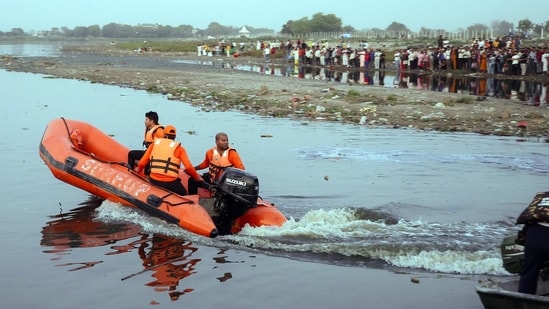
Following the collision, local boatmen on the banks were the first to rush to the scene, acting as ad-hoc first responders. Within thirty minutes, teams from the State Disaster Response Force (SDRF) and the National Disaster Response Force (NDRF) arrived at the site with specialized inflatable rescue boats and deep-water divers.
The District Magistrate of Mathura has since ordered a magisterial inquiry into the incident. Authorities have sealed the ghat from which the ill-fated boat operated, and an FIR (First Information Report) has been registered against the absconding boat operators under relevant sections of the Bharatiya Nyaya Sanhita (BNS) for culpable homicide not amounting to murder and reckless negligence.
The state government has announced an ex-gratia compensation package for the families of the deceased and financial assistance for the injured, though grieving families maintain that no amount of money can compensate for lives lost to preventable administrative negligence.
## The Human Toll: Families Shattered
Behind the administrative reports and safety statistics lies a profound human tragedy. The ghats of Vrindavan, usually echoing with hymns and devotion, have been overshadowed by the wails of bereaved families.
For Vijay Bahl, who stood on the banks awaiting the recovery operations, the trauma is insurmountable. His family’s horrific experience underscores the vulnerability of tourists who place blind trust in local operators. The psychological impact on the survivors, many of whom witnessed their loved ones being swept away by the river’s currents, will require extensive trauma counseling and long-term support.
Local civil society groups have stepped in to provide food, shelter, and medical assistance to the out-of-town survivors whose belongings were lost in the river. The tragedy has cast a somber mood over the region, drastically reducing footfall at the riverfront as the reality of the danger sinks in for visiting pilgrims.
## Regulatory Reforms and Future Implications
The Vrindavan boat tragedy must serve as a watershed moment for inland water safety in India. Policy experts are calling for immediate, stringent reforms to overhaul how tourist boating is managed across the country’s major rivers.
**Proposed Immediate Actions:**
1. **Digital Ticketing and Manifests:** Implementing a centralized digital ticketing system at the ghats to ensure accurate passenger manifests and strictly enforce capacity limits.
2. **Mandatory Vest Enforcement:** Deploying dedicated river police at embarkation points to ensure no boat leaves the shore without every passenger actively wearing a fastened life jacket.
3. **Routine Fitness Certificates:** Mandating bi-annual mechanical fitness certificates for all commercial passenger boats, similar to the protocols required for commercial road vehicles.
The local tourism board is currently in emergency talks with municipal authorities to draft a new ‘River Safety Charter’ that will hold not just the boat operators, but also the municipal licensing bodies, accountable for future lapses.
## Conclusion
The horrific boat tragedy in Vrindavan on April 11, 2026, is a grim reminder of the fatal consequences of prioritizing convenience and profit over basic human safety. As survivors like Vijay Bahl grapple with unimaginable loss, their testimonies regarding the mid-river vessel swap and the catastrophic bridge collision have laid bare the deep-rooted negligence in the local tourism sector.
While rescue operations conclude and the immediate shock fades, the focus must shift to relentless accountability. Only through the uncompromising enforcement of maritime safety laws, regular mechanical audits, and a cultural shift toward prioritizing passenger safety can authorities ensure that the holy waters of the Yamuna do not claim more innocent lives. For the families shattered by this event, justice will not merely be the prosecution of a single boatman, but a complete overhaul of the system that allowed this tragedy to happen in the first place.





